



An argument for the basics: advocating for reference projects in this time of erasure
11 December 2025 – Emma Wiley
Author’s disclaimer: This article is based on my own research and opinions and does not reflect the views of any former or current employer.
Over the past several months, the public history community has been reminded of the fragility of public-facing work. As the federal government scrubs websites, historic sites, and educational materials of histories regarded as antithetical to the Trump administration’s values, the public is losing gateways to learn about a myriad of histories, from trans activism to the horrors of slavery. In this time of erasure and censorship, basic historical reference resources remain crucial—yet often overlooked—tools in providing accessible and inclusive historical knowledge to the public. Reference resources like topical and place-based digital encyclopedias are well-positioned to provide essential basic historical information about the people, places, events, and more that are integral to our country’s story—especially as the federal government will not.
At the end of March, President Trump signed an executive order titled “Restoring Truth and Sanity to American History” which has been used to target and remove historical content the administration deems divisive, against its policies, or critical of the United States. Formerly used as accessible and trusted sources, government websites such as those of the National Park Service are now missing crucial information, and many public historians view their revised contents with skepticism. Even projects and organizations not controlled by the federal government are starting to cave by removing lesson plans and other materials on diverse or controversial topics. This censorship has prevented everyday Americans from accessing their own histories, particularly underrepresented narratives and difficult stories that we must continue to learn from and reckon with.
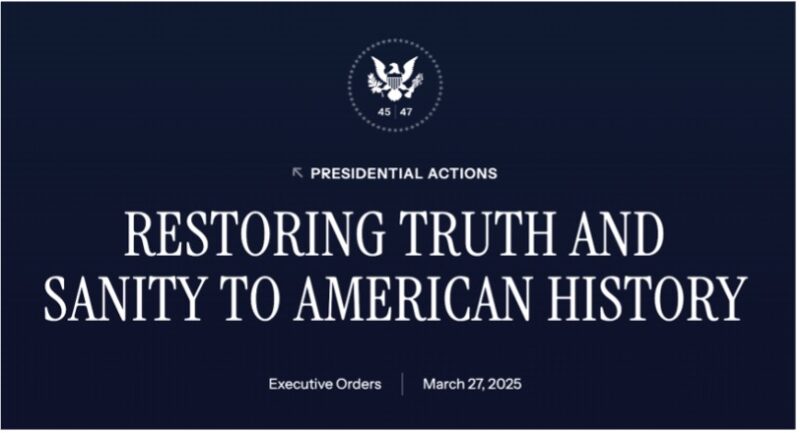
Screenshot of the title of President Donald Trump’s March 27, 2025 Executive Order titled “Restoring Truth and Sanity to American History,” which targets “divisive narratives” and “corrosive ideology” at federal historical sites. Image credit: public domain
A lot of thought and metaphorical ink have rightfully been put in to imagining new and radical futures for public history and public-facing projects. At the same time, we also need to shore up the existing reference sources that serves as the building blocks for public understanding of local and state history. Until recently, I managed one of these reference projects: the digital state encyclopedia ConnecticutHistory.org, which has connected millions of people to the state’s history over the past thirteen years. As those same stories began to disappear from other resources, the encyclopedia’s value—providing access to basic historical information—became even more critical. It is our responsibility as public historians to ensure the continued availability of this information, and all of our country’s histories.
Since the 1990s, digital encyclopedias specific to a topic, state, city, or other place have been an increasingly popular way for state humanities councils, libraries, historical societies, universities, and other organizations to share their area’s history in a digitally accessible format. Not every state or city has one, but those that do exist in every region of the country, and represent over fifty percent of US states and Guam. Students and scholars use these resources to “double check” the basics; AI crawls them to respond to queries about local or state history; and many others use them to learn facts or satisfy historical curiosity. When historians need to answer their own questions, they go to an academic journal, monograph, or database like JSTOR, but when the public is looking for an answer, they flock to the internet where they find results in freely available digital encyclopedias.
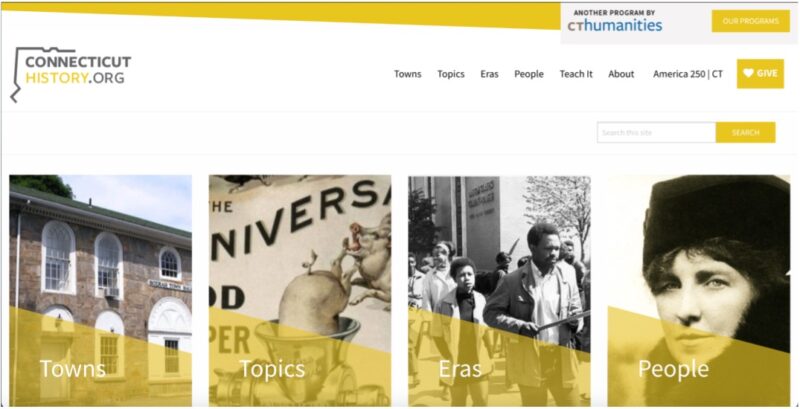
Screenshot of the homepage of ConnecticutHistory.org, Connecticut’s digital state encyclopedia run by Connecticut Humanities. CC BY-SA license.
I’ll be the first to admit it: encyclopedic public history is not always the most exciting trend, and academia has consistently looked down upon it as being too basic or failing to contribute something new to the historiographical conversation. Such sources do, however, make crucial local and regional history available to communities by translating academic historiography and publications into a format the public will consume. In fact, news sources like newspapers and public radio often reach for digital encyclopedias for their article’s historical background, while teachers use entries in their lessons because they are usually written at accessible reading levels. Finally, due to their focused scope and community connections, many encyclopedias provide extensive information about local history that will never make it to a peer-reviewed journal or monograph.
This is not to say such reference sources are perfect or flawless—far from it. No project has endless funds, and content is driven by a variety of factors, including funding opportunities, community partnerships, institutional priorities, and human biases. For example, reference projects are rarely completely representative of the demographics of their location, and managers are constantly trying to fill gaps in content. Unlike a one-off project whose website stops getting updated, or a sign at a historical site controlled by the federal government, many of these digital resource sites are decades-long works-in-progress. Yet many of their host institutions are still quietly committed to producing diverse, accessible, and inclusive content.
These projects are not safe. While most digital encyclopedias and other reference projects are not controlled by the federal government, they are not impervious to the current slew of risks. Many already work with limited staff and rely on public funding and grants from federal sources, such as the Institute of Museum and Library Services (IMLS) and the National Endowment for the Humanities (NEH), both of whom have been “DOGE’d.” Other funding streams include individual donations, state funding, and independent grants. Only one project—Encyclopedia of Cleveland History—enjoys the stability provided by an endowment. My own position working on ConnecticutHistory.org recently was eliminated due to federal funding cuts to state humanities councils. While most of us cannot directly control the erasure and censorship of historical information happening at the Smithsonian or federally-managed sites, we can advocate for and support reference projects that provide and preserve access to our local and state history.
While encyclopedic or reference work is not necessarily groundbreaking, nor the sexiest endeavor in public history work, it plays a crucial role in preserving the basic foundations of state and local history. If we believe that people armed with representative and accurate historical knowledge of our communities, towns, states, and country build a stronger democracy, then we need to make sure that the public has the resources to access that information. We cannot hope to continue creating cool, amazing public history projects in the future without protecting the building blocks now. Otherwise, a future American public will be looking at the mosaic of American history with half the pieces missing.
~Emma Wiley is a public historian based in Washington, DC. She holds an MA in history with a public history concentration from American University and a BA in history from Vassar College.
i would like to consider republishing this article in Illinois Heritage magazine (circ 2000) for the Illinois State Historical Society as an incentive for such an encyclopedia on Illinois history.