



You can’t go home again: archiving community memory and the reclamation of Black Boston
22 January 2026 – Rhonda Jones
“Wait—there are Black people in Boston? I’ve never met a Black person who’s actually from Boston.”
As a second-generation Black Bostonian, every time I hear that question the statement says far more about cultural assumptions than it does about actual demographics. This isn’t just about visibility. It’s about memory, belonging, and the right to have one’s story preserved.
Boston’s dominant images of Puritans, revolutionary patriots, cobblestoned streets, elite colleges and universities, and championship sports teams have too often excluded the neighborhoods, businesses, churches, masonic lodges, cultural institutions and civic organizations where generations of Black Bostonians have lived, worked, and built community. When probed, they may recall Phillis Wheatly or Crispus Attucks, but give limited thought to African American abolitionists, journalists, club women, civil rights activists, or consider that Great Migration routes extended beyond New York State. The assumption that Boston has no Black community reveals a deeper stereotype that Black life only thrives in places where it is hyper-visible, like Washington D.C., Harlem, Atlanta, Chicago, Philadelphia, or Oakland. The truth has never been absent—it’s simply been ignored.
I was nurtured by the vibrant, rich culture of our presence: Roxbury, Dorchester, and Mattapan, each alive with nightclubs, dance studios, street festivals, barber shops, beauty salons, roller skating rinks, soul food restaurants, churches, mosques, libraries, corner stores, professional offices, and bookstores. These spaces fostered dreams and nurtured ambition amid redlining, disinvestment, and the school desegregation battles. They were full of community, faith, and quiet excellence—yet in the popular imagination, they barely existed. That absence isn’t accidental. It’s the result of decades of stereotyping, uneven preservation, and institutional neglect.
So, let me say this plainly: Yes, Black people live in Boston. We always have.
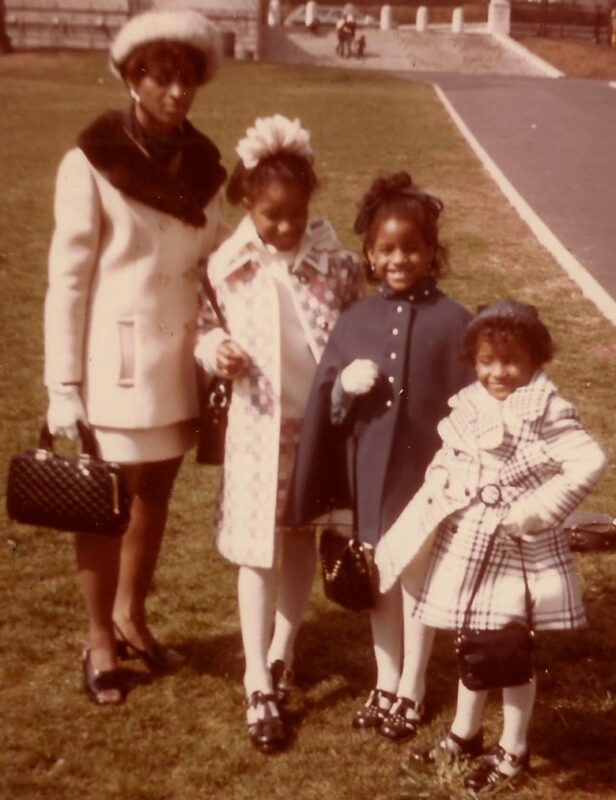
The “Jones Girls,” the author and her family on Easter Sunday, 1973, Boston Common, Boston, Massachusetts. Photo credit: Rhonda Jones.
A City with Deep Black Roots
Historians William Cooper Nell, George Washington Williams, Adelaide Cromwell, James Horton, Mel King, and Robert C. Hayden have long documented Boston’s deep Black roots. In the 1800s, the North Slope of Beacon Hill was home to free African Americans, abolitionists like Maria Stewart and David Walker, and institutions such as the African Meeting House and the Abiel Smith School. The city hosted the first meeting of the NAACP in 1909 and supported a vibrant press—The Guardian, The Boston Chronicle, and The Bay State Banner—that chronicled the life of its Black citizens.
Black Bostonians built settlement houses, civic clubs, churches, mosques, and advocacy groups that defined the city’s social and political life. Their work laid the foundation for activism that stretched from the fight against slavery to civil rights and educational equity.
The Danger of Erasure
The phrase “you can’t go home again,” borrowed from Thomas Wolfe, captures a truth many Black Bostonians know too well. For us, it isn’t just about nostalgia; it’s about transformation and loss. The neighborhoods that once felt like home have been reshaped under the banner of “gentrification.” Triple-decker houses and elementary schools have been converted into condos, corner stores have become boutiques, and buildings have been razed to make way for empty lots. Bike lanes have narrowed streets. Church congregations have relocated to the suburbs due to ongoing disputes over street parking. Gentrification hasn’t just displaced residents from the communities they helped build—it has rewritten the city’s memory. When cultural landmarks disappear, so do the everyday stories that are held—getting “dressed to the nines” for the annual kite festival at Franklin Park, listening to WILD AM radio from sunrise to sunset, buying records at Skippy White’s, watching the elevated “T” being rerouted and dismantled, visiting exhibits at the Afro-American Museum, and showing high school spirit at White Stadium football games. “You can’t go home again” becomes a statement about physical and cultural displacement.
Memory Work as Resistance
In response to these losses, a quiet revolution in preservation is underway. After the closing of the Nubian Notion’s bookstore, in the heart of Dudley Square, the community rallied to rename the area “Nubian Square.” Northeastern University, public libraries, and neighborhood groups are collaborating to center Black voices in Boston’s historical record. Projects like the Lower Roxbury Black History Project, Freedom House Collection, Boston Research Center, and Reckonings Project are reclaiming history as lived experience by digitizing newspapers, oral histories, family photographs, business directories, and church bulletins—materials once dismissed as too “ordinary.” These snapshots of joy, resilience, and everyday dignity form a counter-narrative to the myth of Black absence.
As a public historian and archivist with nearly thirty years of experience, I have learned that archives are not neutral spaces. They can wound or heal. These efforts are acts of resistance—they challenge the silence imposed by institutions and restore ownership of the past to those who lived it. Community-based heritage efforts, from the Museum of African American History and the Black Heritage Trail to The Embrace memorial and neighborhood murals, serve as vital anchors of Boston’s collective memory that ensure Black communities can engage the past on their own terms.
Return as Restoration
Thomas Wolfe was right that you can’t go home again, at least not to the place as it once was. But home can be found in memory, in stories, and in the archives that honor them. The work of archiving Black Boston is not about nostalgia; it’s about possibility. It’s about asserting that our past is not a footnote to the city’s grand narrative but central to it. Even as gentrification transforms the landscape, these archives keep our history alive, allowing future generations to encounter not absence, but presence.
So yes, Black people do live in Boston. We always have. And through the preservation of our stories—our photographs, our sermons, our storefronts, and our songs—we always will.
~Dr. Rhonda D. Jones is a public historian, digital archivist, and assistant professor whose work centers on memory, community-based archiving, and the ethics of cultural preservation. Her research and practice focus on how Black communities narrate and safeguard their histories through oral tradition, sonic expression, and embodied storytelling.
This well written and much needed article documents the importance of preservation in keeping alive the spaces that families and communities called home. For Black families these is key to refuting claims that their presence was not evidenced in certain areas. This article identifies Boston but the author clearly outlines how other spaces in different locations can reclaim their own presence for future generations.