



Feminist revolutions: interpreting the unfinished promise of the American Revolution
04 June 2026 – Olivia Errico
In response to the federal government’s ongoing attempts to censure complicated histories of the United States during the country’s 250th anniversary, the temporary exhibit Feminist Revolutions at the Alice Paul Center for Gender Justice examines the contributions of the feminist movement to American society and the ongoing work of gender justice. The exhibit invites visitors to consider how each era’s activists pushed the nation closer to fulfilling the promise of the Declaration of Independence. Each section of the exhibit highlights a different feminist idea: women as citizens, “the personal is political,” and intersectionality. These ideas challenged prevailing orthodoxy about gender in America and revolutionized the way we think about women’s place in society. The exhibit foregrounds the role of ordinary citizens in making change in our country.
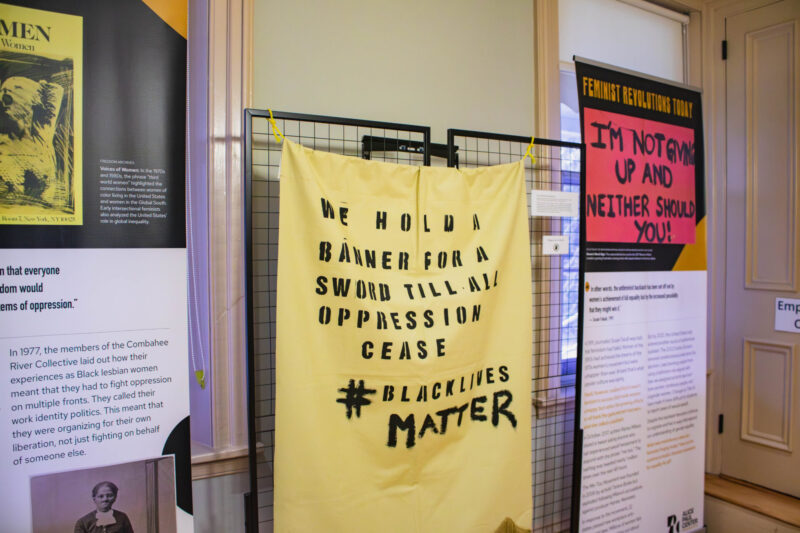
Opening of “Feminist Revolutions” exhibit on January 10, 2026, Alice Paul Center for Gender Justice, Mount Laurel, NJ. Photo credit: Alice Paul Center for Gender Justice.
In Executive Order 14253, President Trump argued that federal sites engaging with topics like institutional racism and the experiences of transgender women were creating “divisive narratives that distort our shared history.” At the same time, staff at the Alice Paul Center for Gender Justice were planning programming for America’s semiquincentennial. As the center’s public programs manager, I initially approached this anniversary as a peripheral historical event, since the center is not a Revolutionary site. As the birthplace of Alice Paul, the center primarily focuses on the women’s suffrage movement in the twentieth century.
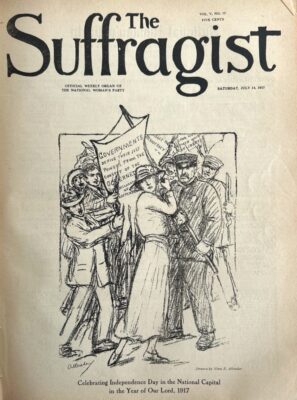
Cover of the July 14, 1917, issue of “The Suffragist.” Image credit: Alice Paul Center for Gender Justice Archives.
However, as I considered the ideals found in the Declaration of Independence, I realized the anniversary’s relevance for the center. America’s founding leaders envisioned a new country established on the principle of equality, yet the equality that the founders envisioned only applied to a small group of land-owning, white men. But history also shows that many people from diverse backgrounds have organized to bring the country closer to true equality. Alice Paul and the members of the National Woman’s Party were one such group who recognized the Declaration’s unfinished promise. In 1918 and 1919, the National Woman’s Party held demonstrations in front of the statue of Marquis de Lafayette in Washington DC, linking their frustration toward President Wilson during World War I to Lafayette’s defiance of the French government to fight for freedom with the Continental Army. Yet after the ratification of the Nineteenth Amendment, Paul recognized that there was still much work to do to achieve equality for women. The vote was just the first step.
Curating Feminist Revolutions provided insights that may be relevant to other historical sites trying to find their space in the semiquincentennial. While the government is attempting to censure our national institutions, local sites are more valuable than ever. We are free to tell the complicated histories of our country the government is trying to hide. We can examine the ways the revolution fell short of the ideals in the Declaration of Independence and trace the repercussions of that failure through the rest of American history. If we understand the revolution as something unfinished, then telling the full, difficult story of American history is essential to semiquincentennial commemorations.
At the exhibit unveiling for Feminist Revolutions, visitors responded to a prompt asking them to name revolutionary actions that they could take today. Some of the responses included prioritizing education, speaking up against injustice, and listening with an open mind. As these responses demonstrate, revolution is not limited to what took place 250 years ago on the battlefield. Revolution has been and continues to be made by ordinary people working to expand the ideals of freedom and equality.
Throughout 2026, visitors to the Alice Paul Center can educate themselves about the fight for gender justice so that they can continue the work of revolution. Our virtual Champions of Equality series highlights a diverse group of women who have led the fight for gender justice. Guests can also sign up for our biweekly “ERA in the News” newsletter which provides updates and action items about the ongoing fight for the Equal Rights Amendment. Feminist Revolutions closes on December 1, 2026.
~Olivia Errico is the assistant director of public programs at the Alice Paul Center for Gender Justice. She holds a master’s degree from Rutgers University—Camden where she studied the 20th-century women’s peace movement and feminism.