



This Is Black Louisville
13 August 2026 – Jacqueline Hudson
community, exhibits, public history, community engagement, project showcase, African American history, community partners
This Is Black Louisville is a semi-permanent exhibition that familiarizes visitors with objects in the collection highlighting the Black experience in Louisville, Kentucky, at the Filson Historical Society, a research library. Debuting on September 19, 2025, the exhibition features Black life through the lens of economic power, creativity, and resilience in the city. With only 70 square feet of space, Black Louisville is one of the first two exhibitions that was launched under the African American History Initiative program implemented by the Filson to grow and make use of its African American collections. This permanent effort expands its collections, educational programs, and relationships, both building upon existing foundations and filling in identified gaps.
The genesis of this exhibition came from an impromptu moment when I interviewed for the African American History Program Manager position and was asked by the Board President what type of exhibition I would want to create if I was hired. Months later, after joining the Curatorial Affairs team, I was tasked by leadership with creating a new exhibition to replace a previous one.
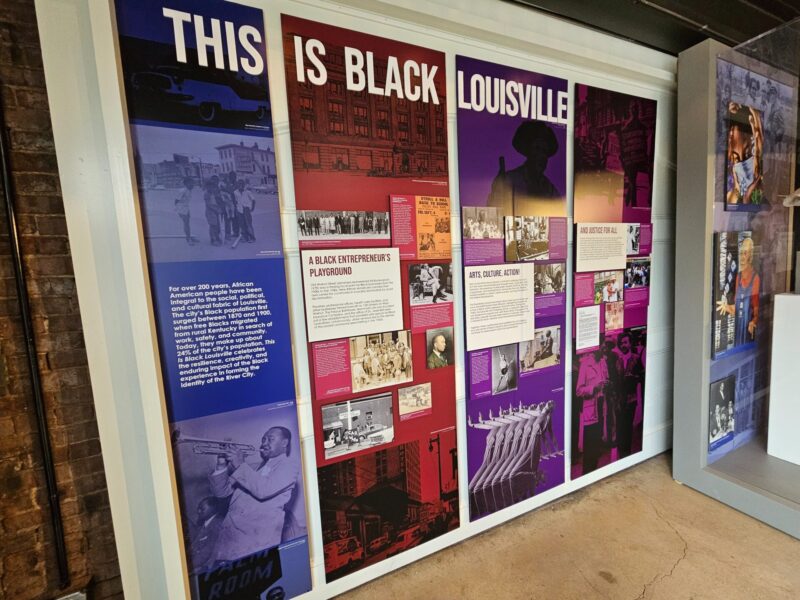
“This Is Black Louisville” exhibition at the Filson Historical Society in Louisville, Kentucky. Photo credit: Jacqueline Hudson
Focusing on three different social scopes, the goal of this exhibition is to explore the importance of the diversity of local Black history and to reveal that Black people are not a monolith in how their contributions have made an impact in their own communities. The first section, “A Black Entrepreneur Playground,” explores Old Walnut Street (now Muhammad Ali Blvd.), where African Americans built a thriving business community despite racial discrimination. Featured sites include the Palace Ballroom, Mammoth Life and Accident Insurance Company, and the office of Dr. Jesse Bell.
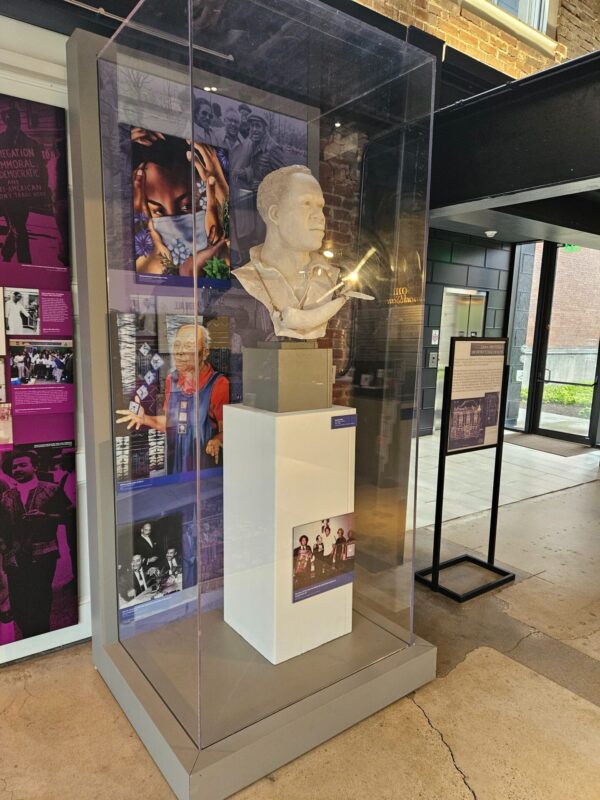
The second part of the “This Is Black Louisville” exhibition. Photo credit: Jacqueline Hudson
The second section, “Arts, Culture, Action!,” celebrates Black cultural contributions through figures like playwright Joseph Cotter, Sr., the Louisville Arts Workshop, and singer-songwriter Faith Pillow. The final section, “And Justice for All,” honors individuals who fought for social justice, including journalist Mervin Aubespin, chemist and artist Elmer Lucille Allen, and activist Charlene Hampton Holloway.
The exhibition process underscored the importance of collaboration. Working with staff, and consulting outside sources, strengthened both the content and direction of the project. Our team conducted research using metadata from PastPerfect and the Filson’s collection, newspaper archives, and interviews with exhibition subjects. A key resource was Two Centuries of Black Louisville: A Photographic History by Marvin Aubespin, Kenneth Clay, and J. Blaine Hudson, which provided valuable context on African American life in the city.
Aligned with the Filson’s mission of sustainability, this semi-permanent exhibition helps expand access and inclusiveness. By showcasing a range of objects and stories reflecting local African American communities, it connects past and present while encouraging visitors to imagine a more inclusive future. The aim of this exhibition is for African American visitors to recognize the history in their own backyard and for other visitors to discover it.
~Dr. Jacqueline Hudson is a public historian specializing in museum work and historic preservation, with experience in curatorial affairs, content development, public programming, and community engagement. She currently serves as African American History Program Manager at the Filson Historical Society in Louisville, where her work focuses on Black history and culture through exhibitions and scholarship.