



Editor’s Corner: breadth of the field
11 August 2026 – Sarah H. Case
Roma, Brazil, The Public Historian, northern ireland, Editor's Corner, covid-19, Arab Diaspora, sensory history, orientalism
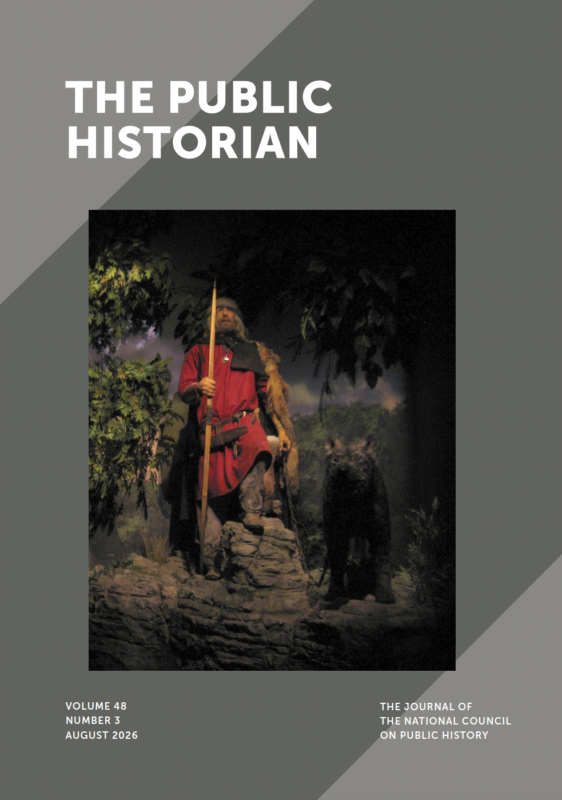
A mannequin welcomes visitors to the Jorvik Viking Centre’s “Time Car” ride in York, England. Photo credit: Chemical Engineer, own work (2017), CC BY-SA 4.0
Editors’ Note: We publish the editor’s introduction to the August 2026 issue of The Public Historian here. The entire issue is available online to National Council on Public History members and others with subscription access.
Our August issue demonstrates the breadth of current public history scholarship, examining the use of smell in museums, dance as a way to engage with history, a national heritage area, and public history in post-conflict society. Analyzing a “museum without walls,” a podcast, Instagram posts, performance, as well as more traditional exhibitions, the issue engages with public history in Brazil, England, and Northern Ireland, as well as the US.
We begin with Will Tullett’s analysis of the use of smell at the Jorvik Viking Centre in York, England, in “‘It Smelt Real’: Jorvik Viking Centre and the Experience of Museum Smellscapes.” Noting that historical scholarship has increasingly given attention to the sensory (especially aural history), Tullett points to a lack of engagement with the experience of smell at historic sites. Jorvik Viking Centre, founded in 1984, seeks to reconstruct a Viking village, and includes specific manufactured smell as part of its interpretation. Previous scholars tended to dismiss the use of smell, viewing it a gimmick that categorized Jorvik as a theme park rather than serious museum. Tullett takes the use of smell seriously as a category of interpretation, demonstrating that earlier critiques are rooted in the “distribution of the sensible” that favors sight over other senses. Significantly, Tullett looks beyond the park’s promotional material (the major source of earlier studies) to consider how visitors experience the use of smell, finding a more complex engagement with the park than earlier assumed. Tullett also gives attention to the creator of the scents used at Jorvik. Overall, the article reminds us how attention to the sensory can enrich engagement with the past.
In “The Hunna Collective, Historians Who Dance: The Politics of Orientalism and Authority in Brazilian Public History,” co-authors Naiara Müssnich Rotta Gomes de Assunção, Jéssica Melo Prestes, Ana Terra de Leon, Francismara Lelis, Nina Ingrid Caputo Paschoal, and Edward E. Curtis IV explore the authors’ engagement with “Oriental dance (commonly known as belly dance in English and raqs sharqi in Arabic), Arabic folk dances, tribal fusions, and Roma dances” as both scholars and performers. Known as the Hunna Collective, the dancers live in Brazil and do not have Arab heritage. Rather, they learned the dance in formal settings and approach their interest as those “from outside the Arab community, but one committed to educating ourselves and others about the Arab cultures that we appreciate.” The Hunna Collective offers classes educating other dancers about Arab culture and history. As they write, they engage in “mobilizing dance as a research subject and a starting point for public teaching about broader cultural, social, historical, and political aspects of Arab and Roma cultures and societies.” In doing so, they push against stereotypes of Arabic and Romani people in Brazil in effective, engaging, and meaningful ways, educating other dancers in thinking critically about their art form, cultural representation, and a long history of migration.
Keith Alexander, in “The Wheeling National Heritage Area: Interpreting Difficult History in West Virginia’s Museum Without Walls,” examines the specific opportunities as well as constraints offered by a city’s designation as a National Heritage Area (NHA). Although given “funding, expertise on interpretation, branding, and legitimacy” by the National Park Service, NHAs are not parks, but communities, and are responsible for half of their funding. Looking closely at Wheeling, West Virginia, Alexander asks how the community’s designation as a National Heritage Area (NHA) influences its presentation of the past, and in particular, how economic and political considerations shaped what stories were favored or overlooked. Although he expected “difficult histories” about race, violence, and colonialism to be downplayed, Alexander found that instead, “with some notable exceptions, the WNHA engaged with and addressed the area’s uncomfortable past, from the legacy of enslavement to problematic portrayals of American Indians and beyond. Although the unique format of the heritage area brought some challenges, it mostly enhanced the WNHA’s efforts to address difficult history.” The “museum without walls” concept, in which the city itself is a museum, allowed for multilayered, anachronic interpretation that could provoke critical thinking by visitors.
We next feature two articles on Northern Ireland that both consider how the late twentieth-century conflict known as “the Troubles” continues to shape how public historians engage with the past, even the more distant past. Jack Hepworth, in “‘While We Have a Shared Past, We Do Not Have a Shared Memory’: Agonistic Public Histories and the Contested Commemoration of the Good Friday Agreement,” directly addresses the conflicted public history of Good Friday Agreement of 1998, heralded as the end of the conflict. Hepworth sensitively shows the starkly different ways that the Agreement is remembered by different communities, beginning with the name itself (referred to as the Belfast Agreement by unionists, and the Good Friday Agreement by nationalists). During commemorations in 2023, for the Agreement’s twenty-fifth anniversary, international policymakers and major media and cultural institutions celebrated enduring success and political stability. Many members of the public and public historians, however, noted ongoing tensions which increased with Brexit and the passage of a truth and reconciliation act in 2023. Noting this, Hepworth “differentiates elite political commemorations—which posited an agreed memory of the Agreement—and agonistic exhibitions and broadcast media that promoted greater debate about the conflict, the peace accords, and their legacy.” In doing so he suggests ways that other post-conflict societies might better address a complex and still volatile recent history.
Although not focused on the conflict in their project, Ian Miller, Hannah Brown, Rhianne Morgan, and Eugenie Scott in “Epidemic Belfast: Health Heritage and Public History in Northern Ireland,” find that the Troubles continue to dominate interest in history and public history work. Their project, a public facing podcast, website, and lecture series about the long history of public health in the area, sought to push beyond this focus. Inspired by the COVID-19 public health emergency and shutdowns, “the team wanted to show that fuller insight into historical health contexts might contribute to then-pressing debates about contagion, vaccines, quarantine, mental health, vulnerable institutionalized groups, long-term disability, and other conversations.” The authors especially wanted to complicate the idea of “health heritage” (the term they prefer) as the history of a few “great medical men” to foreground the experience of those experiencing ill health. The report from the field also considers the complexity of working with community partners who might have different priorities and expectations for their collaborations.
~Sarah H. Case, the editor of The Public Historian, earned her MA and Ph.D. in history at the University of California, Santa Barbara, where she is a continuing lecturer in history, teaching courses in public history, women’s history, and history of the South. She is the author of Leaders of Their Race: Educating Black and White Women in the New South (Illinois, 2017) and articles on women and education, reform, and commemoration.