


Editor’s Corner: monuments and their destruction
05 November 2026 – Sarah H. Case
Editors’ Note: We publish the editor’s introduction to the November 2026 issue of The Public Historian here. The entire issue is available online to National Council on Public History members and others with subscription access.
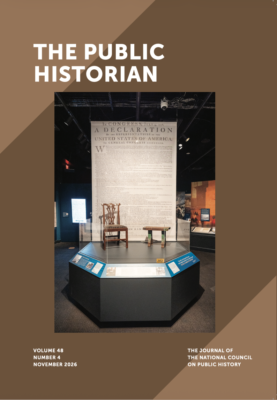
A view from “The Declaration’s Journey,” an exhibition at the Museum of the American Revolution in Philadelphia. Thomas Jefferson’s Chippendale slipseat chair (on loan from Monticello) is paired with the metal stool from the jail cell in Birminigham, Alabama, where Rev. Dr. Martin Luther King Jr. was held after his 1963 arrest. Photo credit: The Museum of the American Revolution
The four articles in this issue all engage with monuments and their destruction or removal, subjects that have received substantial scholarly and public attention in recent years. Historians and local communities have reflected upon monuments and statues in their communities and have explored how and why some people and events receive commemoration, and others not. In many cases (most notably Confederate statues in the United States), statues have been graffitied, broken, or toppled, symbolic protests against their representations of the Lost Cause and white supremacy. Critics of the removal of monuments lament this as “erasing history,” but historians maintain that monuments tell us much more about the beliefs and priorities of those who built the monuments than about any history that they intend to describe. That is, monuments present a particular way of thinking about an historical event largely informed by the historical context of the monument makers. As interpretation changes, public statuary changes as well.
Our first article, Sven Saaler’s “Public Statuary in Modern Japan: Great Men, the Heroic Nation, and Historiography,” focuses on Japan to explore how statues articulate a specific understanding of history, namely “Great Man theory,” or the idea that heroic individual men make history. Representational statues by their very nature celebrate individual accomplishment and can tend toward hero worship. Saaler argues that individual “great men” appear in textbooks and other areas, but statues especially promote “heroic narratives in ways that elicit powerful emotional responses.” Statues, he argues, “give the nation a face, thereby making a highly abstract notion tangible.”
In a very different vein, “Tar, Bombs, and Rowdy Students in Montreal: Considering Iconoclasm for the Field of Commemoration History,” by François Lamoureux, analyzes how publics have questioned or pushed back against the kinds of heroic narratives discussed by Saaler. Here Lamoureux introduces us to the history and historiography of iconoclasm. Focused on Montreal, Lamoureux traces iconoclasm in the city across time and three kinds of iconoclastic acts: “staged, dissenting, and ordinary iconoclasm.” He examines three acts during specific eras—eighteenth-century attacks on a bust of King George III; 1960s defacing of a statue of John A. Macdonald (a key figure in the nineteenth-century confederation of Canada) by the Front de liberation du Québec; and “everyday acts” that seemed to lack clear meaning but demonstrate “disavowal” of—or perhaps indifference to—the meaning of the statues. As Lamoureaux asserts, the line between vandalism and iconoclasm, ignorance and intention, is uncertain, and he argues that “the process through which iconoclastic acts are classified is historical and meaningful.”
Meghan A. Townes opens her article, “The Bust of William Mahone: State Art and Public Visions of the Future in Post–Civil War Virginia,” with an act of attempted iconoclasm—the intent to destroy the bust of the title by a political rival. Townes, who worked as the visual studies collection registrar at what is now known as the Library of Virginia, examines the institution’s extensive art-collecting during this period and links it to the political contests of the time. Townes finds a notable expansion of collecting occurred much earlier than previously understood and that it served a political purpose for white elites during and shortly after Reconstruction. Statues, paintings, and other artworks commissioned and collected during this time were part of the effort to push back against interracial political cooperation and Black political representation during a particularly volatile time. As she argues, “Art was as much a tool for reasserting white supremacy and political hegemony as it was a way of acknowledging they had been achieved.”
Finally, in “Monumental Shifts: Reframing the Meanings of Emancipation Garden (St. Thomas, US Virgin Islands), 1850–2022,” Rikke Lie Halberg focuses on a public square in Charlotte Amalie, St. Thomas, US Virgin Islands. Halberg “examines Emancipation Garden as a site where power, memory, and space intersect.” The area, once a market for the auction of enslaved people, was renamed Emancipation Garden following abolition in 1848. Yet public statuary there did little to attend to the history of slavery on the island. Instead, it first served to honor King Christian IX of Denmark as a means of asserting Danish identity in the island. Later, a replica Liberty Bell installed in 1950 was an “attempt to anchor the park within an American narrative of liberty while sidelining the deeper and more complex histories of emancipation and colonialism that the site embodies.” Not until 1998 did the park host a statue, Freedom, that engaged the theme, yet the Danish king remained in a central place until 2022. Halberg concludes that “monuments demonstrate that decolonization in public space rarely occurs through a single act of removal; rather, it unfolds through successive interventions that reshape which pasts are made visible and whose histories occupy the center.”
Our cover image signals a special review section, Exhibitions Commemorating the Semiquincentennial of the Declaration of Independence, with reviews of installations and programing at institutions across the US. Together, they speak to the many ways Americans grapple with the legacy of the Declaration and the complexity of public history today, in a time of thinning funding and increased political scrutiny. Yet despite the obstacles, many museums and historic sites created meaningful engagement with the myriad ways we’ve striven to understand the 250th.
~Sarah H. Case, the editor of The Public Historian, earned her MA and Ph.D. in history at the University of California, Santa Barbara, where she is a continuing lecturer in history, teaching courses in public history, women’s history, and history of the South. She is the author of Leaders of Their Race: Educating Black and White Women in the New South (Illinois, 2017) and articles on women and education, reform, and commemoration.