



Rethinking “History Mysteries”
13 May 2026 – Talia Brenner
“What are the clues? Where does the evidence lead?” “It’s a mystery!” If you have worked in public history for long enough, chances are you have at some point described a historical episode or research question as a mystery. While it may be a useful strategy, public historians should thoughtfully consider the implications of a “mystery” framing before using it. The “lost colony” of Roanoke Island (1587), one of America’s favorite historical mysteries, provides an example as to why.
A simple online search reveals countless public history institutions who have used the “history mystery” tag for any number of projects, including digital initiatives, public programs, and school curricula. And who can blame us? For one, there’s the rhyme. Beyond that, “mystery” captures something true about the nature of historical research: the search for evidence, the pieced-together narratives. Describing history as a detective story represents the longtime ideal for the profession, which uses investigative methods to find the truth.
But perhaps the main reason for history mysteries is that they are interesting. Mystery is a popular genre, and public historians are always seeking to connect our resources with people’s interests to create engaging programs. Many people have a morbid curiosity and a desire to solve problems, knowing the satisfaction when all will be revealed. This framing can democratize participation, by engaging visitors in solving a historical mystery. Studies of museum learning show that visitors respond well to more interactive experiences. Visitation and visitor experience are key to a museum’s success in fulfilling its public mission. These are also key to staying afloat financially, whether through ticket sales or demonstrating relevance to public and private funders.

An Illustration appearing in the 1873 volume of St. Nicholas, a periodical for childen (New York: Scribner & Co., 1873), 149. Image credit: Flickr, CC0
_(1873)_(14777192484).jpg)
Yet the mystery framing in public history has certain limitations, as evidenced by one of the most famous history mysteries: the “lost colony” of Roanoke Island (1587). Though elevated to a well-known story, it was only one of many failed attempts by colonists to create an English settlement in North America. Euro-Americans have since reveled in the mysteriousness of the colonists’ alleged disappearance, but it is really not best described as a mystery at all. Native North Carolinians have long maintained that the colonists joined Indigenous communities. Leading historians of Native America support this claim. While there are genuine unknowns, such as gaps in both European and Native American historical records about exactly where the colonists went after leaving their settlement and who their descendants may be, the fact that they assimilated is not up for debate amongst historians.
Nonetheless, museums interpreting this history often still frame it as a “mystery.” Static and interpersonal interpretation encourages visitors to question whether colonists died en masse, struck out on their own, or joined Indigenous communities. Interpreting this history as a “mystery” poses a number of problems. Though this example takes place on Roanoke Island, it can inform the practices of public historians elsewhere.
For one, the mystery framework may limit which publics an institution can engage. For example, many Indigenous North Carolinians believe that the lost colony obsession is a settler myth, derived from white Americans’ refusal to believe that Europeans would ever voluntarily join Indigenous societies. The “mystery” framing would likely alienate these visitors, impeding a museum’s ability to meet its public mission.
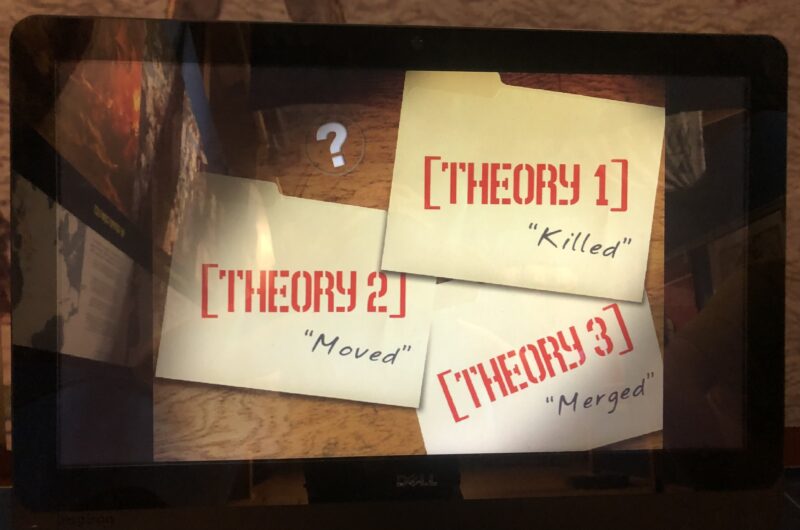
Interactive display at Roanoke Island Festival Park, 2025. Photo credit: Talia Brenner
“History mystery” also usually conveys a light-hearted tone. As with turning historical episodes into ghost stories, mysteries can sanitize serious topics. In the case of the “lost colony,” those topics include colonization, war, starvation, hatred, and death. Some historical topics can be made fun, but a light-hearted framing is not suited for every history.
A mystery framing can also distract from a site’s factual interpretation, leading a museum to abdicate its responsibility to interpreting historical truths. In the case of the “lost colony,” the “mystery” framing not only avoids the historical reality but also opens the door to some visitors’ wild speculation. For example, written visitor responses displayed at one site included suggestions of aliens, robots, and mass murder by the colony’s governor. As public historians move in the direction of decentering curatorial authority, it is important for museums to hold the line on what speculation they will not abide.
Although using a commercially savvy narrative framework like “history mystery” can open participation, it can also run away from us. Museum professionals should think carefully before framing a historical topic as a mystery. Are there multiple plausible explanations or do historians generally agree on the answer? Are you prepared for a feeling of playfulness around this topic and is it appropriate? Do you want to encourage continued speculation? There are historical topics that are best described as mysteries. Is yours?
~Talia Brenner is a PhD candidate in public history at North Carolina State University. Her dissertation project addresses the public history of the “lost colony” of Roanoke Island. https://chass.ncsu.edu/people/tlbrenne/