



The danger of a single history from an African perspective
18 August 2026 – Ngozi Romanus
The National Archives of Nigeria (NAN) preserves the country’s official records. Yet many histories, particularly those of activism among Nigerians, are absent from its collections. Activist histories were instead collected by the Archives of the Nigerian Left, raising an important question: why were these materials not preserved in the first place?
NAN was established to preserve government records and to document Nigeria’s administrative past. The movement for its creation started in 1949 when historian Dr. Kenneth Onwuka Dike identified the poor preservation of historical records in colonial government offices and called for their proper documentation. Nigerian histories were further jeopardised by colonialists who had taken many official documents to London in what was called the “migrated archives.” Dr. Dike’s recommendations led to the establishment of the Nigerian Records Office in Ibadan in 1951. It became the country’s first official archival institution, with formal acquisition of records beginning in 1954. These early collections were comprised of colonial administrative documents, correspondence of colonial administrators, and missionary records, reflecting the priorities of the institutions that produced them. The archive, which later developed into the National Archives of Nigeria, received legal backing through the Public Archives Ordinance of 1957 and was further strengthened by the National Archives Act of 2004.
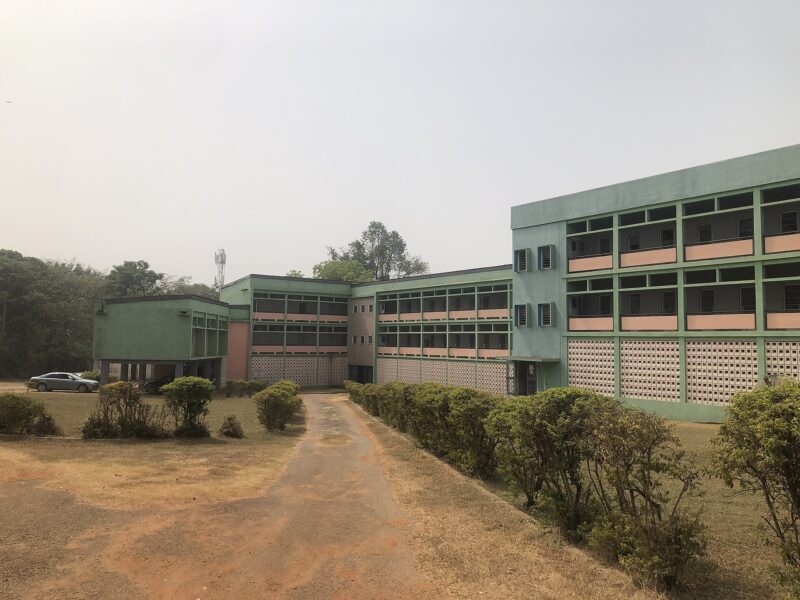
Main building of the National Archives of Nigeria, Ibadan branch, 17 December 2024. Image credit: Ei’eke, Wikimedia Commons, CC BY 4.0

Having expanded from its initial scope, today the National Archives holds extensive heritage documents, with the key collections being British colonial administrative papers, court records, local government records, photographs, and private papers. However, despite the depth of the NAN, the histories of ordinary Nigerians that shaped Nigerian political and social history are rarely preserved, particularly those of activists, labor groups, feminists, and student groups. There are many reasons why these histories have been left out of the National Archives. The National Archives primarily collects documents that are at least twenty-five years old for preservation. This means much of Nigeria’s post-independence history from the 1960s to the 1980s was never fully captured in real time. Another limitation of the National Archives is chronic underfunding leading to loss of new collecting. For instance, the Ibadan headquarters has not conducted a major acquisition of public records since 1986 due to funding shortages, leaving huge swathes of history undocumented. The Federal Ministry of Information and National Orientation (FMINO) confirmed that critical archival functions, such as nationwide records acquisition, have ceased for the same reason. While these are the official reasons for the lack of activist histories preserved in the National Archives, other explanations remain.
Activist histories are politically sensitive. Because they may challenge the government narrative, their preservation can be considered threatening. Those who engage with these records may come to question and challenge the government’s official histories. Therefore, hiding or failing to preserve certain histories upholds the status quo and protects the government from scrutiny. For example, some documents of the Nigerian Civil War have been classified by the Nigerian government and kept away from the public eye. As suggested by patterns documented in recent restrictions on Biafra-related memory websites, access to such historical content is sometimes limited under arguments linked to national unity. This raises a question about whether such actions genuinely protect the public or function as a means of controlling historical knowledge.
Omission of controversial history by government officials is not unique to Nigeria. Recently in the United States, the exhibition panels at the President’s House in Philadelphia were taken down and replaced by the administration of President Donald Trump for discussing that President George Washington kept nine enslaved people at the site. The government argued that the panels were unpatriotic and presented American history in a negative light. This reaction itself shows how certain versions of history are protected while others are resisted, allowing one narrative to dominate public memory, much like the exclusion of activist histories from NAN.
To bridge the gap that NAN failed to fill, the Archives of the Nigerian Left, also known as the Archives of Nigerian Radicalism, was established in 2021 by the Centre for Democracy and Development (CDD) and funded by the Institut Français de Recherche en Afrique (French Institute for Research in Africa). It houses collections of post-independence Nigerian activists such as the Socialist Library and Archives (SOLAR), the Ola Oni and Kehinde Oni archive, the Baba Omojola archive, and the Bala Usman archive, among others. The materials that are digitized and preserved include pamphlets, internal letters, movement posters, and other records of civic activism, allowing the younger generation to engage directly with their radical heritage and giving people access to multiple perspectives of Nigerian history. While the national archives hold documents that tell history from the viewpoint of governments and institutions, the Archives of the Nigerian Left highlights the voices of Nigerians who worked and fought for social justice outside the corridors of power.
In addition to preservation and access, the Archives of the Nigerian Left offers impressive initiatives like annual grants for Nigerian artists, writers, filmmakers, and content creators to explore its digitized and physical collections for creative work. These grants allow artists to produce documentaries, poetry, creative writing, or visual art that brings Nigeria’s radical and pro-democracy history to a wider audience, promoting engagement with public history. This initiative has also benefited me as a historian. Through the 2026 grant application process, I was guided to research overlooked figures in Nigerian activism. Through this process, I came across Gambo Sawaba, a Northern feminist in Nigeria’s First Republic and her activism around women’s rights and political participation in Northern Nigeria. The management and initiatives of the Archives of the Nigerian Left also reflect what a well-funded archive can achieve and should serve as a guide for the Nigerian government in funding the National Archives.
The emergence of the Archives of the Nigerian Left underscores a critical truth: historical narratives are only as complete as the archives that sustain them. This means that preserving and discussing multiple histories is the best way to combat the dangers of a single history.
~Ngozi Gift Romanus graduated with a first-class degree in History and International Studies from the University of Nigeria, Nsukka. She is the founder of The Young Historians Initiative for Historical Education, a mentorship network supporting emerging historians in Nigeria, and is passionate about using history as a tool for social change and making African history accessible. For more background about the issues Romanus discusses, she recommends reading Amodou Okpanachi Solomon’s article “National Archives Ibadan and Archival Management in Nigeria: Challenges and Prospects,” in Kashere Journal of Humanities, Management and Social Sciences 3, no. 2 (2019).