



A neurodivergent approach to public history labor
20 August 2025 – Stephanie Rowe
Editor’s note: This piece builds on an article that appeared in the June 2025 edition of Public History News.
Going into the 2025 NCPH Annual Meeting in Montréal this March, I expected to bear the weight of the experience more deeply than prior years, not just because of our current political moment but because of my own circumstances. After 40+ years of confusion and struggle, I sought and received an AuDHD (autism+ADHD) diagnosis in January.
Experiencing the annual meeting through this new lens brought into perspective the ways that my brain wiring has unconsciously shaped how I approach my work and role at NCPH, specifically balancing an expanding set of needs from our public history community with our reliance on a small staff and volunteer-based structure in a caring and ethical way. As a public historian, this diagnosis has identified for me a need to reflect and engage in community as we consider the future of public history work in increasingly inhumane times. Further, I have a heightened awareness of the cost of emotional commitment that can result in temporary or long-term burnout in the field.
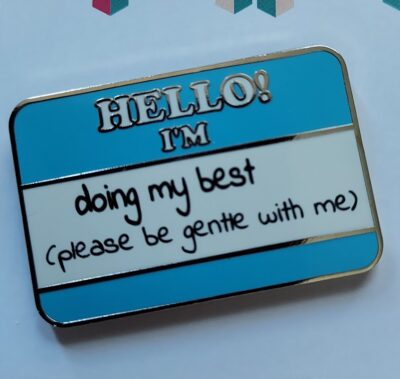
Pins purchased for NCPH to wear at NCPH 2023. Photo courtesy of Stephanie Rowe.
One of my biggest sources of pride in NCPH is how human-focused we have worked to become over the last decade. In talking with fellow neurodivergent folks in Montréal, I began considering the extent to which a different way of seeing and interacting with the world has influenced the development of our organization. We admit that we do this work because it matters, not because we make good money. This does not mean that so-called passion jobs are not still work–and often work that comes with emotional costs.
My brain’s conclusion then, is that our people must matter to NCPH as much as their practice does. (Well, my autistic brain is absolute in believing it must matter more). This is reflected in the last ten years of organizational priorities under my tenure: we’ve been exploring the intersections of sexual harassment and gender discrimination in public history work; requiring listed compensation in job and internships postings; interrogating our reliance on volunteer labor; focusing on public history work as just that, labor; and developing an advocacy focus on how our environments affect our abilities to do this work (or not). We’ve also prioritized keeping registration, membership, and programming costs as low as we can, calling on those of us who have enough resources to share with our peers to subsidize costs for those who do not.
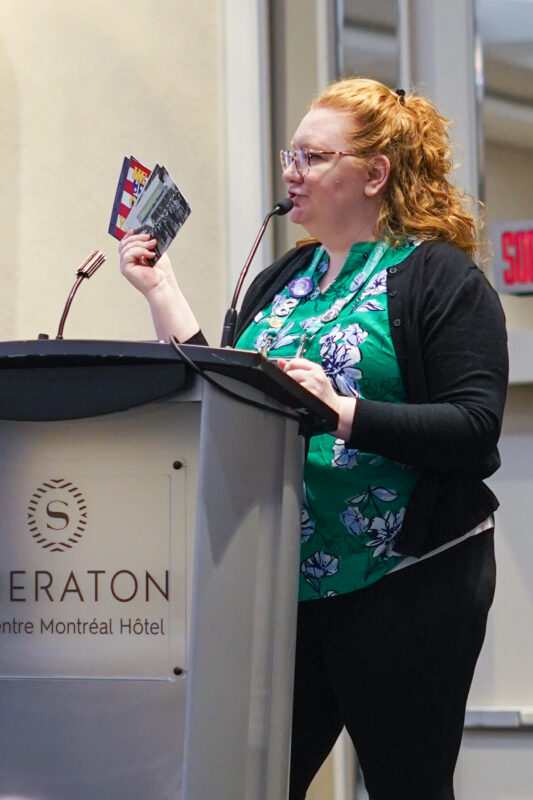
The author addressing NCPH 2025 attendees. Photo courtesy of Sharon Leon.
While essential, this attention to human needs and meticulous work comes at a great personal cost, most evident for me during the time around each year’s conference. I am capable of successfully hosting, speaking publicly, and convening committee and board meetings. But this comes with disabling consequences. The energy it takes me to get through a 15-hour day of social interactions in a foreign environment causes stress, anxiety, and overwhelm, no matter how smoothly events run. It means for weeks afterwards my tank is empty. I struggle to leave the house, to complete everyday tasks, to text friends or take part in hobbies. This is my autistic reality; our annual meetings bring me joy but take a physical and mental toll.
Although this potential for burnout is greatest at the conference, by no means is the experience limited to the annual meeting. Hosting sometimes three Zoom meetings per day while being an on-camera host is also draining. In our current moment, working with so many who are struggling, my hyper empathy results in my inability to say “no” when others say I should, as well as experiencing routine emotional exhaustion. For decades I thought this was a lack of strength or the result of gender-based socialization, but now I understand it is a core characteristic of my place on the spectrum. Navigating this reality requires me to consider some accommodations or modifications to my approach to the job to be healthy, and it requires me to consider the workplace culture this aspect of my neurodivergence contributes to.
These considerations don’t stop with me.
For years, the fiscal solidity of the organization has rested on the staff; we weathered Indiana University’s elimination of our salary support as well as COVID-19 by leveraging cost-savings from staff departures. Empowered by my new diagnosis and understanding of the true cost of burnout, that workplace culture is changing. Despite losing two staff members this summer and needing to run two searches, I worked with the Board to prioritize support for another staff’s requested partial leave this summer, and I am not sacrificing my two-week break. NCPH must model an approach to work that avoids burnout. To bridge the gap, we invested in temporary staff and will fund overlap between our outgoing and incoming hires. The goal is that we create a system of supports to ensure that our success as an organization does not come with a human cost.
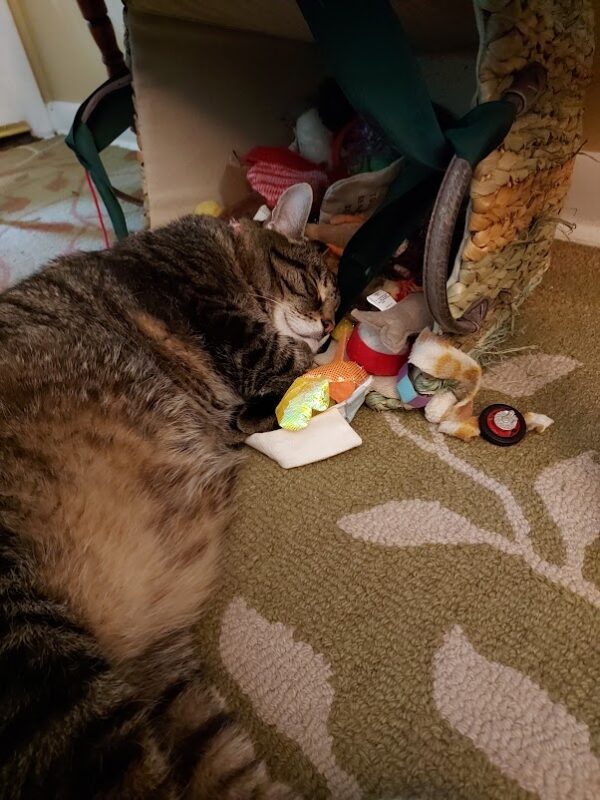
The author’s post-annual meeting recovery. (Just kidding, but this is one of my public history pets!). Photo courtesy of Stephanie Rowe.
These considerations can’t stop with NCPH.
This approach should not be a luxury for public history organizations, it should be a requirement to consider supportive measures for our staffs. Burnout is only getting worse with continued–and deep–funding cuts. While organizational change moves slowly, NCPH can be a model and a resource. This year we convened a virtual working group on accessibility, disability, and public history to develop a cohesive and comprehensive strategy for NCPH’s accessibility efforts. The working group looked at ways we can support accessibility internally as a membership and professional organization but also focused on ways we can support our members externally in centering disability history and disability justice in their work. We’re also continuing to support our Labor Task Force, which launched a series of resources for employers and employees earlier this year, as well as a series of posts right here on History@Work.
This is me asking for your help. Please extend grace and empathy not only to NCPH but to all your public history peers. We may need to keep cameras off, or handle correspondence via email instead of live–and that’s ok. Public history organizations exist to serve people, but they are also run by people: people who deserve to have work-life balance, supportive and accommodating work environments, and care for their humanity. This feels important to articulate in a time when such considerations are on the decline. Thank you all for being colleagues that allow me to feel comfortable and confident in bringing my whole self to my work despite the outside precarity that brings. I hope that within your own workplaces you can foster the same culture of accessibility and inclusion.
~Stephanie Rowe serves as NCPH Executive Director
This is such an important statement, Stephanie. Thank you for being there for all of us. People first, absolutely. Sending virtual hugs!
Thank you for sharing Stephanie and continuing this important conversation! We appreciate and value your work.