



Climbing the hill: access and opportunity at the Met Cloisters with Dr. Julia Perratore
29 October 2025 – Madison Haine
Editor’s Note: This post is part of a 2025 History@Work series authored by members of the NCPH Labor Task Force in response to our Special Open Call on “#Advocacy in the Field.” In addition, this piece is part of a series based on Rutgers University student interviews with practicing public historians. You can read each post as it is published throughout the year under H@W‘s #Advocacy tag.
In Manhattan, high on a hill above Washington Heights, stands an edifice that looks straight out of eleventh-century France. That castle contains offices where Dr. Julia Perratore, Curator of Medieval Iberian Art, works at the Metropolitan Museum of Art Cloisters, the foremost museum of medieval art in the United States.
Dr. Perratore explains the labor of access—that is, the work of expanding her museum’s audience and the process of becoming an individual who has influence over how accessibility initiatives look. My interview with Perratore explores how labor is tied to the tension between loving museums as public spaces and the difficult, highly competitive journey to work at a particular institution.
The Metropolitan Museum of Art’s mission statement, which guides Perratore’s work, references connecting all people to art. In her effort to increase visitation to the museum from the Spanish-speaking community of Washington Heights, Perratore has advocated for the inclusion of Spanish language interpretive materials at the museum. Additionally, she works to close the distance between the Cloisters and its surrounding community: “One way that we’re seeking to help people to better understand our museum is to think about the history of our collection.” She adds, “We’re working right now to create better signage, better labels that can interpret [the Cloisters’] history.” That history is the story of the Cloisters’ construction, which includes 800-year-old stones from a monastery in France. Perratore contends that the Cloisters’ appearance distinguishes it from its surroundings, and that this difference might discourage visitors from climbing the hill to see this spooky castle.
Perratore believes improved signage and labels will help the Cloisters reach a wider audience. One such example is the inclusion of Spanish in her most recent exhibit, Spain 1000–1200: Art at the Frontiers of Faith. This was the first bilingual exhibition at the Cloisters, with all labels available in both Spanish and English.
Perratore expresses that curation is a highly collaborative process. She does everything from researching individual objects, to requesting items from the registrar’s office, to working with the object handler, to meeting with the design department, to finalizing labels, and so much more, all under the umbrella of the Metropolitan Museum of Art as an institution with particular values. Every decision is made with the approval of multiple people and has numerous moving parts. Everyone is on the same team—the museum’s team—but each facet of the project has its own structures and hierarchies that allow the team to move forward.
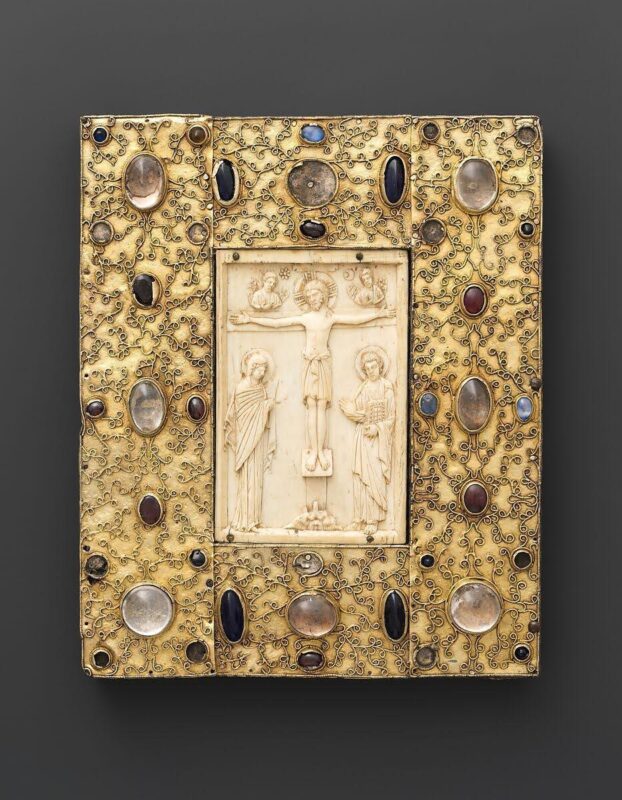
An image of an eleventh-century Spanish book cover Dr. Julia Perratore is currently working with. Photo credit: Metropolitan Museum of Art, Public Domain
“I’ve always seen museums as democratic spaces where everyone is and should be welcome. And I say that because I experienced it as a child [and] as a young adult,” she says. Even for someone like Perratore, who was exposed to museums at an early age, climbing the professional ladder to a leadership position at an internationally renowned museum required an incredible investment of labor and time, with no certainty of future returns. In high school, she had the opportunity to intern at the Metropolitan Museum of Art on Fifth Avenue, where she worked in the department of Medieval Art. She then attended NYU for her undergraduate degree, and the University of Pennsylvania, where she received her PhD in the history of Medieval Iberian art.
Perratore began her work at the Cloisters seven years later. “Just speaking about my time between finishing my PhD and actually getting this full-time job as a curator . . . the experience of the job market was the most challenging part of this journey,” she says. In those seven years between her PhD and the Metropolitan Museum of Art, Perratore spent five years teaching and then had a two-year fellowship at the Met before finding her current position.
The effort one puts into gaining access to a dream job does not always pay off. When considering a career path in museums, Perratore offers some advice: “I think that people entering PhD programs now can and/or should be thinking about casting a broader net, by thinking about being more versatile. What kinds of skills do they have? How can they parlay the research skills and writing skills and communication skills that they develop in a PhD program? How can they potentially parlay that into another career path if their initial chosen career path doesn’t work out?”
Increasing accessibility in museums is an ongoing process. Our approach to accessibility evolves with our careers and with the field’s culture. It is imperative for public historians in positions such as Perratore’s to increase the diversity of museum audiences and museum workers alike, and to help burgeoning museum professionals in their career paths. Like Perratore, we encourage public historians to ensure that more people have the opportunity to learn at museums, access their contents, and pursue career paths that will take them inside museums.
Read the full transcript of the interview here: History@Work interview transcript
~Madison Haines is a graduate student at Rutgers University pursuing a master’s degree in Global Comparative History. She is a medievalist with a focus on neomedievalisms in contemporary Spanish politics.
Outstanding Reporting.