



“Collaboration is the heart of It”: The value of community-building in the Washington Prison History Project
23 October 2025 – Ánh Adams
Editor’s Note: This post is part of a 2025 History@Work series authored by members of the NCPH Labor Task Force in response to our Special Open Call on “#Advocacy in the Field.” In addition, this piece is part of a series based on Rutgers University student interviews with practicing public historians. You can read each post as it is published throughout the year under H@W‘s #Advocacy tag.
For Dr. Dan Berger (University of Washington-Bothell), co-curator of the Washington Prison History Project (WPHP), collaboration has been integral to bringing a project about incarceration in Washington state to life. “The kinds of relationships that I’ve developed and maintained with people who are incarcerated are what makes the project possible . . . and so collaboration is the heart of it,” Dr. Berger says. The WPHP’s approach to thoughtful collaboration and community offers space to interrogate how public historians can balance relationship-building with adequate compensation. The project shows that monetary compensation should not prevent historians from discovering new, meaningful ways to relate to the communities they collaborate with that are not solely based on the transactional wage-labor framework.
The WPHP began as a “happy accident” when Ed Mead, a formerly incarcerated man, reached out to Dr. Berger to donate his personal papers to the University of Washington. From 2017 onward, Berger collaborated with archivists, librarians, and students at UW-Bothell to build an archive of mass incarceration in Washington State as told by incarcerated people themselves. By highlighting the voices and contributions of currently and formerly incarcerated people, the WPHP aims to de-stigmatize the prison experience and illuminate the rich political culture created by incarcerated people. Since 2017, the WPHP has expanded to a digital archive of nearly 2,000 items including prisoner publications, documentary photographs, oral histories, and an online game. In May 2024, the WPHP received a Mellon Foundation Imagining Freedom Initiative grant to support and expand the project.
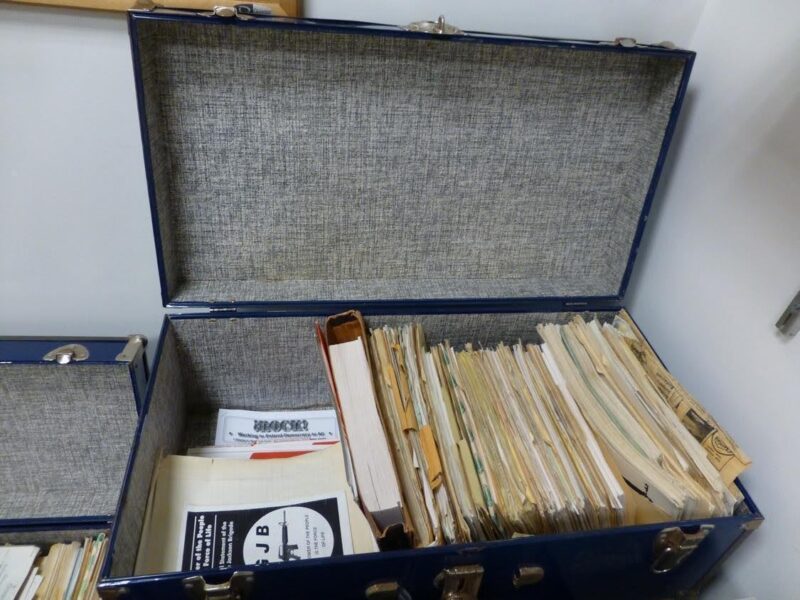
Original box of materials donated to the Washington Prison History Project Archive by Ed Mead. Photo Credit: Washington Prison History Project
For seven years, the WPHP relied largely on the labor of student-volunteers, so Berger believed it was important that he frame the project as a beneficial opportunity for students to receive mentorship and participate in collaborative research to support the project. Berger described that “part of accepting volunteers is my own capacity to mentor them and train them . . . part of the labor is to align the work that people can do with their preparation to do that work.” Tasks such as building a project website or creating an archive on COVID and incarceration were taken up by the students who used their work on the WPHP to fulfill independent study requirements for their degrees.
The grant has transformed the WPHP by expanding their capacity to work with and compensate currently and formerly incarcerated community members who contribute to the project. However, Berger acknowledges that monetary compensation comes with its own set of challenges, especially when trying to account for the emotional labor of collaborators who have shared personal stories of trauma and abuse in correctional facilities for the WPHP’s oral history collection:
It’s something I think about a lot, and I am troubled by the lack of answer. . . . Is $1,000 enough to recount all these abuses? Is a million? . . . It’s all arbitrary and it’s all a token, you know, and obviously these tokens are meaningful. But, you know, if you pay $1,000, maybe you talk to five people, right? If you pay $50, maybe you could talk to a hundred people, but $50 is an insult. All these kinds of questions are so unanswerable, and unfortunately, they make the process transactional, even though it’s all well-intentioned. . . . The relational component is the most important, and when there’s money involved, it’s never only relational. So that part is tricky. I both like where we landed, and I feel unreconciled about it because it is unreconcilable. So, I think trying to really assert and reassert and return to the primacy of relationality is the most important thing right now.
It is difficult to imagine if money can fully make up for the emotional labor performed by currently and formerly incarcerated contributors to the WPHP. Certainly, monetary compensation is a powerful step to honor this labor and attempt to repair damage caused by mass incarceration. Yet, it is the relationships that Berger and the WPHP have built with these collaborators that will sustain the project even when the term of the grant ends. The thoughtful philosophy on compensation and community-building at the heart of the WPHP models how projects can adapt to and withstand change.
With the defunding of the National Endowment for the Humanities and other pools of tax-payer money, public historians will need to contend with how their projects will withstand political attacks and economic scarcity. This is not to say that public historians should cease to challenge institutional politics or adopt extractive labor practices that do not adequately compensate for labor. Nor is this a call to discontinue the important discussions around unionization, contingent labor, and the racialized and gendered realities of public history work. Rather, what we learn from the WPHP is that the ability to provide sufficient monetary compensation for labor in the field of public history is most successful when grounded in strong interpersonal and community relationships. Foregrounding these relationships not only ensures that projects can withstand lapses in funding but also helps public historians imagine thoughtful ways of relating to the communities we work with that are well-rounded and nourishing.
~Ánh Adams is a PhD Student in History at Rutgers University
This is a good article. Thank you for illustrating the difficulties that come with distributing compensation for emotional labor, and showing the importance of communicating the value of the contributions of the individual participants alongside the remuneration.