



Editor’s Corner: Cemeteries as Evidence
08 December 2025 – Sarah H. Case
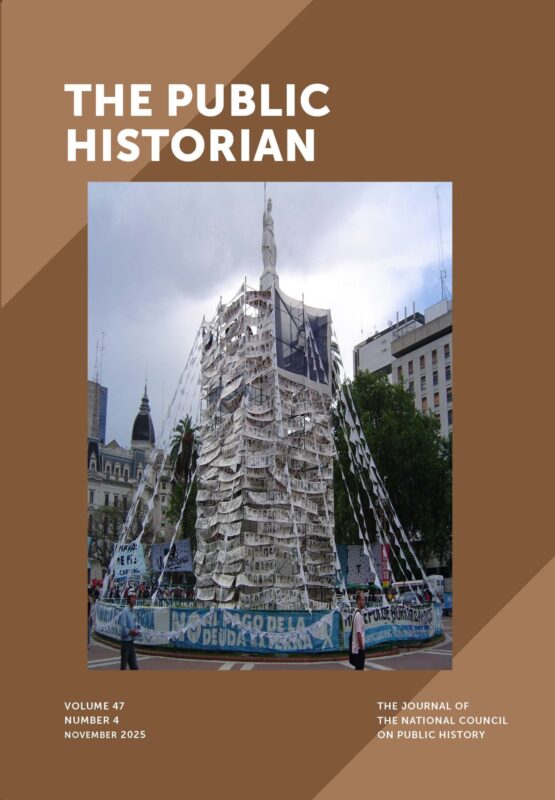
The Pirámide de Mayo in Buenos Aires covered in a tower of photos of the desaparecidos during the annual March of Resistance, December 2004. Image from Cheryl Ana Jiménez-Frei’s article, part of this special issue “Cemeteries, Graveyards, and Massacre Sites.” Photo credit: WikiLaurent, CC BY-SA 3.0

Editors’ Note: We publish The Public Historian editor’s introduction to the November 2025 issue of The Public Historian here. The entire issue is available online to National Council on Public History members and to others with subscription access.
Our special issue, “Cemeteries, Graveyards, and Massacre Sites,” guest edited by Lily Anne Welty Tamai, considers burial grounds and sites of mass violence as important sources for public historical research.
The wide-ranging issue examines sites that have been ignored and repurposed for development or recreation, as well as sites that have been claimed by survivors “in the absence of a grave,” in the words of our cover article. Articles in the issue describe sites ranging from the Marshall Islands, to Argentina, to the US West, South, and Northeast. They analyze how communities, sometimes working with organizations, governments, or universities, might reclaim these sites and make new kinds of memorials and meanings from them. Many document this kind of collaborative public history work; others are calls to action. As Tamai emphasizes in her introduction, these articles represent just the beginning of possibilities for work in this subject area. We look forward to continuing conversations in this field.
~Sarah H. Case, the editor of The Public Historian, earned her MA and Ph.D. in history at the University of California, Santa Barbara, where she is a continuing lecturer in history, teaching courses in public history, women’s history, and history of the South. She is the author of Leaders of Their Race: Educating Black and White Women in the New South (Illinois, 2017) and articles on women and education, reform, and commemoration.