



Editor’s Corner
09 September 2025 – Sarah H. Case
Editors’ Note: We publish the editor’s introduction to the August 2025 issue of The Public Historian here. The entire issue is available online to National Council on Public History members and others with subscription access.
The four articles in this August issue examine preservation in many aspects, including the racial implications of historic commemoration and preservation; preservation of historical sites affected by the COVID-19 shutdowns; recommendations for the preservation and management of historical house museums and sites; and the preservation of precarious records created by campus organizations.
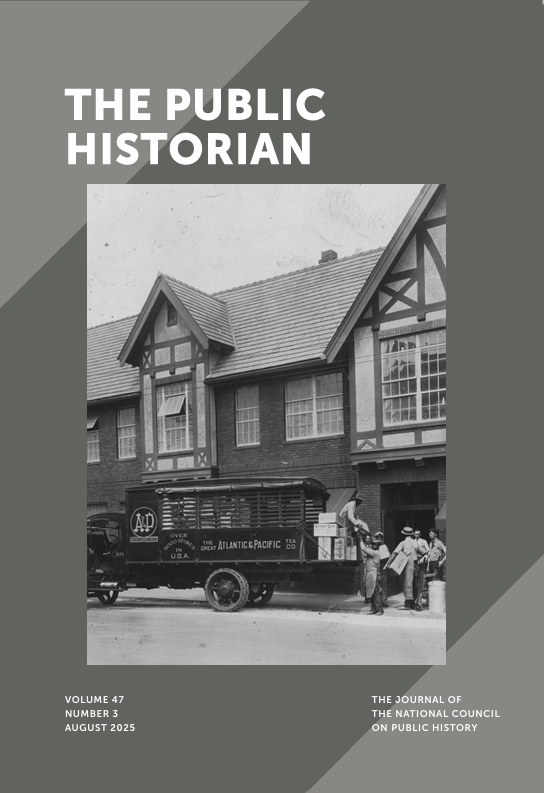
On the cover: A&P grocery, Avondale Estates, Georgia, 1926. As Kathryn E. Wilson argues in her article, the local memory of Avondale Estates erases both its history of segregation and the presence of Black workers and residents, evident in images such as this one. Photo credit: Forkner Collection, DeKalb History Center Archives
First, we feature Kathryn E. Wilson’s “Being like Mayberry: Memory, Landscape, and the White Spatial in an Atlanta Suburb.” Wilson asks us to look beyond Confederate memorials and tributes to the Civil Rights movement to consider how more “modest forms of quotidian commemoration” shape local history in the South and the nation. As she argues, street names, plaques and other signage, community celebrations, and other everyday parts of the built and cultural environment create and support “versions of history that produce normative and naturalized relations of power.” Often, as in the Atlanta suburb of Avondale Estates, these power relations are implicitly or explicitly racialized, equating order, safety, and cleanliness with whiteness. Wilson considers how local and national preservation law and practice has served to bolster a vision of the past and present that justifies white supremacy while at the same time masking it in a language of race neutrality. The “white spatial imaginary” (a George Lipsitz phrase employed by Wilson) continues to shape Avondale Estates today, as Wilson’s graduate students found through interviews with local residents.
Next, “Beyond Keeping the Lights On: COVID-19’s Impact on Lower Mississippi River Valley Museums and Public History Sites,” by Liz Skilton and Ian Beamish, examines the short- and long-term effects of pandemic shutdowns on the area’s historic sites. Skilton and Beamish had planned to take students on a study-travel course on the Mississippi River in late March 2020. Instead, they worked with their students to “start answering a question we were preoccupied with: were the public history institutions we were set to visit at risk of permanent closure due to the shutdown? And, if so, what would public history sites and museums (or public history as a profession) look like at the end of the closure period?” Skilton and Beamish used the results of their class research to track the effects of the COVID-19 lockdown period on Mississippi River Valley historical sites during and for several years after mandated shutdowns. Their work diverges with the widely circulated estimate that 30 percent of all museums would close permanently; the actual number of closures was quite small. And yet, Skilton and Beamish demonstrate that, despite initial overestimates on public history institutions’ inability to keep their doors open during the COVID-19 lockdown period, museums and historic sites were significantly impacted by the shutdown. This impact was seen in loss of income, staff layoffs, and unprecedented reliance on virtual programming.
Additionally, this issue brings two Reports from the Field. The first, “Charting a Path toward Historic Sites Sustainability: Mission, Money, and Meaning,” was co-authored by representatives of Museum Insights, a museum consulting firm, and Connecticut Landmarks (CTL), a preservation organization. The authors, Sara Patton Zarrelli, Guy Hermann, Aaron Marcavitch, and Shaelyn Amaio, examine the issues facing historic properties and offer concrete, actionable recommendations to help historical organizations “make thoughtful decisions about management of resources (properties, finances, and people) in times of relative calm that will, thereafter, lead to the development of an operating model that will sustain the organization long-term.” They first describe the process they used and then propose a toolkit that can be applied to other, similar organizations across the country.
Alex Ketchum, in “The Practice of Simultaneously Curating Physical and Virtual Exhibits to Resist Against Institutional Memory Loss: Keeping LGBTQIA2S+ Campus Histories Alive,” offers readers a roadmap. Ketchum demonstrates how curating physical and virtual exhibitions together helps prevent the kind of “memory loss” that is prevalent in university settings, with their frequent turnover of faculty, staff, and especially, students. Ketchum argues that “digital humanities strategies such as distributed knowledge production, collaboration, multimodal creation and distribution, animating the archive, accessibility, and sustainability, curating of physical and virtual exhibitions at the same time works to overcome some of the root causes of institutional memory loss.” As she stresses, this kind of work is especially essential for marginalized communities, including the LGBTQ+ community at McGill University in Montréal, Canada, the focus of the exhibition.
Our review section also focuses on Montréal, the host city of this year’s annual meeting of the National Council on Public History. Featured are four reviews of sites or tours highlighted for conference attendees.
~Sarah H. Case, the editor of The Public Historian, earned her MA and Ph.D. in history at the University of California, Santa Barbara, where she is a continuing lecturer in history, teaching courses in public history, women’s history, and history of the South. She is the author of Leaders of Their Race: Educating Black and White Women in the New South (Illinois, 2017) and articles on women and education, reform, and commemoration.