



Feeling at Home in a Newport Mansion
25 September 2025 – Isla Stewart
Editor’s Note: This post is part of a 2025 History@Work series authored by members of the NCPH Labor Task Force in response to our Special Open Call on “#Advocacy in the Field.” In addition, this piece is part of a series based on Rutgers University student interviews with practicing public historians. You can read each post as it is published throughout the year under H@W‘s #Advocacy tag.
Newport, Rhode Island’s reputation as a Gilded Age retreat for wealthy New Yorkers persists today largely because of the preservation efforts of institutions such as the Preservation Society of Newport County (PSNC). Turning historic buildings and grounds into public spaces where all visitors feel welcome requires balancing community relationships delicately. Speaking with Kate Petterson, the Education and Programs Manager at PSNC, underscored for me how museum programming simultaneously relies on and strengthens community networks to create spaces for local residents at popular tourist destinations.
Having worked at PSNC as a Curatorial Research Fellow in 2023-2024, I am intimately familiar with Newport’s community and Petterson’s initiatives to create access to the mansions. Commonly known as “Newport Mansions,” the PSNC oversees twelve historic properties. These glittering Gilded Age homes and gardens once served as the private summer residences of the extremely wealthy. Local residents of popular tourist destinations can easily feel disconnected from the museums in their backyards, especially when those museums originally housed families such as the Vanderbilts or the Wetmores. In Newport, many of PSNC’s properties sit on Bellevue Avenue, a historically significant street leading to the popular Ocean Avenue. An expensive part of town, the eastern end of Bellevue Avenue might not be the first-choice destination for someone who wants to avoid the crowds. Generations of city residents live close by but never visit the area. With this in mind, PSNC set out to develop dynamic programs to create a welcoming environment for non-tourists.
Petterson organizes and oversees three distinct types of events to attract local residents: adult programming, including lectures and symposia; family programming for those with young children; and K-12 educational events serving school groups. Her work balances constant communication with the Newport Mansions’ different departments while organizing programs and maintaining external relationships with local community organizations.
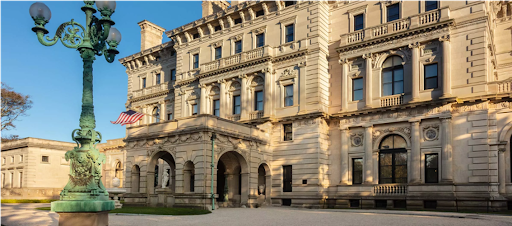
The Breakers Mansion, The Preservation Society of Newport County
When Pell Elementary School fourth graders participate in the annual “Trim a Tree” event every Christmas, the largest mansion in Newport transforms into something akin to their own personal space. The students decorate ornaments to adorn Christmas trees set up in the kitchen at the Breakers Mansion. Their families visit the mansion, receiving a private tour of the former Vanderbilt property that concludes in the kitchen. The personally decorated Christmas trees serve as the showstopping grand finale. A highly anticipated event, Petterson describes how “younger siblings will often say ‘I’ve been looking forward to this, my older sibling did it a few years ago and it’s my year now.’” Maintaining this program year-in-and-year-out helps local people from all socioeconomic classes encounter the museum in an intimate, meaningful way. The program centers local residents and encourages families with young students to see the elaborate buildings as places to make cherished memories. By centering grade-school children, “Trim a Tree” works to dismantle geographic and class barriers by creating access for Newport residents as early as childhood.
Similarly, when students from the Boys and Girls Club or the MLK Center visit the mansions during summer camps, Petterson hopes that they begin to see the museum not only as a tourist destination, but as a space for them to bring their own curiosities, passions, and interests.
Educational and family programming includes more than visiting the houses. Lectures, symposia, story time, craft projects and annual events all offer creative ways to draw people from different walks of life into these historic homes. By offering dedicated time and space for the local community, Newport Mansions staff can learn from their residents what interests them and what type of programming they would like to see. Petterson emphasized the importance of low-cost and no-cost events to help create access for working-class people. After all, without working-class people and their labor, the Newport Mansions never would have been operable. PSNC tells stories about the mansions’ laborers at several of their sites, including the Breakers and the Elms, to emphasize the importance of commemorating the area’s diverse socioeconomic history. Programming aimed at welcoming anyone in the community into these spaces seeks to underscore this duality. This balance prevents the Newport Mansions from becoming a members-only club.
Originally created for the most upper-class members of American society, Newport Mansions’ now offers meaningful experiences to a broader public thanks to the work of its staff. Petterson serves as the conduit in this endeavor, creating connections between those who live in Newport, those who visit, and those who commit to supporting the institution’s historic preservation work. By centering diverse histories within their museum spaces, institutions can help their workers create more opportunities to connect with their local audiences.
~Isla Stewart is a second-year Art History Ph.D. Student at Rutgers University–New Brunswick.