



Introduction to student interviews with public history and humanities workers
08 September 2025 – Andy Urban
Editor’s Note: This post is part of a 2025 History@Work series authored by members of the NCPH Labor Task Force in response to our Special Open Call on “#Advocacy in the Field.” You can read each post as it’s published throughout the year under H@W‘s #Advocacy tag.
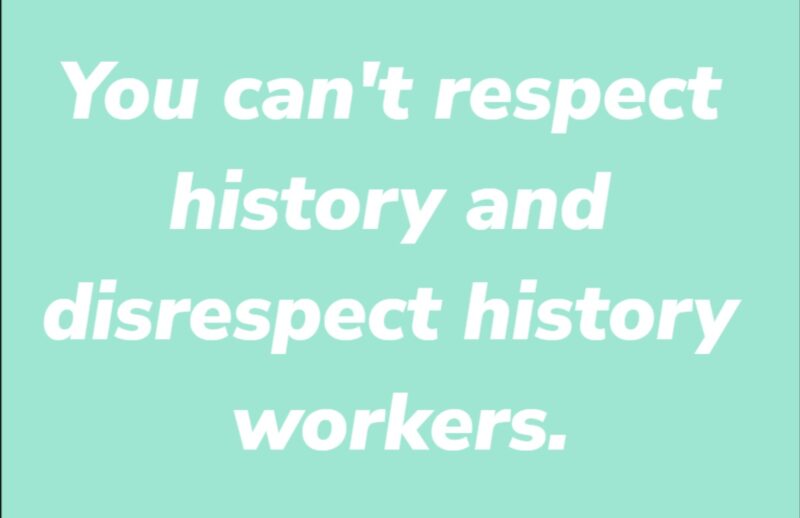
Sticker distributed by the “Empowering the Public History Workplace: Information, Advocacy, and Collective Power” working group at the NCPH conference in 2023. Image provided by Andy Urban.
When the NCPH’s Labor Task Force collectively decided to participate in this blog’s #Advocacy in the Field initiative, I immediately thought about how I might tie this opportunity to the interdisciplinary, graduate Introduction to Public Humanities course I was teaching at Rutgers, New Brunswick, during the spring 2025 semester. While the Labor Task Force has been a crucial voice advocating for professional guidelines related to fair working conditions, compensation, and access in the field, there is still much to learn about how public history workers understand the jobs they perform, and what they gain–financially and otherwise–from their labors.
A recurring conversation that emerged in our seminar, and appears in these posts as well, is how difficult it is to define what public history work is, where it occurs, and who does it. Public history, and public humanities content more broadly, is produced by professional, full-time employees at museums and cultural institutions, by scholars and their students, by volunteers, commercial establishments, and by numerous community stakeholders enlisted to collaborate on different projects. In short, public history is made by a range of actors with different motives and commitments.
Taking an inclusive view of who might be considered a public history and humanities worker–while continuing to interrogate field boundaries–the interviews that inform these posts rely on questions and concerns that labor scholars have traditionally been drawn to. Interviewees were asked, as workers in the public humanities, what exactly do they produce? How do they produce it? How does the public consume the good or service they produce, and how is that commodity–if it is to be called that–ultimately valued in exchanges? What value does the laborer derive from their contributions to the production of that good or service, economic or otherwise?
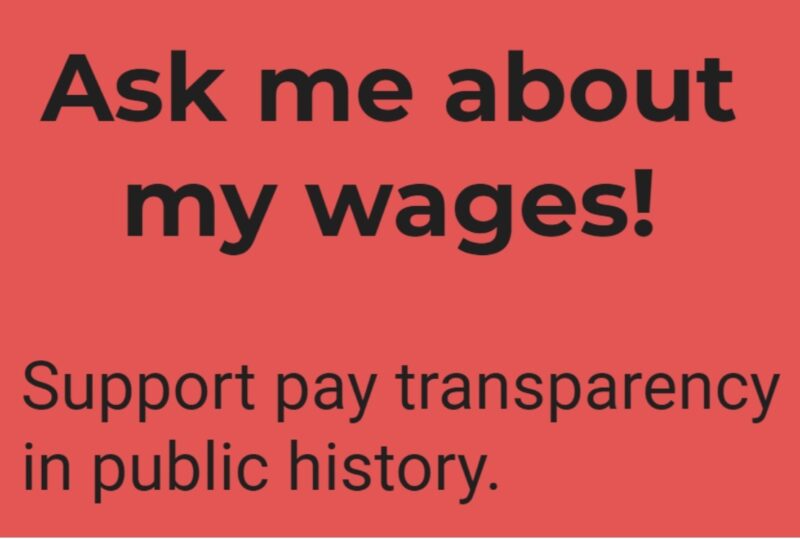
Members of the “Empowering the Public History Workplace: Information, Advocacy, and Collective Power” working group created this slogan and distributed these stickers at the 2023 NCPH annual meeting. Image provided by Andy Urban.
The emphasis in the posts is on practice and sharing interviewees’ observations about what they do at their jobs, and what their work means. The authors tease out how experience and perspective, as garnered from the interviews they conducted, can be a basis for analysis. Posts cover a range of topics–from the ethical complications that attend to compensating vulnerable community partners; to the challenges and benefits of doing contract, freelance work for museu;, to the strategies that go into generating public excitement and interest in history. We all have plenty to learn from those willing to share insights into how public history and humanities content gets made, and we hope that some of the conversations that informed these posts might be pursued in other workplaces and in classroom settings. Transparency is a necessary foundation for both advocacy and workplace solidarity moving forward.
~Andy Urban is an associate professor of American Studies and History at Rutgers University, New Brunswick. In June 2024, Andy was awarded a three-year Mellon Foundation Monuments Project grant, to support Monuments to Migration and Labor: The New Jersey Im/migrant Laborers’ Monument Project. In the face of attacks on immigrants, Monuments to Migration and Labor invites stakeholders in New Jersey to create, through collaborative and participatory processes, public art and history that celebrates the lives and stories of immigrant and migrant workers across the state, past and present. Andy’s current book project, Processing History: Labor, Capitalism, and Memory at Seabrook Farms (forthcoming, 2027), explores the history of Seabrook Farms, a frozen foods agribusiness and company town in southern New Jersey where labor exploitation and environmental pollution undergirded the mid-twentieth-century birth of a novel, “miracle” consumer product.