



Public History and Social Media
30 July 2025 – Evania Pietrangelo-Porco
What shapes public history in 2025? The answer (for me) is social media. By utilizing the online persona of The Sex Work Historian as public history, I have uncovered social media as a medium and a method of history, allowing me to see it as a path forward for some historians’ work and as a solution and problem to issues facing historians in the digital era.
The Internet is changing and shaping how historians grapple with knowledge production and dissemination, how the general public understands our work, and how our expertise is defined. My experience operating as The Sex Work Historian reflects and highlights these changes. The Sex Work Historian (2022-present) is a multi-media venture that discusses the taboo histories of sex work in often interactive and collaborative ways. I do so by blogging, connecting with people on Bluesky Social and Instagram, and streaming on Twitch. Through this work, I have learned that my followers are people generally seeking out information that is accessible and easily digestible.
The formatting and character limits of Bluesky and Instagram allow for this, making them the ideal vehicles (for some) for learning and knowledge sharing. The Sex Work Historian is seen and understood as a resource for those wanting to learn about sex work history online because I specifically designed it with this in mind. I wanted to make The Sex Work Historian as accessible as possible.
I also became a source of knowledge through my name. The image included in this post shows that I have literally labeled myself as “The Sex Work Historian,” making me a likely search result when people look up sex work history or sex work historian into Google and other search engines.
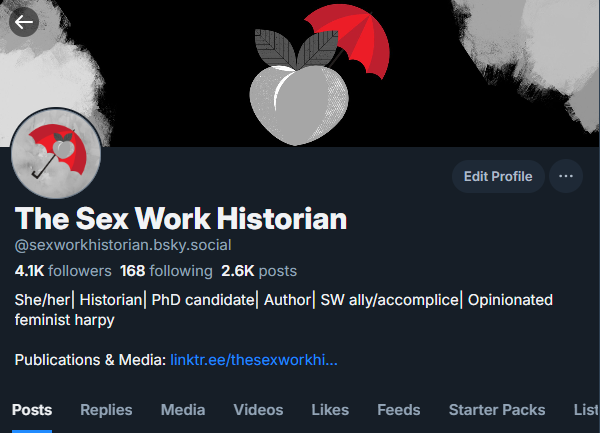
This is an image of The Sex Work Historian Bluesky containing my logo, handle, follower count, and bio. The same handle, logo, and bio are featured on The Sex Work Historian Instagram account. Photo provided by Evania Pietrangelo-Porco
With all this combined, my audience has come to understand my work by way of my sharing/accessibility and my caring. On multiple occasions, both publicly and privately, I have been told my efforts are appreciated. I discuss silenced topics and actively include sex workers and sex worker allies in the history-making process, which is important when speaking about those often treated as agentless subjects within and outside the academy. I do this by asking them the type of history they want to see, acknowledging those who play fundamental roles in sex work history and activism, sharing the resources they have given me, and engaging in sex work history with others online. I am seen as an authority because I recognize others as experts and disseminate their knowledge.
But what about credibility? If historians grapple with questions surrounding knowledge and expertise, what does credibility look like to those seeking information online? Being a digital historian means distinguishing between being an Internet historian (a historian who focuses specifically on the Internet), an “Internet historian” (those who spread false information online), and a historian who uses online platforms to share their work.
The Sex Work Historian and its credibility falls into the third category. I am made credible because of my identity, the other respected sex work scholars, activists, and organizations I follow/follow me and who like and repost my work, and, most significantly, my number of followers. All this to say, I am formally trained in history, publicly cited by other experts, and favored by the algorithm. My visibility and its ties to credibility prove troubling in this regard. When social media becomes a medium and a method, it raises further questions (that seemingly have no singular answer) about the credibility of informal knowledge produced and shared offline in an increasingly digital world. This knowledge matters. However, does it truly exist if it cannot be shared, liked, and even memed?
When it comes to being a public historian in 2025, for better or worse, visibility is the name of the game. One must put their work out there and either risk being drowned out by more algorithmically favored voices or themselves become the loudest voice in the virtual room (thereby becoming an expert by proxy of your reach). This visibility touches on yet another question of the public historian: how well (if at all) their work is communicated. If The Sex Work Historian is anything to go by, the answer is quite well.
While historians have long worked more closely with those already using archiving, oral storytelling, and museum and community-based projects to tackle this issue, they are no longer solely confined to brick-and-mortar spaces. Social media allows historians to appear virtually anywhere and in real time. Museums, archives, and even academic and non-academic institutions/entities are sharing their work, research, and collections through Instagram posts, Twitter/X and Bluesky threads, campaigns and promotions, podcasts, and livestreams.
I, for example, streamed on Twitch with Sex Workers Outreach Project Los Angeles (SWOP LA) and the British Columbia Coalition of Experimental Communities (BCCEC) for The International Day to End Violence Against Sex Workers. This 8-hour livestream collectively raised funds for both organizations while simultaneously highlighting the historical significance of December 17. This livestream and subsequent video repository (with now hundreds of views collectively) connected sex work knowledge and history with a live, highly engaged audience, allowing for the real-time creation, recording, and dissemination of collaborative/living history.
Today’s public history is not the same discipline that emerged in the late 1970s. The current education crisis has exacerbated the need for access. From mass layoffs to allegedly temporary academic program suspensions to book bannings, the dissemination of knowledge through accessible means is vital now more than ever. Although social media as a medium and method is not suitable for all forms of public history (as incendiary topics run the risk of shadow bans and attracting harmful attention online), its relative availability and ability to make information go viral solves some issues impacting historians in 2025. The Sex Work Historian proves as much.
~Evania Pietrangelo-Porco (she/her) is a sex worker ally/accomplice, author, blogger, and trained historian focusing on Canadian, feminist, North American Indigenous, and contemporary sex work history. She is a multiple national grant awardee, holds various professional affiliations, contributes to numerous journals, and, most significantly, has worked alongside many people in the sex work community.
Instagram: @sexworkhistorian.bsky.social
Bluesky Social: @tswhistorian