



Reactivating Forgotten Records: Holocaust Art Recovery in Hungary
03 November 2025 – Jonathan Schwartz
In 1944, the Hungarian government carried out two operations simultaneously. More than 430,000 Jews were deported to Auschwitz in just eight weeks, while at the same time state officials—commissioners, police, and museum staff—systematically confiscated their art collections. The records of this bureaucratized looting survived on microfilm, largely untouched for decades. Today, the Michigan-based Holocaust Art Recovery Initiative is reactivating these forgotten collections–restoring evidence, memory, and paths to restitution. For public historians, the project shows how neglected archives can be transformed: translation and AI tools make reels searchable, survivor collaboration gives them human meaning, and sharing findings through digital platforms turns dormant records into tools for justice and remembrance.
In the 1960s, Hungarian microfilm reels preserving thousands of pages of 1944 government records were deposited at the U.S. Holocaust Memorial Museum and the Zekelman Holocaust Center (ZHC) in Michigan. Few were translated or studied, until Hungarian Holocaust survivor Clara Garbon-Radnoti discovered them while volunteering. In 2019, Clara and I launched the Holocaust Art Recovery Initiative (HARI)—a public-history and restitution project that documents Holocaust-era cultural plunder, provides heirs and institutions with evidence to support claims for return, and transforms dormant archives into public resources for remembrance and accountability. Together, Clara and I–with the help of A.I. technology–translated and analyzed nearly 2,500 pages related specifically to the theft of artwork and cultural property in Hungary during WWII. In 2025, based upon the significance of our initial findings, with support from the World Jewish Restitution Organization (WJRO), the reels were made available online.
For decades, the reels had been nearly impenetrable without translation, context, and structuring. I first encountered Clara and the Hungarian documents while researching Holocaust-era art claims as an attorney. I quickly realized how little of this material had ever been studied. Clara urged that they be brought to light, and in 2025 the technology and support finally aligned to make it possible. At the outset, we expected to find scattered references to missing works. Instead, we uncovered the largest unsolved art crime in history, complete chains of custody, detailed inventories, typed and handwritten lists with artists, titles, sizes, and frames—records that prove the scale and precision of the looting. By combining survivor testimony, careful translation, and digital tools, we turned underutilized sources into a living resource–transforming an archive into public history.
Over several years, and expedited over the course of this year with the help of A.I., our team translated and transcribed the records; built databases that track paintings by artist, title, medium, and dimensions; and mapped networks of families, officials, and institutions involved in the looting. These tasks alone required countless hours of painstaking work. We then spent additional months turning the findings outward–sharing them through blogs, op-eds, articles, exhibits, and outreach—so that the evidence could move from archive to community memory.
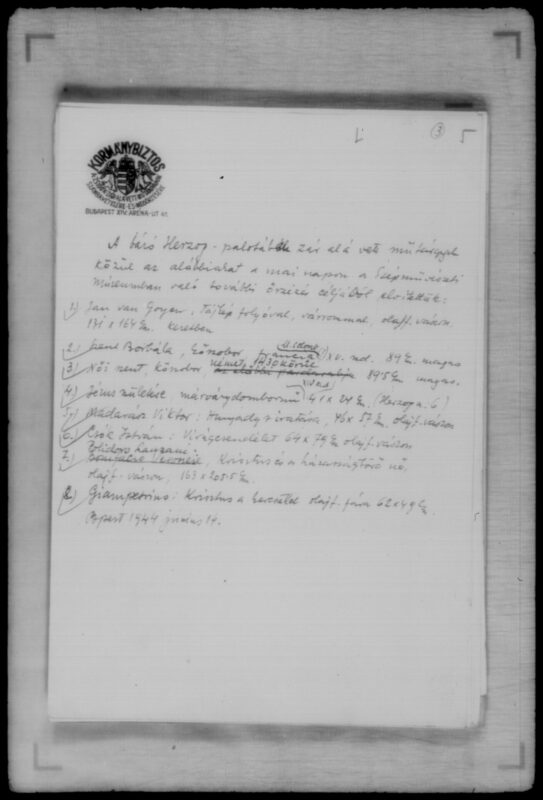
1944 Hungarian government inventory listing Jan van Goyen’s Landscape with River and Castle (131 × 164 cm, framed), seized from the Herzog Palace and transferred to the Museum of Fine Arts. Image courtesy of the Holocaust Art Recovery Initiative
This work transforms microfilm into memory. Each typed list and handwritten entry is both a catalogue and a Holocaust artifact.
The documents show not chaos but bureaucracy. Typed inventories list works with precision: artist, title, medium, size, frame. Museum transfers record the delivery of seized works into the custody of the Museum of Fine Arts in Budapest and other institutions. Petitions from Jewish owners survive (many denied) confirming that families protested but were powerless against official decrees. Together, these records demonstrate that the cultural side of the Holocaust was not incidental. It was organized, stamped, and archived. We found meticulous records that undermine the common perception of looting as chaotic wartime plunder. What the documents reveal is a state bureaucracy treating Jewish cultural property with the same meticulous record-keeping it applied to trains or taxes.
The reels include the names of both canonical artists and Hungarian modernists. One June 14, 1944 inventory from the Herzog Palace begins with Jan van Goyen’s Landscape with River and Castle (131 × 164 cm, framed). Elsewhere, a handwritten entry records Pierre-Auguste Renoir’s Seated Woman, again with precise dimensions.
This is not a rumor of wartime loss. It is a Hungarian government record, complete with artist, subject, and measurements, confirming museum custody.
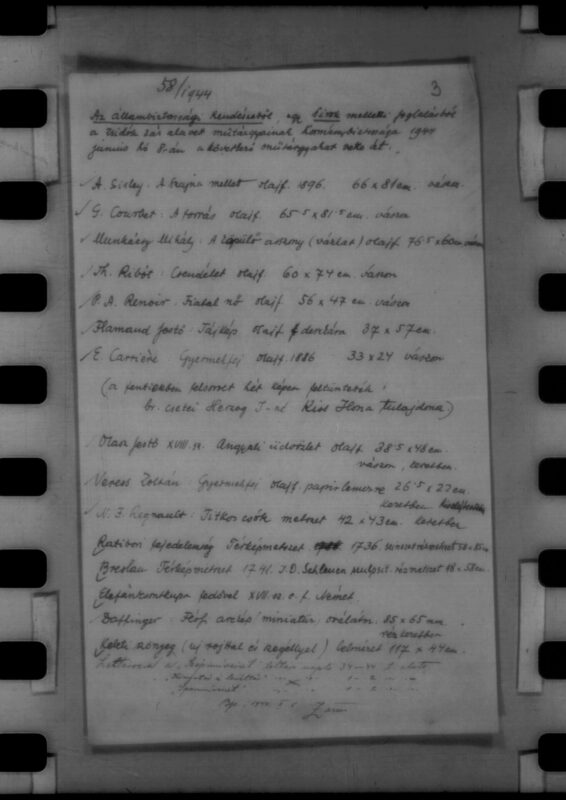
Handwritten Hungarian inventory entry noting Renoir’s Seated Woman with title, dimensions, and medium. Image courtesy of the Holocaust Art Recovery Initiative
Renoir, Van Goyen, El Greco, Rembrandt, Courbet, Munkácsy, Rippl-Rónai—the range is staggering. Each name on these reels ties the Holocaust in Hungary not only to the destruction of lives but also to the erasure of cultural heritage.
The heirs of Baron Mór Lipót Herzog have sought the return of more than $100 million worth of works through the courts, with limited success. The case, De Csepel et al. v. Republic of Hungary et al., was filed in the U.S. in 2010. While many of the claims have been pared down due to arguments over foreign sovereign immunity and other defenses, it remains ongoing, with heirs arguing that Hungarian museums still hold many of the contested pieces. Yet that case covers only a small fraction of what the Hungarian documents reveal.
The records we analyzed show thousands of works, seized and catalogued with official precision, many of which remain in Hungarian museums today. In addition to artworks, the reels document the seizure of every kind of cultural and personal property—from mineral and rock collections to jewelry, musical instruments, archaeological artifacts, household silver, religious relics, photographs, even children’s toys—all inventoried with the same bureaucratic precision. They demonstrate that cultural looting was not opportunistic theft but part of the machinery of genocide, carried out with carbon paper, typewriters, and stamps.
For public historians, the project underscores the value of reactivating neglected archives. Translation and AI tools made inaccessible reels searchable. Survivor collaboration gave them human meaning. Sharing findings through digital platforms has turned dormant sources into tools for restitution, remembrance, and accountability.
These reels are no longer forgotten microfilm. They are living records—evidence of genocide and resilience—that can restore names to victims, expose institutional complicity, and remind us that the Holocaust’s assault on identity was carried out not only with trains but also with paperwork.
~Jonathan H. Schwartz is a Detroit-based attorney and founder of the Holocaust Art Recovery Initiative (HARI), which documents and advocates for the restitution of Holocaust-era cultural property. He works with Holocaust survivor Clara Garbon-Radnoti to analyze Hungarian archival reels and bring new evidence into public memory.
Twitter: @ArtRecoveryInit