



Labors of love and organizing for solidarity within, across, and beyond the cultural industries
17 July 2025 – Amanda Tobin Ripley, Lee Bishop, Haley Bryant, Greig de Peuter, Steff Hui Ci Ling, Salma Geneidy, Carolyn Jong and Bonnie McDonald
Editor’s Note: This post is part of a 2025 History@Work series authored by members of the NCPH Labor Task Force in response to our Special Open Call on “#Advocacy in the Field.” You can read each post as it’s published throughout the year under H@W‘s #Advocacy tag.
Working conditions in the cultural sector are rapidly deteriorating—and workers are joining forces to change that. Low pay, increasing employment of casual and freelance workers (who are ineligible for union membership), diminished access to benefits like retirement and health insurance, and a lack of respect from directors and boards, all threaten the livelihoods of cultural workers. At NCPH’s annual meeting in Montreal this year, one session focused on how workers across industries are demanding structural change through an unprecedented wave of labor organizing. In this post, we share some of the highlights of the discussion: the political implications of the identity of “cultural worker”; common working conditions; how unionization supports diversity, equity, accessibility, and inclusion (DEAI); and how we are imagining new kinds of organizing and ways of working.
The panel discussion “Labors of Love and Organizing for Solidarity Within, Across, and Beyond the Cultural Industries” gathered unionization-focused practitioners and researchers in digital media, video games, art museums, history museums, and science centers in the U.S. and Canada. Participants discussed shared experiences across these sites, such as decreasing benefits and a common attitude among leadership that there is an abundance of disposable, yet willing, workers. Part of our challenge in organizing is how to re-frame this attitude so that these institutions prioritize people and distribute resources fairly.
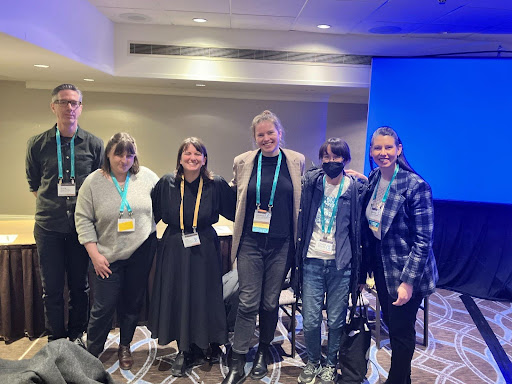
Panel participants, from left to right: Greig de Peuter, Haley Bryant, Lee Bishop, Amanda Tobin Ripley, Carolyn Jong, and Bonnie McDonald. Photo credit: Amanda Tobin Ripley
One critical step in organizing against worsening conditions is to consider a shift to thinking of ourselves as workers, aligned with the broader scope of labor first, and then as cultural practitioners. Identifying as a worker is both an enabling position and a political outcome. It is an enabling position in that seeing your work as labor instead of as a creative calling enables you to see unionization as an available tool. As a political outcome, identifying as a worker broadens class consciousness, builds solidarity, and strengthens collective organizing within and beyond the cultural industries.
During the panel, we also questioned who “counts” as working class and whether it is worthwhile to enforce those boundaries. Cultural workers may not have been considered working class in the past due to the sectors’ associations with leisure and entertainment, high educational requirements to entry, and the historical role of manual labor in labor unions. Rather than debate who is or is not working class, the more important goal is to organize and create worker solidarity. What workers ultimately have in common in all of the creative industries—and in every sector—is capitalism: its production of a class of workers who must trade their labor for a wage, and its unrelenting mandate to expand and extract profit no matter the cost.
Panelists also talked about how motivations vary between for-profit and not-for-profit cultural institutions, and how those differences contribute to the exploitation of workers. Whether we work to generate profit or serve the public good, passion is at the core of cultural work: we tend to love what we do. Devotion to our craft, however, opens us up for exploitation, because employers assume that our love for our work compensates for low pay and worsening conditions. Employers, granting bodies, federal mandates, and governance structures rely on worker passion to keep cultural industries afloat while they deflate compensation and slash benefits.
Unionization not only protects workers from this kind of exploitation by raising wages and securing better benefits—it also advances DEAI in our workplaces. Collective bargaining can lead to higher wages, transparency around institutional policies, and new protections (like sanctuary union status), which ensure equitable access to and career advancement in an industry that thrives on un- and underpaid labor. Union contracts that explicitly protect workers from identity-based discrimination and harassment may also be increasingly important in the U.S. as institutions face federal funding restrictions around DEAI.
The connection between labor unions and DEAI becomes more obvious when social justice is central to an institution’s mission. For example, because President Lincoln’s Cottage is a significant Civil War site, staff regularly interpret the history of enslavement. During negotiations, workers treated their Collective Bargaining Agreement like a mission-driven document tied to the institution. Staff negotiated with value-oriented goals (like expanding the definition of “family” in family leave to include chosen family), before moving toward concrete financial gains.
This new spike in organizing in the cultural sector expands the possibilities of our work and of collective action. During the panel, we only just began to touch on some of the radical potentials of organizing, from shifting the video games industry away from its ties to the military-industrial complex, to leveraging the high visibility of the cultural sector to spread new narratives of worker solidarity, to the development of new worker-owned cooperatives like Defector Media. We encourage readers to start their own conversations and build solidarity networks out of these discussion threads.
~Amanda Tobin Ripley, PhD, is a museum scholar and practitioner with fiften years of experience working within museum and gallery spaces to support opportunities for individuals to use the connective power of art to foster a shared sense of belonging, responsibility, and humanity. Bluesky: @amandatobinripley.bsky.social