



American World War II Heritage Cities: educating future generations on local wartime history
14 October 2026 – Sarah Nestor Lane
When I visited Waterloo, Iowa’s designated American World War II Heritage City, a local leader who supported the nomination pulled out a binder of things they hoped to accomplish: exhibits, walking tours, signage, and “Lesson plans for local schools.” There was relief and excitement when I said I would tackle the latter for the city. It matters that students learn the history of their communities to understand how national events shaped the places where they live and to inspire them to preserve and share those stories. State social studies standards across the country include state history and require students to understand the local impacts of World War II, yet there has been a gap in accessible resources tied to local themes. Without materials, teaching local wartime home front history can be daunting. Creating these educational resources is a step toward the long game: helping today’s students become tomorrow’s historians and stewards of local history.
The Heritage City lessons
The American World War II Heritage City program was established under Section 9007 of the John D. Dingell Jr. Conservation, Management, and Recreation Act of 2019. The program designates one jurisdiction per U.S. state and territory to nationally recognize the community as having made significant contributions to the war effort. I have had the privilege of serving as a consulting educator, researching and authoring lesson plans for each of the 38 currently designated cities, available at World War II Home Front Education Materials.
Each city series includes an overview and four to five lessons on that city’s home front history. Lesson topics include defense manufacturing, women in the workforce, war bond drives, civil defense preparedness, and military training. The final lessons guide students to compare cities across the country and develop a capstone project. The lessons include artifacts such as newspaper articles, oral histories, and photos, with background texts, statistics, and quotations. Each source includes comprehension and reflection questions tied to an essential question. Most lessons link to local resources with encouragement for educators to connect with them as a key part of the learning.
The lessons are freely available nationwide. They are designed for anyone educating students: primarily teachers, but also organizations such as museum programs, clubs, and home school groups. The series are connected to use with middle and high school students on state, U.S., and world history. Organizations such as local historical societies and museums have shared this was some of the first locally specific World War II education materials they had been able to provide to educators.
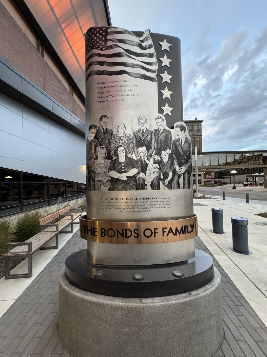
An installation in Waterloo, Iowa honoring the Sullivan brothers, who were five brothers who lost their lives together, and whose family campaigned on the home front to encourage others to support the war efforts, September 19, 2024. Photo credit: Sarah Nestor Lane
Uncovering Local History
Researching the Casper and Natrona County, Wyoming, lessons, I read hundreds of newspapers and repeatedly came across a section called “Under the Double V” in Slip Stream, the newspaper for the Casper Army Air Base. The pieces, all written by Cpl. Atlee D. Washington, shared news of the 377th Squadron, a Black unit in the segregated military. I had not previously come across columns in base newspapers written by Black units or titled to reference the Double V Campaign.
I wanted to learn more about Washington, so I sent a message through a genealogical website to someone I believed to be his son. He was, in fact, Washington’s son, and I learned I was the first person to share this part of his family’s history with him. The connection was later featured by Wisconsin Public Radio. Teachers can now use stories such as Washington’s, used as the focus of Lesson 2 in the series, to teach both the role of the local air base and the service of African American service members, and to inspire students to dig into other lesser-known histories.
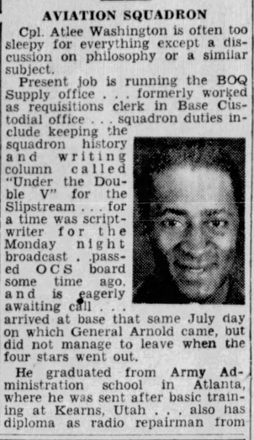
Biography of Cpl. Atlee Washington, noting his writing for “Under the Double V,” in the Slip Stream newspaper for Casper Army Air Base, Casper, Wyoming. December 8, 1943. Image credit: Casper College Goldstein Foundation Library Western History Center Digital Collections
In Camden, Arkansas, Teresa Harris of the Ouachita County Historical Society sent me scanned copies of their Historical Quarterly, including a firsthand account by a family who lost their land and home through eminent domain to build the local defense industry complex. That account became an important reading in Lesson 2 of the Calhoun and Ouachita Counties series. This perspective is one that would not usually be covered in a national textbook. Recently the area was in the news for modern defense production, making the lessons more relevant still.
For the Lewistown, Montana, lessons I joined a community Facebook group and introduced the project. Most comments pointed to someone described as a resident historian, Gary Yaeger. Gary shared dozens of photos and reminiscences with me by messenger and email of growing up on the home front, including hearing B-17s training over his family’s ranch, a sound he said he “shall NEVER forget.” His stories became a key part of a lesson in that series. Gary passed away in February 2025. Going back through our messages, I found his reply after I told him the lessons were live: “Thank you for the efforts you put forth to preserve history!” Students can now learn from his childhood stories of growing up on the home front.
Lesson Implementation
Valley City, North Dakota, shows what implementation can look like. I visited the Barnes County Historical Society exhibits and mural, as well as the city’s World War II guided walking tour. I provided the lessons to the historical society and joined a call with the public-school district’s leadership and teachers, hearing their ideas for using the content to teach local history and connect it to the walking tour, artwork, and a historical society visit in the coming school year.
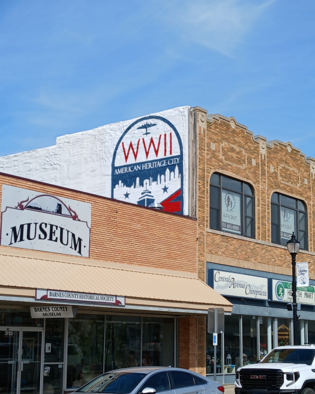
Photo: Heritage City mural in downtown Valley City, North Dakota. August 29, 2025. Photo credit: Wes Anderson, Barnes County Historical Society
My hope is that students learning from these lessons become inspired to connect to local people and places in ways that help preserve and share lesser-known stories to strengthen and advance their local communities. By having these resources available, educators can help students see that history is not only a national story found in textbooks, but also a collection of stories rooted in the people and places in the communities where they live. This is the next generation of historians and community members who will serve on local history committees and volunteer at their historical societies. That is the long game of lesson plans, and it is worth the wait.
~Sarah Nestor Lane is a National Board Certified Teacher who served as the consulting educator and author for the World War II Home Front Education Materials, funded through the National Council on Public History’s cooperative agreement with the National Park Service. One of her first lessons drew on the story of her grandmother, a World War II cryptologist.