



I just think they’re neat! Creating 3D prints and AR models for museum education
01 October 2026 – Kevin Lukacs
3D printing, object-based learning, museums, technology, material culture, digital projects, augmented reality (AR)
Three-dimensional (3D) scanning and printing technologies are becoming more accessible than ever. Current-generation smartphones have built-in LIDAR (using pulses of light to measure distance) and many local libraries have 3D printers. While this technology has become more common in daily life, its use in museums is developing slowly but surely as costs lower and software becomes more accessible. At the Daughters of the American Revolution (DAR) Museum, we believed that 3D technology could be the next major frontier for education initiatives, and have invested in this technology to create both physical and digital interactives.
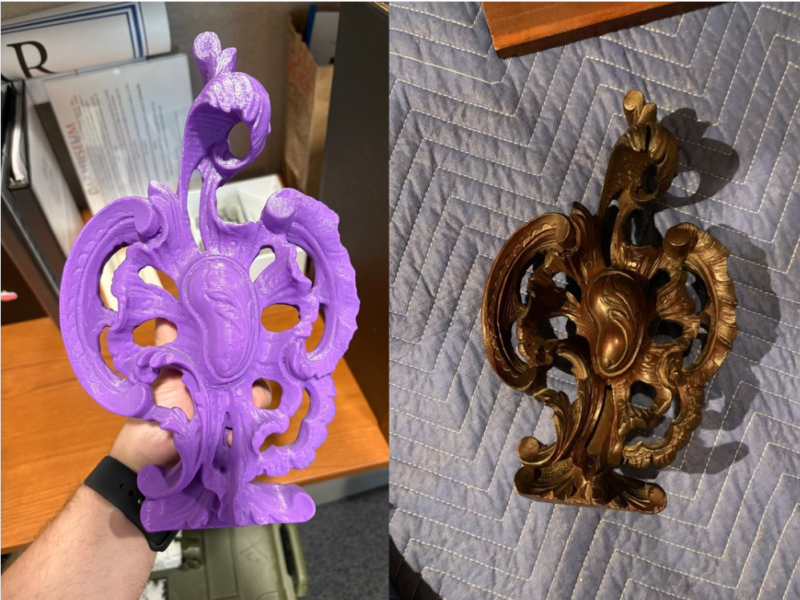
The Philadelphia cartouche was a common embellishment on various furniture items in the nineteenth-century rococo style. We chose a bright color for the 3D print to exaggerate its role as a toy and interactive, and not as a facsimile or object that needed careful handling. Years of “no touching” has caused museum visitors of all ages to be hesitant even to touch objects we feel were clearly interactive. Photo credit: Kevin Lukacs
It all started with a desk and bookcase from Philadelphia, made in 1776. The bookcase features a beautiful carved symbol, or cartouche, at the very top of its eight-foot-tall frame. More than just a pretty piece of pizzazz, the cartouche demonstrates American involvement with, and interpretation of, the Rococo movement, modern art at the time of the Revolution. The DAR Museum utilizes the cartouche to facilitate conversations on the development of artistic movements and the robust tradition of craft in the colonies. This cartouche was in the back of a period room at the top of the tall desk and bookcase, practically invisible to many guests. Yet the symbol, emblematic of a Philadelphia style during the Revolution, had a big story to tell. We created a 1:1 3D model by using LIDAR scanning and a 3D printing machine from some colleagues at Virginia Commonwealth University. This enabled us to put the cartouche into visitors’ hands, letting them really appreciate the details and craftsmanship up-close. It made the object more real, more personal, and more exciting.
The success of this endeavor led the DAR Museum to purchase its own scanning device and 3D printer. We began scanning textile objects, such as an 1890s gown that was featured in an exhibit. The gown was turned inside out so that visitors could see the construction, but due to the color of the gown and lighting in the exhibit, it was difficult for many visitors to see and appreciate those details. With a scaled-down 3D printed version, visitors could see and feel even tiny details. This tool also allowed visitors to experience multi-sensory learning that is more effective than learning through visual or audio alone.
Software using 3D models also helped us to meet visitors halfway when it came to requests to see more historical clothing. The DAR Museum’s textile collection is its most popular, yet mannequins with period clothing are rarely displayed in the museum’s period rooms due to safety concerns. We used 3D scans of period clothing to make augmented reality (AR) models so that visitors can interact with the gowns. Using the Smartify museum exploration app, visitors are able to project true-to-size AR models of the gowns into any space, be it the period rooms or their homes or classrooms. They can examine the gowns, viewing the texture and rich colors of the fabrics.
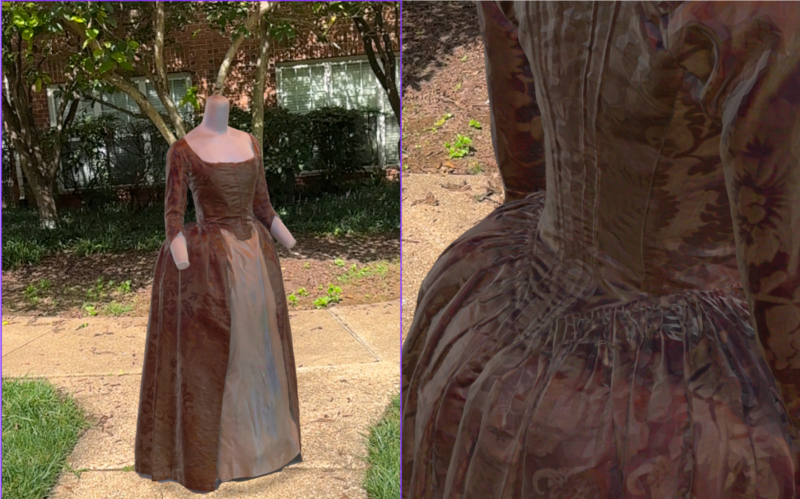
This dress was made between 1740 and 1785. It is silk damask in an English style. Projecting the AR image onto the sidewalk lets me walk around it, and even zoom in on the details. When I was done taking screenshots, I instinctually went to pick the mannequin up off the ground, forgetting it was only a digital object on my phone screen. AR models have incredible potential for interactivity. Image credit: Kevin Lukacs
The project was still in its early stages as of 2025, but a working group of objects can be used and viewed online. If you pull up the links below on a phone or tablet, you’ll have the option to view a detailed digital model or utilize augmented reality to view the model in your space.
- Silk Dress, 1860 (For provenance, click here)
- Silk Damask Dress, 1740-1785 (For provenance, click here)
- Child’s Dress, 1780-1795 (For provenance, click here)
AR is a great option for visitors to engage with objects without introducing potential harm, or to bring museum objects to distant audiences. While creation of 3D models is increasingly accessible and has the potential to be an incredible digital tool for object-based learning, augmented reality tools remain relatively expensive. As with any museum experience, it is important to have a strong, intentional interpretive purpose when using this technology. While it’s tempting to begin 3D printing every little thing in the museum, it’s also critical to remember that every interactive should have purpose and meaning. 3D prints are an incredibly cheap way to make little toys for visitors to interact with, but they should function as more than a distraction or clutter in interactive spaces. As with all objects in the museum, we want to avoid shallow and scattered interpretation and instead search for personal connection and meaning. While many 3D printing materials are easy to recycle, we still want to avoid wasteful use of plastic materials. The technology should be used intentionally and meaningfully, fulfilling a purpose that cannot be met by the object alone.
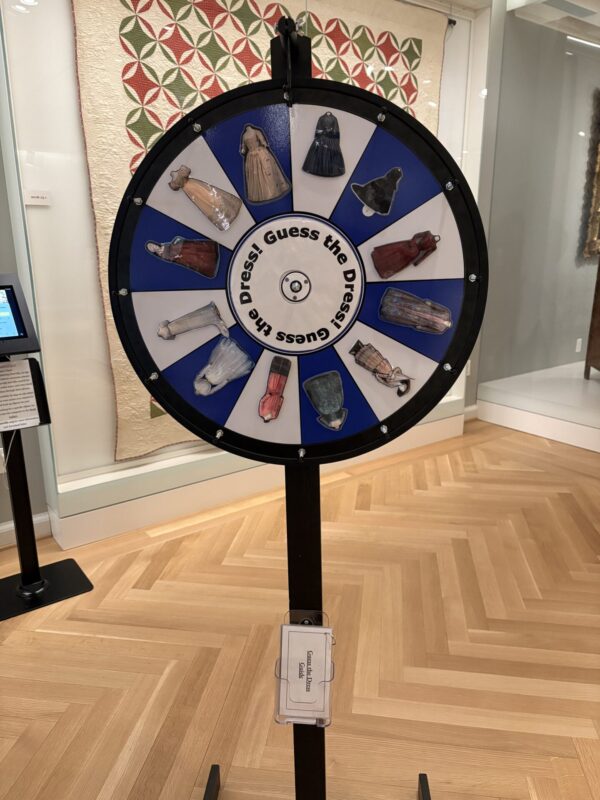
The 3D prints were presented alongside other games and interactives in the Study Gallery, like Guess the Dress. This popular game involved visitors guessing the decade in which a certain gown (determined by spinning the wheel) was made, after which they could earn a seasonal sticker. Photo credit: Kevin Lukacs
Now is the best time to start exploring this technology. A host of 3D models for printing or digital use are already available online through the Smithsonian and other educational sites. 3D scanning and photography apps are increasingly accessible through modern smartphones, and accessing a 3D printer could be as easy as popping into your local library. Object-based learning is at the heart of museum education and nothing will replace the connection and resonance of interacting with physical objects. Yet, as new technologies surface and become accessible, they add to a robust repertoire of tools that can aid in accessibility, outreach, and are also just . . . fun! It’s always good to find new ways to have fun. How could your educational experiences benefit from 3D digital or physical interactives?
~Kevin Lukacs is a public historian and museum educator working in the D.C. area. He does contract work and consulting for education and nonprofit leadership. You can read more about his work on comic books, horror, and working with students and local communities at History@Work.