



Fihris: the revolutionary Arabic manuscript transcription tool
04 August 2026 – Loren Weiss and Lindsey Waldenberg
Digital Preservation, archives, Artificial Intelligence (AI), project showcase, Digital humanities, Translation, Lebanese Diaspora
Researchers and the public alike face significant physical and language barriers when accessing archival content. To address this, the Khayrallah Center released Fihris.org—a free resource for searching and translating the thousands of pages of Arabic manuscripts held within its Nassour Archive of Lebanese Diaspora—in spring 2026.
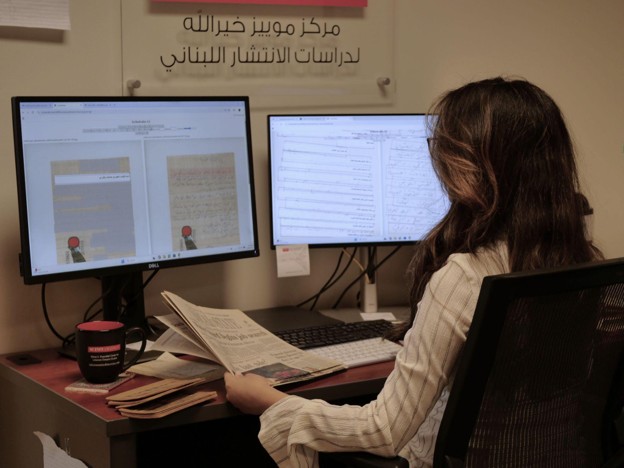
The Khayrallah Center Archive Assistant, Rama Khalifeh, reviews ScribeArabic’s transcriptions in May 2026. Photo credit: The Khayrallah Center.
Powered by a proprietary artificial intelligence (AI) model, Fihris, which means index/catalog in Arabic, allows users to search through the Nassour Archive’s Arabic manuscript images, transcribe them into digital text, and translate them. The program offers translation into English, French, Spanish, or Portuguese, providing a resource for the Lebanese diaspora in North and South America to search and read Arabic content without needing to know the language.
The project began two years ago with the creation of ScribeArabic, an AI program that annotates and transcribes images of Arabic manuscripts. Developers placed more than 500 manually transcribed images into ScribeArabic, then began an extensive training process involving manual cleanup of the AI predictions. This process ensured that the program could recognize various formats and handwriting styles. After 12 months of training, the model achieved 85–95% accuracy, and the team expanded the dataset to account for over 4,000 images. The final goal is for users to submit images of their own Arabic manuscripts, requiring a highly trained program to recognize and accurately transcribe all kinds of Arabic handwriting.
New manuscripts are regularly uploaded, and their transcriptions are checked and confirmed by expert on-site Arabic editors to ensure linguistic accuracy and to maintain the integrity of the represented communities and historical actors. By combining careful human oversight with computational methods, Fihris ensures that this data search and retrieval system is responsible, reproducible, and respectful of the historical record. More information on the development process can be found in an interview with Arabic for Nerds, where Khayrallah Center director Dr. Akram Khater and project lead scientist Dr. Mehreen Saeed discuss the paths taken to the first stage of Fihris’s release.
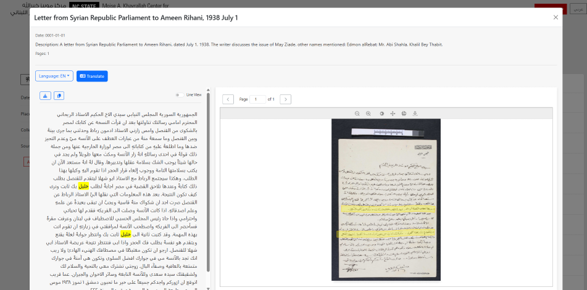
This screenshot of Fihris.org’s interface shows one of the results for the search term “Khalil.” Photo credit: The Khayrallah Center.
Developers next plan to integrate the center’s newspaper database, ArabicSearch, with Fihris and ScribeArabic to apply the same transcription and translation capabilities to the repository’s 450,000+ newspaper pages. This database includes more than 70 collections of Arabic books and newspapers, as well as newspapers involving the Lebanese diaspora. Analytics data from both Fihris and ArabicSearch show that most user queries focus on finding the names of people, tribes, cities, and other locations. Integrating the two platforms would broaden the scope of search and enable users to discover information not only from personal accounts preserved in handwritten manuscripts, but also from newspapers and magazines published during the same period.
Fihris supports the Khayrallah Center’s mission to advance, preserve, and share the history and experiences of the Arab diaspora in the United States and around the globe. Since 2014, the center has created and hosted an array of easily accessible resources dedicated to furthering knowledge of the Arab diaspora, as demonstrated by its Arab American Labor digital humanities project. To explore the Khayrallah Center’s projects, databases, and other initiatives, visit lebanesestudies.ncsu.edu.
~Loren Weiss is the Communications and Outreach Manager at the Khayrallah Center.
~Lindsey Waldenberg is the Director of Research at the Khayrallah Center.