



Learning Across Landscapes: Building Global Public History Partnerships in Scotland
08 January 2026 – Carolyn Barske Crawford
The University of North Alabama’s (UNA) summer study abroad experience in Scotland demonstrates that regional universities can create meaningful international public history experiences for their students. Co-led by public historians from UNA and archaeologists from Historic Environment Scotland (HES), the program gives students a rare opportunity to work directly with international heritage institutions, applying classroom skills to research, interpretation, and community engagement. What began as a field documentation course in 2015 has evolved into a laboratory for public history practice, encouraging students to consider how the past is preserved and shared in a global context.
The program grew out of Dr. George Makowski’s long-standing relationship with HES, which began in 2011 through his interest in the cultural heritage documentation work of Scotland’s Rural Past program. This initiative empowered communities to record abandoned rural settlements through archaeological surveys, photography, sketching, and archival research, serving as the basis for the first iteration of the program. When I joined the trip in 2018, we broadened the curriculum to include museum studies and historic site interpretation across the two-week course. Our students began working with curators and interpreters at the Scottish Crannog Centre (SCC) in 2023, expanding a partnership that began with earlier museum visits in 2015 and 2018.
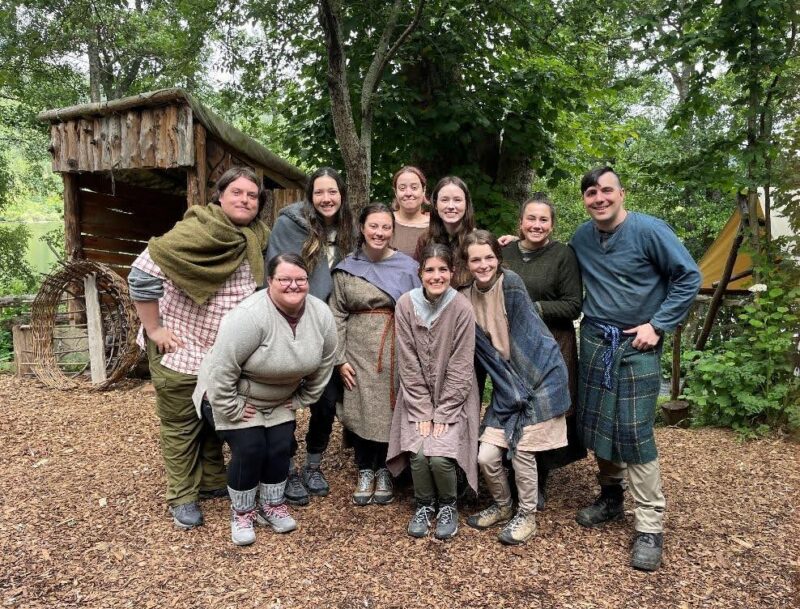
UNA students volunteering at the SCC in 2023. Image credit: Carolyn Barske Crawford
While in Scotland, students contribute to ongoing research: mapping historic sites for inclusion on HES’s Trove database (including the Acharn and Kinnell stone circles, Allt Mhucaidh hut circle, and a farm site at Cloichran) and interpreting prehistoric lifeways for SCC visitors. They have also prepared a site evaluation report for SCC staff to support future interpretive efforts. Beyond fieldwork, students meet with professionals and conduct research at the National Records of Scotland (NRS), the National Library of Scotland (NLS), and the National Museums of Scotland (NMS). These partnerships are at the heart of the program—built slowly over time and strengthened with each return trip.
Why the International Setting Matters
During COVID-19, we replicated elements of the Scotland program in Alabama—mapping historic landscapes and visiting regional museums to explore preservation and interpretation practices—but the experience produced different outcomes. In Scotland, students work within a national heritage framework where archaeology, archives, and museums are closely integrated. Cultural heritage resources—landscapes, sites, records, traditions, and language—are understood as a shared national inheritance, and their preservation for future generations is considered a government responsibility. In the United States, the word heritage often carries a different connotation, rooted more in personal or group identity than in the cultural landscape. Preservation here is shaped by a patchwork of state and local responsibilities operating within federal policy frameworks, with much of the work falling to nonprofit organizations rather than government agencies. Without the international comparison provided by Scotland, students working only in Alabama lacked the broader context that helps illuminate both the possibilities and limitations of heritage practice in the United States.
Building on this comparative perspective, experiencing heritage interpretation abroad sharpens students’ awareness of the value of public history. In visiting a variety of museums with varying levels and methods of interpretation, students see how public historians add context, critical inquiry, and narrative depth to heritage spaces, transforming preservation into meaningful interpretation. Interpreting another nation’s history also challenges assumptions about ownership of the past and opens conversations about cross-cultural storytelling. In Scotland, every interaction with an SCC interpreter, a HES archaeologist, or an NLS curator becomes a case study in how history is negotiated and shared. Being abroad positions students as observers rather than participants in the heritage system, providing a distinct vantage point from which to reflect on both the gaps they encounter and the significant contributions public historians do make.
The international setting also fosters exploration and growth. Students strike out across Edinburgh, kayak and sail on Loch Tay at the University of Edinburgh’s Firbush Outdoor Centre, and build friendships in both the city and the Highlands.
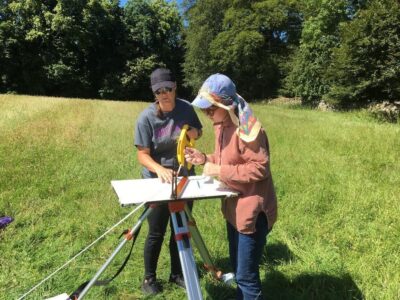
UNA students Lacie Rowe and Sarah Hicks map the Kinnell Stone Circle site with HES in 2018. Image credit: Carolyn Barske Crawford
Institutional Support and Program Goals
The Scotland program is grounded in core goals: experiential learning, professional skill development, and partnership building. We want students to understand the diverse methods historians and heritage professionals use to gather, interpret, and present the past. By framing the trip as a field school in public history, we demonstrate its academic rigor and its alignment with the university’s strategic goals for global learning.
These outcomes have resonated with UNA administrators and our partners. Tangible student work products, meaningful professional engagement, and long-term institutional partnerships—all of which raise UNA’s international profile—benefit both students and the university. Our program has shown that study abroad, when rooted in collaboration and applied research, is an investment in both educational outcomes and institutional reputation.
Accessibility and Student Support
Study abroad is often viewed as inaccessible, especially for students at regional universities who may come from lower-income backgrounds. For some of our participants, the trip is their first time on a plane. Preparing students for the experience logistically and emotionally is part of the learning process. We meet monthly in the spring to review packing lists, travel plans, cultural expectations, and to build community before leaving for Scotland. These sessions also introduce the fieldwork methods used during our site documentation work.
To keep costs manageable, the program charges a single fee covering housing through the University of Edinburgh, flights, in-country transportation, site admissions, and most meals, while tuition remains at UNA’s regular summer rate. Students offset expenses through UNA Study Abroad Scholarships (typically reducing costs by about $1,000) and through the UNA Quality Enhancement Program, which funds mentored research and experiential learning. Beginning in 2025, we also helped students secure sponsorships from local organizations and community members. In return, students present to sponsors or create short videos showcasing their work, which helps to promote equity and also strengthens ties between community partners and our students.
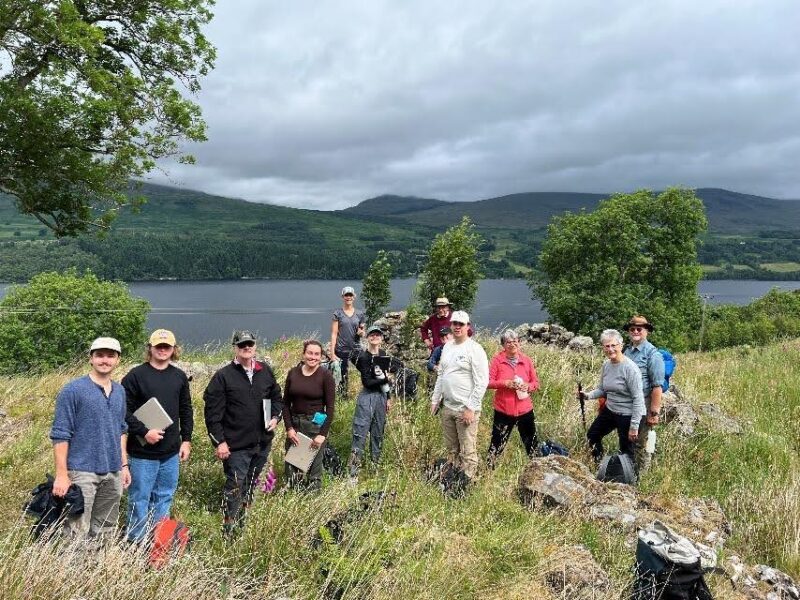
UNA students and faculty with archeologist Adam Welfare of HES at the Cloichran Farm Site in 2025. Image credit: Alex Hale
Lasting Impact
The long-term outcomes underscore the program’s influence on our students. Alumni have pursued graduate study in public history and archaeology, and many now work in archives, historic sites, and cultural nonprofits across the Southeast. Students routinely highlight the Scotland experience in applications and interviews, citing both the technical skills they gained and the confidence that comes from working with international partners. For UNA’s public history program, this collaboration broadens our understanding of what doing public history can involve. Public history is inherently relational—built on reciprocity and sustained through collaboration. Our students contribute research and labor, while partners open their sites, share expertise, and welcome new perspectives. Each trip deepens that exchange. As the program evolves, our partners remain committed to fostering stewardship, humility, and purpose in our students—qualities that will guide them throughout their public history careers.
~Carolyn Barske Crawford is an assistant professor of history at the University of North Alabama, where she leads the graduate program and teaches public history, environmental history, and women’s history. She founded UNA’s public history program in 2012 and later directed the Muscle Shoals National Heritage Area from 2017 to 2024 before returning to the department.