



Quechua throughout the globe: a conversation with Américo Mendoza-Mori
28 October 2025 – Paul Montjoy Forti
Editor’s Note: This post is part of a 2025 History@Work series authored by members of the NCPH Labor Task Force in response to our Special Open Call on “#Advocacy in the Field.” In addition, this piece is part of a series based on Rutgers University student interviews with practicing public historians. You can read each post as it is published throughout the year under H@W‘s #Advocacy tag.
I never had the opportunity to learn Quechua, the Indigenous language of the Andes, at my high school in the north of Perú, but I did learn English. This is a common story among Peruvians, especially those from the coast. Américo Mendoza-Mori wants to rewrite this story. Mendoza-Mori is a Quechua scholar at Harvard University. He is developing innovative academic and community initiatives with the Quechua diaspora in both Latin America and the U.S.
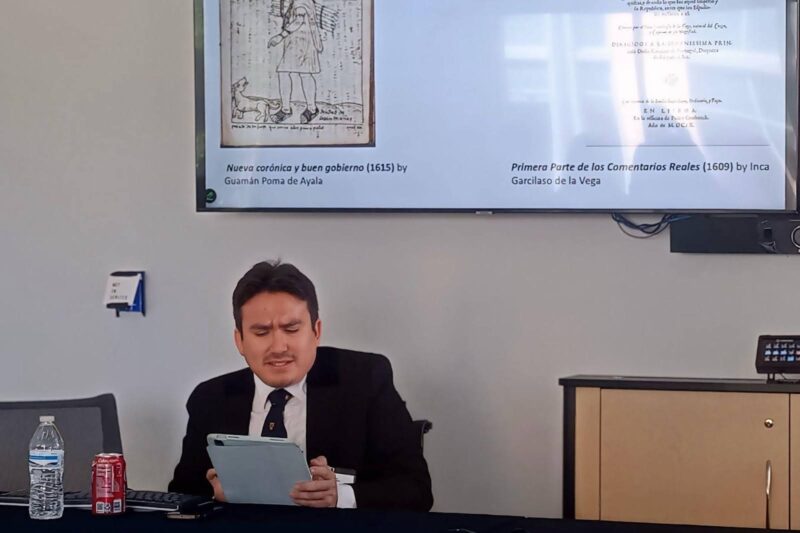
Américo Mendoza-Mori at the first Andean-Amazonian Symposium at Rutgers University. Photo credit: Paul Montjoy Forti
The Quechua diaspora is made up of native Quechua speakers and those of Quechua heritage who emigrated due to economic, social, or political conditions in their country of origin (including Perú, Bolivia, Ecuador, and other Andean countries). Mendoza-Mori developed the Quechua Initiative on Global Indigeneity that is focused on preserving Indigenous knowledge, creating spaces for Indigenous languages, and teaching students to integrate Indigenous perspectives in their academic work. He also works with the Quechua Alliance, a grassroots platform that meets annually. The Alliance has created awards to celebrate activist works that promote Quechua cultures. “These efforts fight against the notion that Quechua is peripheral. My goal is to center them in the educational and cultural discourse,” Mendoza-Mori says. He also fosters key connections between educational institutions, Quechua scholars, communal leaders, and artists. Mendoza-Mori’s work goes beyond the classrooms: it is an example of how academics and intellectuals can support public communities’ initiatives and promote changes in public policies to uplift a historically marginalized group of people. Mendoza-Mori and I met at the first Andean-Amazonian Symposium at Rutgers University.
After it became independent in 1821, Peru adopted Spanish as its official language. Quechua was marginalized. “Language was, and continues to be, used as a tool of social and cultural exclusion,” says Mendoza-Mori. Non-Spanish-speaking communities were excluded from the development of Peru into a nation-state. “[The exclusion was] not only physical but structural and epistemic, involving the silencing of knowledge systems, community practices, oral traditions, and cosmologies related to Indigenous languages,” Mendoza-Mori affirms. Losing ancestral knowledge due to Westernization is a problem that makes it difficult for Peruvians to explore our own identity and cultures.
The marginalization of Indigenous knowledge is why I never had the opportunity to learn Quechua. “The educational system has not implemented structural changes to meaningfully include Quechua in the national curricula,” Mendoza-Mori explains. “While English is seen as key to global citizenship, Quechua is often deemed irrelevant.” In Peru, it is easier to learn English or French than an Indigenous language, and it is easy to find politicians who refer to Quechua as a language of the past and not one of “progress.” But Quechua is not part of the past; it is the present and the future. Now, in contrast to what is happening in Peru, some U.S. institutions like the University of Pennsylvania and Harvard have implemented Mendoza-Mori’s initiatives and are offering Quechua language classes to their students.
Mendoza-Mori’s work takes place in different spaces: from the Andes to the U.S. (there are an estimated 10,000 Quechua speakers in the New York City area alone); from universities to community centers; from Indigenous epistemology research to Indigenous activist work. In Peru, a country with severe economic inequality and systemic discrimination, it is urgent that scholars work in public to advocate for change. “Scholars must co-create spaces in which Indigenous peoples are agents of knowledge and visibility, [and] push for policy changes,” Mendoza-Mori argues. Non-Spanish speaking communities are underrepresented in Peru, which affects how public policy is made. Better Indigenous representation in Peru and other Andean countries would allow the discussion of urgent problems facing Indigenous communities, such as language preservation, human rights, access to public services, and protection of our cultural heritage.
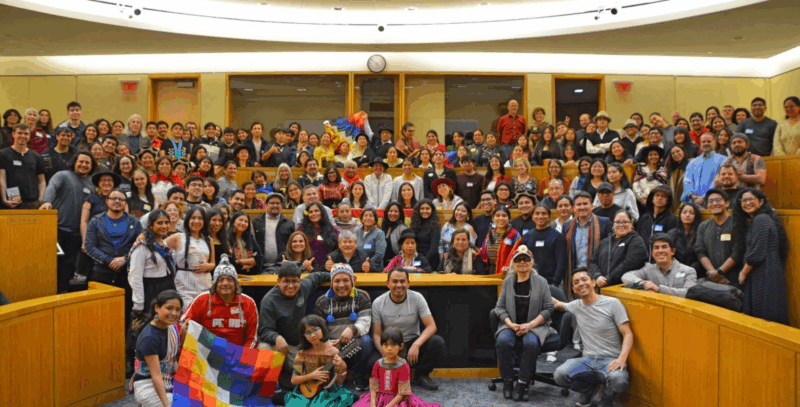
The 7th Annual Meeting of the Quechua Alliance at Harvard University, Boston, MA, April 1, 2023. Photo credit: thequechua.org
Understanding that Quechua is part of a vibrant diaspora that enriches U.S. culture is key during a time when there is pushback against diversity, equity, and inclusion (DEI) in political and cultural institutions. “[Quechua speakers] maintain traditional practices, organize community events, and revitalize the language. . . . Quechua speakers promote intercultural dialogue, challenge monolingual ideologies, and promote knowledge systems rooted in reciprocity, ecology, and resilience,” Mendoza-Mori comments. Mendoza-Mori’s work is changing perceptions about Quechua culture and its claim to public and academic spaces. Unseen cultural work is vital to preserving culture, strengthening democracy, and promoting human rights. Younger generations are renewing Quechua identity in poetry, music, art, and community organizing. “[The Quechua speakers in the diaspora] are not just preserving a past; they are crafting a future in dialogue with their counterparts in the Andes,” says Mendoza-Mori.
Mendoza-Mori provides a refreshing and realistic view of Quechua communities and their movements around the U.S. and the globe. Mendoza-Mori’s work reminds us that it is necessary to facilitate public discussions, represent and empower community leaders, and incorporate and preserve Indigenous knowledge when working in the public humanities. Advocating for diversity is indispensable to building a better society. I invite you to read the complete interview.
~Paul Montjoy Forti is a writer, researcher, and a PhD student in the Spanish and Portuguese Department at Rutgers University. He coordinates the Andean-Amazonian Working Group at the Center for Latin American Studies (CLAS) at Rutgers University.