



Editor’s Corner: the work of public history
01 May 2026 – Sarah H. Case
discrimination, government, equitable hiring, The Public Historian, labor task force, gender/sexuality, TPH48.2, labor, surveys, Editor's Corner, working group
Editors’ Note: We publish the editor’s introduction to the May 2026 issue of The Public Historian here. The entire issue is available online to National Council on Public History members and others with subscription access.
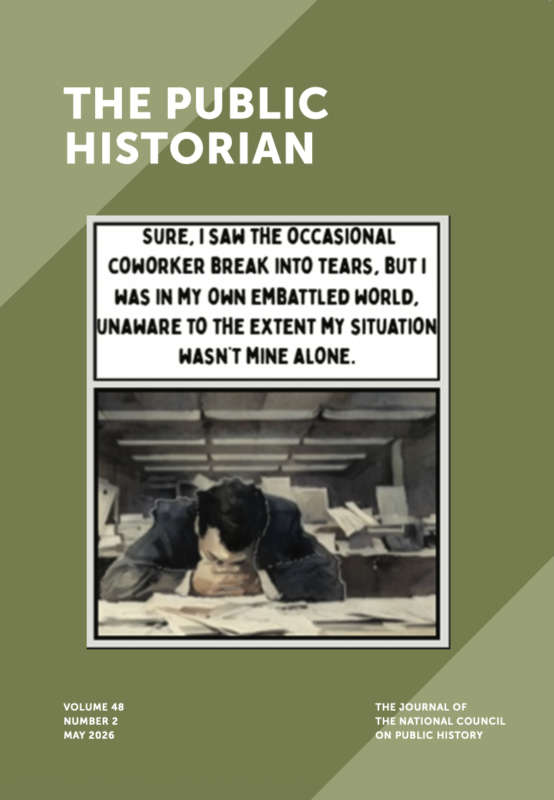
This cover of this issue of “The Public Historian” features a panel from John Fulton’s comic, “History and Solidarity: A Union Story.”
Our special issue, “Public History and Labor,” takes a careful look at the work of public historians. Guest editors Alena Pirok and Andy Urban have expanded the conversation about labor, pay, workplace conditions, and conflict that began as part of the National Council on Public History’s (NCPH) working group “Empowering the Public History Workplace.” The issue asks why public historians have done little to critically examine the conditions of their own labor as well as the class inequities that shape work in humanities fields. Urban provides an overview of the issue’s themes and contents in the issue’s introduction, while Pirok offers a close read of our journal’s lack of attention to issues of labor over its first forty-eight years. Next, Amy Tyson highlights the work of freelance first-person interpreters who work outside of traditional historical sites (in libraries, community centers, and retirement centers, for example) and underscores both the significant amount of effort that goes into this work and its precarity as part of the gig economy.
Three reports from the field then examine sites in Washington, D.C. Lauren Rever discusses the role of guides at the U.S. Capitol Visitor Center, work that combines interpretation with the specific stresses of working in the seat of government with visitors who range from indifferent to hostile. Former employees of the museum of the Daughters of the American Revolution detail the process of convincing the organization to hire professional educational staff, only to see new leadership cut those positions and resist inclusive programming. More hopefully, Haley Bryant and Joan Cummins relate their experience unionizing President Lincoln’s Cottage and offer strategies for successful organizing efforts at cultural institutions. We then follow with a new format for The Public Historian, a comic, by John Fulton, which examines the process and difficulty of unionization. A panel from the comic is our cover image. The final two articles examine labor and inclusion. A roundtable by members of the Lived Experience Working Group highlights the structural inequalities in museums and other public history workplaces that disabled people face and offers recommendations for more accessible workplaces. In her discussion of the surveys created by NCPH and AASLH on gender discrimination and sexual harassment, Mary Rizzo finds that the economic precarity of historical institutions contributes to reliance on “power brokers,” including leaders, board members, and donors, who too often take advantage of their influence to perpetuate gender-based inequality. The issue also includes the NCPH’s Labor Task Force Statement and Recommendations on Labor and Public History. The pieces in this issue are attentive to public historians’ ongoing difficulties and setbacks in the workplace and also provide models of success and paths forward to greater accessibility, equality, and support.
~Sarah H. Case, the editor of The Public Historian, earned her MA and Ph.D. in history at the University of California, Santa Barbara, where she is a continuing lecturer in history, teaching courses in public history, women’s history, and history of the South. She is the author of Leaders of Their Race: Educating Black and White Women in the New South (Illinois, 2017) and articles on women and education, reform, and commemoration.