



NCPH’s Asian American and Pacific Islander Working Group
09 March 2026 – Lily Anne Tamai and Michael Yee
Since the 1970s, community groups—often working alongside professional historians—have created a growing number of public history organizations, including museums, archives, and preservation groups to document, preserve, and share the histories of their communities. Notably, the growth of public history developed in tandem with the growth of Ethnic Studies. This led to the creation of specific institutions dedicated to ethnic groups, like Asian Americans and Pacific Islanders, including the Japanese American National Museum and the San Diego Chinese Historical Museum.
While public history and Ethnic Studies have grown in parallel, there has been little formal collaboration between the two on a national scale. Further, there is still a paucity of AAPI history outside of museums dedicated to specific AAPI groups. Though there are more AAPI public historians in museums, archives, and historic preservation than ever before, they still lack visibility and parity with other underrepresented groups in the U.S. and Canada. This blog post documents the work undertaken by NCPH’s Asian American and Pacific Islander Working Group over the last few years to grow the presence of AAPIs in public history. In it, we explain the planning, networking, and community-building work we’ve done across disciplines and national borders. We also highlight the tools we have developed for non-AAPI organizations to grow their engagement with AAPI history. We hope our work can serve as a model for other underrepresented ethnic groups who wish to grow their presence in the field of public history.
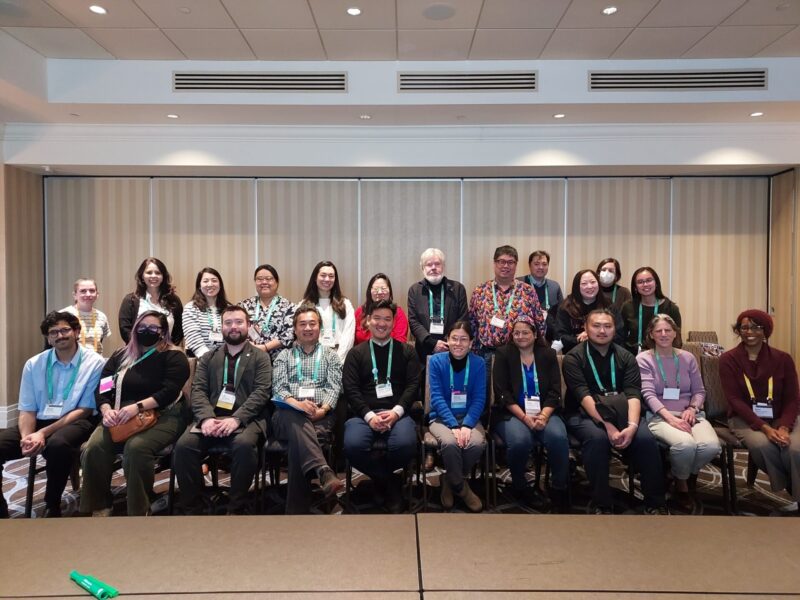
The NCPH AAPI Working Group at the Montreal Conference in 2025. Photo credit: Lily Anne Yumi Tamai
This blog post highlights the efforts undertaken by the members of the Asian American and Pacific Islander Public History Working Group between the annual conferences of the National Council on Public History. Many of the working group’s members are both public history professionals and academics working in Asian American Studies. Others are community advocates and allies. Everyone in the working group recognized the importance of increasing the presence of AAPIs within the field of public history and within NCPH. Documenting the working group’s efforts in 2023, prior to the annual NCPH conference in Salt Lake City in 2024, and our efforts since the NCPH conference in Montreal in 2025, may provide insight on strategies and approaches for developing community outreach with AAPI public historians and organizations to increase visibility in the field.
The NCPH conference in Salt Lake City in 2024 included a well-attended roundtable session that brought together panelists with a range of expertise who led discussions about the state of AAPI public history and its future. Panelists presented recommendations for directions for research and shared areas still requiring attention and growth, such as disability visibility in AAPI communities. From the attendees, we learned about the needs of non-AAPI institutions and museums who wanted to better serve Asian American visitors to their sites. We also learned about institutions that wanted to recognize AAPI Heritage Month without essentializing those communities, and others who needed support for how best to approach difficult discussions about race in public history. Prior to the conference, the working group met multiple times to plan the themes of the breakout groups, what questions would help facilitate a robust discussion, and how we could continue the conversation after the conclusion of the conference. Organizing ourselves was key. The members felt that a shared file of online resources and a directory of AAPI public historians and AAPI institutions and organizations was necessary in order to remain connected.
Working group members continued to collaborate throughout 2024. Then, at the NCPH conference in Montreal in March 2025, we facilitated another informative and interactive working group session. During the first half, we divided attendees by industry to facilitate discussion based on similar vantage points. This allowed for people who worked with historic ethnic enclaves—like Japantowns and Chinatowns—to find commonality, whether they were in Chicago or Los Angeles, and gave them the opportunity to make transnational connections with Vancouver’s Asian Canadian enclaves. In the second half, we focused on pressing issues in AAPI public history. The issues discussed included the approaches of different state governments, funding opportunities, the erasure—whether by accident or by design—of smaller underrepresented groups, the sunsetting of federal grants, and the vetting, politicization, and even elimination of historic content.
We also promoted follow up networking opportunities at the conference in Montreal. One outcome was a webinar—the AAPI Digital Public History Project Showcase, held on May 14, 2025—which was a partnership with the National Trust for Historic Preservation (NTHP). Six national AANHPI public history organizations shared their innovative projects. With a Zoom attendance of nearly 300, over 20 participants shared their work and web links were compiled by NTHP into a video recording and resource list that we posted online. One example of a successful collaboration following the showcase was a new connection between the Kanaka Davis Trust (whose founder William Heath Davis is of Hawaiian heritage and is the founder of New Town San Diego) and Pacific Islanders in Communications (PICCOM). They plan to partner to bring audio features to Kanaka Davis’ statue in San Diego.
A second tangible outcome was the AAPI public history organizations and public history professionals directories which have successfully promoted unique projects, successes, and expertise from the Pacific Islands, Canada, and across the United States. One goal is that college students will use the directory as a resource for class projects which will explore AAPI topics further. Please join the over 80 organizations and individuals who have participated as of December 2025. See the directory home page for links and instructions. We welcome you to join our collaborative effort.
The NCPH AAPI Working Group has facilitated important face-to-face discussions and community building. It has also been an opportunity for us to organize ourselves. We want to thank NCPH, as well as the National Trust for Historic Preservation, Asian and Pacific Islander Americans in Historic Preservation (APIAHiP), and other public history partners, for their continued support and for helping to organize forums and working groups such as this one. We hope these efforts will allow others to use our strategies as a model to build stronger relationships and to center underrepresented communities in public history.
~Dr. Lily Anne Welty Tamai is an assistant professor at California State University, Channel Islands. She previously served as the curator of history at the Japanese American National Museum. She earned a doctorate in history from the University of California, Santa Barbara. She conducted research in Japan and in Okinawa as a Fulbright Graduate Research Fellow and was also a Ford Foundation Fellow. She co-edited Shape Shifters: Journeys across Terrains of Race and Identity (University of Nebraska Press, 2020).
~Michael Yee, MA is a public historian who leads the NCPH AAPI Public History Working Group. He is also chair emeritus of the San Diego Chinese Historical Museum and chairs the Trustee Engagement Committee for the conservancy-like Forever Balboa Park in San Diego. He is currently curating and writing the book Chinese Americans in San Diego for Arcadia Publishing.
I attend the AAPI working group every year I’ve been to NCPH that it’s been available. It is always the highlight of my time at the conference. The session is always cathartic, productive, and inspiring. I hope to attend again in 2026 at the Providence meeting.