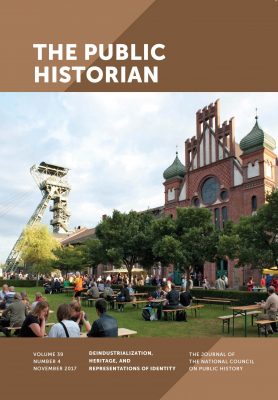
Editor’s note: This is the fourth in a series of posts on deindustrialization and industrial heritage commissioned by The Public Historian, expanding the conversation begun with the November 2017 special issue on the topic.
Living in Scotland but researching and writing about France, I’m often struck by the differences in the way in which deindustrialization figures in the public imagination in these two places. Read More
Editor’s note: This is the third in a series of posts on deindustrialization and industrial heritage commissioned by The Public Historian, expanding the conversation begun with the November 2017 special issue on the topic.
At its peak, the Carrie Furnace of the massive, sprawling Homestead Steel Works was a bastion of American industrial might, belching flame and smoke around the clock and employing hundreds of men in the dangerous, grueling work of producing more than one thousand tons of iron per day. Read More
Editor’s note: The post is the fifth in a series commissioned by The Public Historian that focuses on essays published in TPH that have been used effectively in the classroom. We welcome comments and further suggestions! If you have a TPH article that is a favorite in your classroom, please let us know.Read More
Editor’s note: This is the second in a series of posts on deindustrialization and industrial heritage commissioned by The Public Historian, expanding the conversation begun with the November 2017 special issue on the topic.
I recently gave a guest seminar to a masters-level class in architecture and design at my university, Monash University in Melbourne, Australia. Read More
Editor’s note: The post is the fourth in a series commissioned by The Public Historian that focuses on essays published in TPH that have been used effectively in the classroom. We welcome comments and further suggestions! If you have a TPH article that is a favorite in your classroom, please let us know.Read More
Editor’s note: This post, by TPH guest editor Christian Wicke, is the first in a series of posts on deindustrialization and industrial heritage commissioned by The Public Historian, expanding the conversation begun with the November 2017 special issue on the topic. Read More
Editor’s note: The post is the second in a series commissioned by The Public Historian that focuses on essays published in TPH that have been used effectively in the classroom. We welcome comments and further suggestions! If you have a TPH article that is a favorite in your classroom, please let us know.Read More
On Monday, August 14, roped and yanked from its pedestal by people angered by the violence that unfolded the preceding night in Charlottesville, Virginia, a statue commemorating “THE BOYS WHO WORE THE GRAY” lay crumpled on the lawn before the old courthouse in Durham, North Carolina. Read More
Sign Up to Receive News and Announcements Emails from NCPH
You may unsubscribe or change your preferences at anytime by emailing [email protected] Cavanaugh Hall 127, 425 University Blvd., Indianapolis, IN 46202-5140 (317) 274-2716 [email protected]




 I recently spent several weeks exploring the remnants of coal towns in southern Colorado, as well as associated public history interpretive sites like the United Mine Workers’ (UMW) memorial at the site of the Ludlow Massacre, the