



“In the spirit of”: creating community through the public humanities
28 April 2026 – Mary Rizzo
Editor’s Note: Mary Rizzo and her collaborators have been chronicling their work with the Chicory Revitalization Project on the History@Work blog since 2019. The following post marks the culmination of their reflective practice and anticipates the publication of a new book about it. Scroll down to learn more about their book launch event scheduled for April 30.
How do you identify collaborators for a public humanities project when there is not an obvious community with which to work? In developing what became the Chicory Revitalization Project, I created a concept I call “in the spirit of,” which helped me answer this question and which I hope will be useful for other public history practitioners. Essentially, “in the spirit of” asks us to prioritize the values embodied in our historical objects as we engage in collaboration.
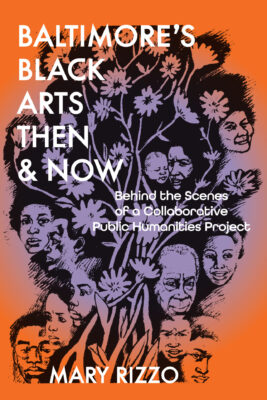
In the Chicory Revitalization Project’s 2026 book, published by the University of Iowa Press in their Humanities and Public Life series, we offer a 360-degree perspective on our project from the perspective of multiple stakeholders.
By 2017, I had rediscovered the grassroots Black poetry magazine Chicory, which was published from 1966–1983, in the collections of Baltimore’s Enoch Pratt Free Library and had partnered with the Digital Maryland State Repository to digitize its entire run for public access. As I contemplated a public humanities project around the magazine, I knew it needed to be rooted in community collaboration. But who was the community for a magazine that had published its last issue four decades earlier? While I first imagined that the people who were involved in it during its years of publication were the appropriate community with whom to collaborate, I soon realized that it was nearly impossible to identify them. Many of the authors had names so common as to be unsearchable or used only their first name or a pseudonym. I contacted three of its five editors, including its founder Sam Cornish, who were excited at the prospect of their literary work finding new life. Only one still lived in Baltimore, though, and others who were participants in it were also dispersed throughout the country.
These challenges caused me to pivot away from this programmatic understanding of community based in historical exactitude to a more expansive vision. Instead of focusing primarily on finding the people associated with it in the past, I contemplated the spirit of Chicory in its time period. Whom did it serve and why? What was its mission? In its original incarnation, Chicory was deeply rooted in Baltimore’s historically Black neighborhoods on the east and west sides of the city. Having read every issue, talked to the editors, and compiled everything written about it, I felt certain that its mission was to amplify the voices of regular people. For the editors, this meant publishing submitted work as-is, rather than requiring it to adhere to traditional literary standards. Or, as the June 1969 issue put it, “the purpose of Chicory is to publish work which reflects the music of language in the inner city.” Equally important were the people who published in it: working-class, primarily Black people, and, especially, youth.
Understanding the values at its heart allowed me to move beyond searching for people directly connected with Chicory in the past to find people in the present who were also working “in the spirit of” the magazine. That meant connecting with youth writing organizations focused on social justice in Baltimore, which led me to my longtime collaborators, DewMore Baltimore and Writers in Baltimore Schools, as well as Baltimore educators and cultural workers. Together we have co-created a traveling exhibition, Soul of the Butterfly: Chicory Magazine and Baltimore’s Black Arts Activism, which has been displayed at fourteen sites, launched a new print and digital magazine, offered numerous workshops and public talks, connected with students in classrooms and after-school programs, and experimented with Instagram as a tool for historical engagement (follow us @Chicory_Baltimore). In April 2026, our book, Baltimore’s Black Arts Then & Now: Behind the Scenes of a Collaborative Public Humanities Project will be published by the University of Iowa Press in their Humanities and Public Life series, allowing us to both document and assess our efforts.
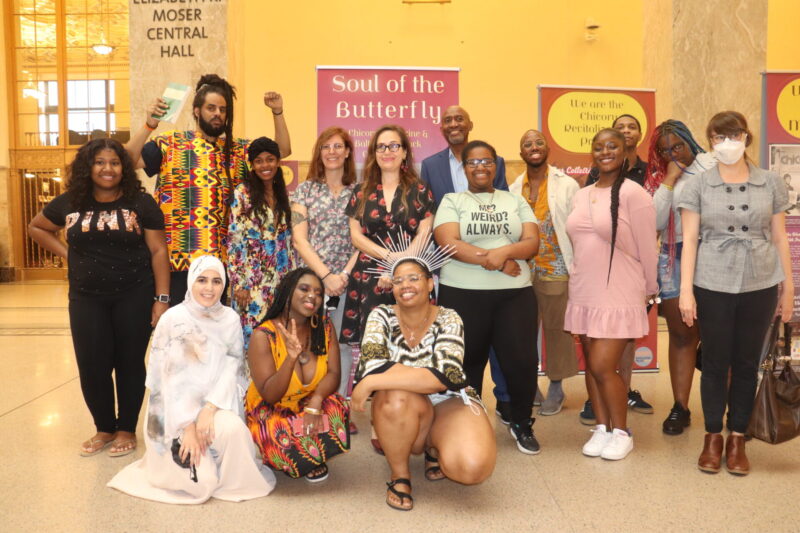
Members of the team that co-created the traveling exhibition, “Soul of the Butterfly: Chicory Magazine and Baltimore’s Black Arts Activism,” at its grand opening at Enoch Pratt Free Library in Baltimore. Photo credit: Maissa Wright-Kerr, courtesy of the Chicory Revitalization Project.
To me, “in the spirit of” is not only a useful approach to working with the public. It also acknowledges that community is never singular and is always created relationally. Instead of seeing community as a static object which the public historian locates to do our job, we need to acknowledge that communities are created through dynamic processes in which we play a part. Furthermore, no public history project engages an entire community because there is never one singular community. Every community is riven with difference. In the end, we hopefully work with subsets which are representative of larger social formations. As I write in the book, “rather than assuming that there is a perfect community out there, our vision shifts to see who is close to the issue historically and today that we can call together in community.”
This “in the spirit of” process also shaped Baltimore’s Black Arts Then & Now as a dialogue about the Chicory Revitalization Project from the points of view of twenty collaborators. Even though public historians assert the need for collaboration, when it comes to publishing about our work, the monograph is still the model. We wanted to push back against that framework. Just like Chicory did not have one voice, our book does not either. For example, the chapter where I elaborate on “in the spirit of” collaboration from my perspective as a public historian is followed by a chapter written by three of the Chicory Revitalization Project’s core collaborators about why they decided to get involved. Instead of my sole perspective, we see how our collaboration addressed multiple needs for each participant. And while I write about the original magazine as a public sphere which cultivated civic dialogue, its longest serving editor, poet Melvin E. Brown, notes in his chapter, “I would have no more imagined Chicory being talked about in that way than I would have imagined the existence and power of the internet” in 1969. For him, Chicory was a platform for regular people’s self-expression, a place to publish amateur and more polished work side-by-side and, essentially, an outgrowth of the Black Arts Movement’s conceptualization of art as activism. Rather than paper over these different viewpoints to pretend that collaboration is seamless, we present the differences to the reader to grapple with, as we have throughout the project’s life.
~Mary Rizzo is an associate professor of History at Rutgers University-Newark. She is a co-founder of the Chicory Revitalization Project and one of the authors of Baltimore’s Black Arts Then & Now: Behind the Scenes of a Collaborative Public Humanities Project. Her previous books include Come and Be Shocked: Baltimore Beyond John Waters and The Wire (Johns Hopkins University Press, 2020) and Class Acts: Young Men and the Rise of Lifestyle (University of Nevada Press, 2015).
Join the Chicory Revitalization Project to celebrate the publication of Baltimore’s Black Arts Then & Now: Behind the Scenes of a Collaborative Public Humanities Project at our virtual book launch on April 30, 2026, at 7pm Eastern. RSVP here.