With the completion of a year-long grant project this month, participants in Northwest Digital Archives’ Expanding Access Grant will have exposed almost 500 new collections in Washington, Oregon, Idaho, and Montana through NWDA’s database. The database, which offers access to more than 11,500 finding aids for archival collections at thirty-seven institutions, is an efficient means for collection discovery and exposure at a wide variety of institutions and repositories. Read More
At the outset of this series, I proposed two seemingly simple questions in hopes of unpacking the complexity of sites of memory and how they “engage citizens in human rights issues” vis-à-vis the past. What type of historic work is taking place? Read More
This past Sunday, June 10, the right-wing Corporation 11 de Septiembre held an homage to the dead dictator Augusto Pinochet under the auspices of a documentary screening at the iconic Teatro Caupolican in Santiago Centro. That day it was answered and challenged in sometimes violent ways by diverse sectors of society and weeks before when many of Santiago’s notably non-violent human rights organizations and sites of memory maneuvered to use legal and political recourse to prevent a ceremony that celebrated a leader infamous for overseeing an era of human rights violations. Read More
There are many transitions we go through when we leave graduate programs and start working as public historians. A hard one for me was the transition from student to role model and possible mentor to others working in the field of history. Read More
Founded in 1984 to combat graffiti, Philadelphia’s Mural Arts Program replaced tags and bubble letters with larger-than-life murals that were designed collaboratively by community members and professional artists, becoming one of the most influential public arts organizations of its kind. Since that time, more than 3,000 murals—memorializing famous Philadelphians, commemorating immigration and migration stories, and acknowledging groups ranging from veterans to people with disabilities—have put a visual face on many neighborhoods, identifying and crystallizing their unique character.[1] Read More
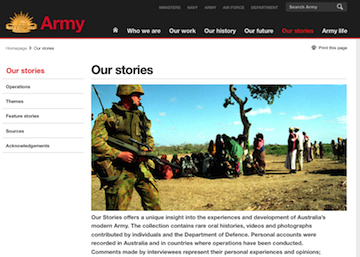
The Australian Army has a powerful story to tell. Our soldiers have contributed to shaping the Australian nation through service in war and peace operations for over 101 years. The popular focus of Australia’s military history tends to be on World War One, World War Two, Korea and Vietnam. Read More
In my previous post I discussed the value of using social networking platforms for networking. In this post, I will discuss how to use social media for marketing by focusing on building an awareness of your “brand.” Social media provides an opportunity to present yourself and your business to diverse audiences in diverse ways. Read More
As a historical consultant working primarily in litigation support, my work usually takes me deep inside the archives. But sometimes, the only way to truly understand the land you’re studying is to see it up close and in person. Last summer, in order to get a better grasp of the vast landscape I’d been researching for two years, I took to Idaho’s backcountry in an area bordering the Frank Church River of No Return Wilderness. Read More
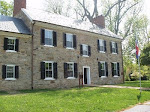
As a professor at a community college, I am typically absorbed in teaching, focused on my classes and students–as many as five classes and upwards of 120-150 students per semester. But recently, I’ve been increasingly engaged in public history by way of developing an associate’s degree program in the field and through involvement in other activities, including the utilization of a restored 1808 manor house on campus, which was the centerpiece of a horse farm when the region had a thriving thoroughbred racing and breeding industry. Read More
Sign Up to Receive News and Announcements Emails from NCPH
You may unsubscribe or change your preferences at anytime by emailing [email protected] Cavanaugh Hall 127, 425 University Blvd., Indianapolis, IN 46202-5140 (317) 274-2716 [email protected]




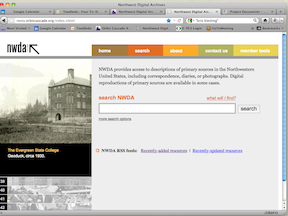 With the completion of a year-long grant project this month, participants in Northwest Digital Archives’ Expanding Access Grant will have exposed almost 500 new collections in Washington, Oregon, Idaho, and Montana through NWDA’s database. The database, which offers access to more than 11,500 finding aids for archival collections at thirty-seven institutions, is an efficient means for collection discovery and exposure at a wide variety of institutions and repositories. Read More