In Chile between 1973 and 1990, according to the 2004 National Commission on Political Imprisonment and Torture (The Valech Report), 1,132 sites were utilized as centers of detention, torture, and extermination. They ranged from hospitals and soccer stadiums to police precincts and private houses. Read More
What is the best way of conveying information to an audience? This question is a perennial favorite among academics, who regularly debate the efficacy of lectures as a teaching tool. It’s an increasingly common question in the museum setting too, as more museums embrace participatory projects and initiatives. Read More
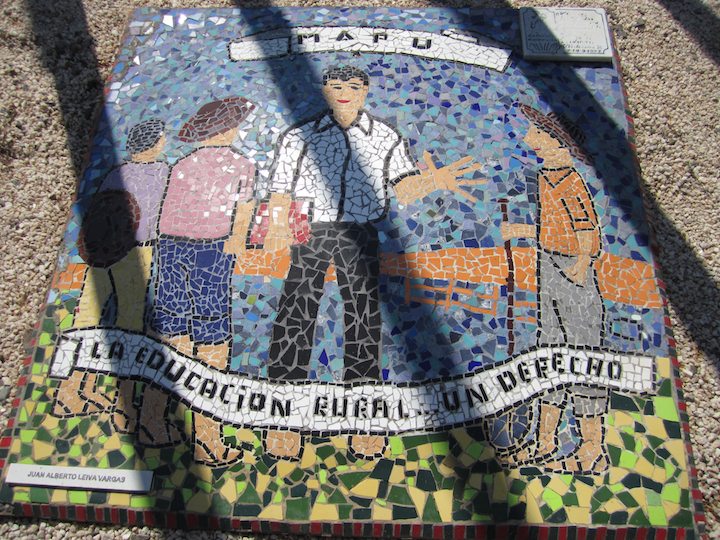
Raúl Lazo liked to ride horses. Luis Gaete worked with his hands in the fields. Juan Leiva believed rural education was a right. José Castro had a red tractor. Juan Leonardo, president of the Association of the Relatives of the Disappeared and Executed Detainees of Paine (AFDD-Paine), explained on a sunny countryside morning that this was a principal point of Memorial Paine: to (re)humanize those community members who fell victim to Pinochet’s repression in the rural region for which the memorial is named. Read More
A considerable amount of ink (and blog space) has been devoted to the articles written last fall by Anthony Grafton, president of the American Historical Association at the time, and AHA Executive Director James Grossman on the state of the job market for history Ph.D.’s. Read More
Horns honk, people push, patience is short; Santiago is teeming with activity, a modern metropolis in the throes of summer heat. But 45 minutes from the city’s center sits a quiet place of rest, respite, and reflection, filled with the pleasant sounds of birds in birch trees and the smell of roses and bougainvillea. Read More
Recently, I attended a local “unconference” designed to bring together preservationists, public historians, community activists and others. During the day, this sentence popped into my head: “People do not forget; they never knew.”
I first came across that pithy explanation of social amnesia in an essay by Barbara J. Read More
Bike culture in Santiago de Chile has boomed in recent years, and today bicycles are veritable mainstays throughout the city. The reasons are many: an uptick in Chileans’ environmental consciousness, skyrocketing public transport prices and the slashing of services, and most importantly, according to the folks at Bicicultura, the cultural dissociation between bicycles and poverty. Read More
[EDITOR’S NOTE: Zachary McKiernan, a doctoral student in public history at the University of California/Santa Barbara and a regular reviewer for “Off the Wall,” is working on a series of “Letters from Chile,” based on his current dissertation research. Read More
2012 is an ambitious year for NCPH, marking the launch of a true locus for our craft on the World Wide Web: the “History@Work” blog located on the new digital Public History Commons. Like the field of public history, this space will take advantage of every phase the Internet has to offer: its content delivery mechanisms will be multi-faceted, its content fluid, and its reach will encompass the entire cloud. Read More
For most of us, music videos don’t immediately bring to mind historical engagement. What’s more reflective of the current epoch than a viral YouTube video featuring feline euphony or Rebecca Black’s ultra-present-focused “Friday”?
But Arcade Fire’s “Wilderness Downtown” collaboration with Chris Milk, featuring their hit 2010 single, “We Used to Wait,” is a remarkable exception to this rule. Read More
Sign Up to Receive News and Announcements Emails from NCPH
You may unsubscribe or change your preferences at anytime by emailing [email protected] Cavanaugh Hall 127, 425 University Blvd., Indianapolis, IN 46202-5140 (317) 274-2716 [email protected]