Editor’s note: This piece from the National Humanities Alliance is being circulated in a variety of relevant venues.
Think pieces abound on how best to make the case for the value of studying the humanities—should we as a humanities community emphasize the quite respectable career and salary outcomes of humanities majors or do we then fall into the trap of suggesting that higher education is necessary only for economic gain? Read More
From around the field this week: Join the International Sites of Conscience to talk about Museums and Guns at tomorrow’s Twitter #MuseumEdChat (May 24); @NCPHInclusion task force member Shakti Castro gives a talk on the history of the opioid crisis in NYC’s Puerto Rican and Latinx communities (May 24);Historic New England is hosting a “Caring for Municipal, Museum, and other Non-Profit Historic Properties” workshop in Massachusetts (May 25); Submit a pop-up proposal for the COSA-NAGARA-SAA 2018 Joint Meeting by May 31;June is Pride Month in the United States, and many cultural organizations are featuring LGBTQ history events and talks. Read More
Editor’s note: this is the second in a series of pieces by recipients of NCPH’s 2018 best in public history awards.
On learning that I would be receiving an award for “extraordinary service” to the National Council on Public History, my initial response was to point out that the projects I’ve been involved in have always been group efforts by staff and many other NCPH members. Read More
Editor’s note: This is the final post of a series that continues the conversation begun in the February 2018 issue of The Public Historian with the roundtable “Responding Rapidly to Our Communities.”
In 2018, tragedy is visible, impossible to ignore, and happening all the time and all across the globe as History@Work’s series of posts and The Public Historian’s roundtable have so deftly illuminated. Read More
Editor’s note: This is the final post in a series of pieces focused on Las Vegas and its regional identity which were posted before and during the NCPH Annual Meeting in Las Vegas in April.
The casino and entertainment industries in Las Vegas have used women’s bodies to sell the city since the 1950s. Read More
When most people think of computer games they imagine something electronic with far more sophistication than the cardboard and plastic games played around a kitchen table. An ongoing exhibit hosted by the Sarnoff Collection at The College of New Jersey in Ewing, New Jersey takes visitors back to a time when computer games had far more in common with Monopoly than with Minecraft. Read More
From around the field this week: Topic proposals for NCPH 2019 are due on June 1 for feedback and offers of collaboration; several NEH grant applications are due in the next few weeks; upcoming workshops from AASLH, the Pennsylvania State Archives, Queens University Belfast, and others. Read More
Our encounter in the hotel lobby on the final day of the Las Vegas NCPH conference was brief—one of those “darn, we missed each other!” moments of a busy event filled with valued but too-rarely seen colleagues. Pulling his suitcase, Aidan was heading for the airport after two weeks of conferencing—probably as exhausted as he looked.Read More
Sign Up to Receive News and Announcements Emails from NCPH
You may unsubscribe or change your preferences at anytime by emailing [email protected] Cavanaugh Hall 127, 425 University Blvd., Indianapolis, IN 46202-5140 (317) 274-2716 [email protected]





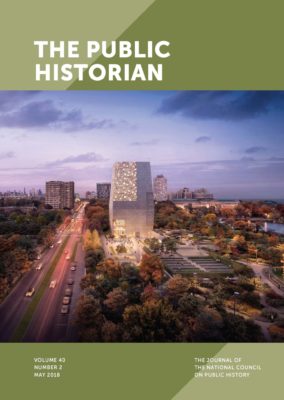 This issue of The Public Historian unfolds as a meditation on one of the central paradoxes in our field.