From around the field this week: Susan Ferentinos delivers a talk on “Presenting the Queer Past” at Rutgers University – Newark tomorrow; applications for the Library of Congress’s Librarians-in-Residence fellowship program open on November 1; proposal deadlines approach for conferences in New York, Delaware, and Massachusetts; AASLH and the OHA are offering webinars next week; a round-up of Rowman and Littlefield’s October publications; and more. Read More
The study and practice of family history is fraught with methodological, historiographical, practical, ethical, and cultural concerns for scholars and practitioners alike.[1] In trying to design an event that might respond to and interrogate these concerns, we asked: What new knowledge might be created if we bring scholars together to discuss the phenomenal growth of family history in different nations? Read More
In July of this year, Georgia became the tenth state to prohibit public colleges and universities from banning concealed weapons on campus for permit holders. The controversy over campus carry legislation is a relatively small part of the national debate over gun rights and gun safety, but the recent Georgia decision is notable in that the governor used historical arguments in his initial rejection of a campus carry bill.Read More
From around the field this week: Attend “Reclaiming our Ancestors: Community Conversations about Racial Justice and Public History” conference next weekend in Buffalo, New York; AASLH’s Call for Proposals for their 2018 conference, “Truth or Consequences,” is now open with a deadline of December 8; upcoming public lectures in Washington, DC next week include Olwen Purdue’s talk about doing public history in Northern Ireland and SHFG’s annual Hewlett Lecture; applications for the 2018 Rome Prize Fellowships supporting innovative and cross-disciplinary work in the arts and humanities are open through November 1; upcoming workshops in Florida and Mississippi from the Conservation Center for Art & Historic Artifacts. Read More
During the summer of 2015, a group of scholars, students, and artists trekked under the sweltering New Mexico sun with cameras and notebooks in hand to document public murals in the city of Las Cruces. What began as a student project in a public history seminar at New Mexico State University grew into the Murals of Las Cruces Project. Read More
From around the field this week: Apply for an AASLH mini-grant for hurricane assistance by October 10; sign up for Wikipedia Edit-a-Thons in Indiana and across Canada; deadlines are imminent or approaching for conferences in Illinois, Virginia, California, and Granada, Spain; Register for next month’s Design for Diversity opening forum at Northeastern University; Rowman & Littlefield’s Interpreting History series is releasing a new title this week, Interpreting the Civil War at Museums and Historic Sites. Read More
Editor’s note: The post is the second in a series commissioned by The Public Historian that focuses on essays published in TPH that have been used effectively in the classroom. We welcome comments and further suggestions! If you have a TPH article that is a favorite in your classroom, please let us know.Read More
Jessica Baldwin Phillips was raised and educated in New York’s historically rich Hudson Valley. After receiving a BA in history from Marist College (with minors in politics and philosophy), she went on to obtain an MA in public history at the University at Albany.Read More
Sign Up to Receive News and Announcements Emails from NCPH
You may unsubscribe or change your preferences at anytime by emailing [email protected] Cavanaugh Hall 127, 425 University Blvd., Indianapolis, IN 46202-5140 (317) 274-2716 [email protected]




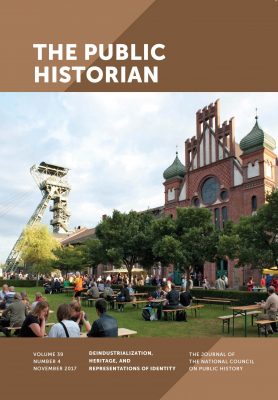 I recently spent several weeks exploring the remnants of coal towns in southern Colorado, as well as associated public history interpretive sites like the United Mine Workers’ (UMW) memorial at the site of the Ludlow Massacre, the Walsenberg Coal Mining Museum, the Cokedale Mining Museum, and the Steelworks Center of the West in Pueblo. Read More