The American Yawp, the profession’s first multi-authored open textbook, contains thirty chapters and almost 300,000 words. It covers everything from indigenous creation stories to Instagram. How, with historical input accelerating and the scope of scholarship expanding, could any individual or small group of historians hope to capture the breadth of American history and to do so as expansively as a textbook demands? Read More
Eastern State Penitentiary Historic Site recently launched Prisons Today: Questions in the Age of Mass Incarceration, the first major museum exhibit to tackle this civil rights issue.* Prisons Today asks open-ended questions and encourages dialogue among visitors about America’s past and present prison systems. Read More
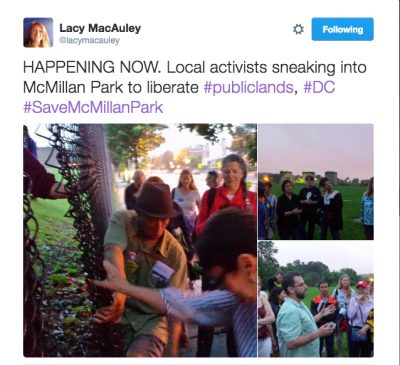
On July 4, about 60 people attended a party thrown by Washington, DC activists trying to save a historic water filtration plant. The event was held in a row house in the city’s gentrifying Bloomingdale neighborhood, which I wrote about in a recent History@Work post. Read More
My thoughts on the Flint water crisis stem from a personal perspective, as well as my academic interests in deindustrialization, African American history, and heritage tourism. When I was two years old, my dad was offered a job as a reference librarian at the University of Michigan-Flint. Read More
I decided to become a professional historian in a campground in Ohio in the summer of 1994. I was spending the day lounging at my campsite, reading About Time: Exploring the Gay Past, by Martin Duberman, when his essay “’Writhing Bedfellows’ in Antebellum South Carolina: Historical Interpretation and the Politics of Evidence” got me so fired up that I decided it was time to go out and do what I could to bring the past to the people. Read More
I study environmental justice movements, both contemporary and historical. Lead (along with asthma) has been a central urban environmental health issue in the US that hits racial minorities and working-class people particularly hard. Lead is often thought of, for that reason, as an example of environmental racism. Read More
Gentrification: It’s not just for sociologists and anthropologists any more. Though historians have been making inroads documenting and interpreting gentrification and displacement, there are abundant opportunities for historians to make significant contributions in public policy and planning. One recent kerfuffle involving proposed bicycle lanes and African American churches in Washington, DC, provides a window into how a better understanding of the past could have defused a racially and class charged debate over painted lines in public spaces.
In January 2015, I introduced the idea of History Communicators on this blog. “History Communicators, like Science Communicators,” I wrote then, “will advocate for policy decisions informed by historical research; step beyond the walls of universities and institutions and participate in public debates; author opinion pieces; engage in conversation with policymakers and the public; and work diligently to communicate history in a populist tone that has mass appeal across print, video, and audio. Read More
Editor’s note: This post continues a series commemorating the anniversary of the National Historic Preservation Act by examining a past article published in The Public Historian, describing its significance and relating it to contemporary conversations in historic preservation.
As I’ve read obsessively the news of campus protests these past few weeks and shared support for protesters both publicly on social media and privately in email conversations with college administrators, I’ve been challenged to think deeply about my position as both a public historian and a faculty member at a state university. Read More
Sign Up to Receive News and Announcements Emails from NCPH
You may unsubscribe or change your preferences at anytime by emailing [email protected] Cavanaugh Hall 127, 425 University Blvd., Indianapolis, IN 46202-5140 (317) 274-2716 [email protected]