We public historians are increasing our fluency in languages. We are conversing with colleagues across the globe and across disciplines, we are ever dexterous in our work with new media, and we are constantly strengthening the ways we reach out to audiences, drawing from a language of engagement that has emerged since our field’s early days and that has blossomed in the last ten years. Read More
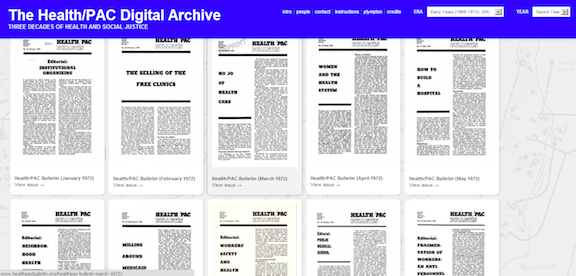
The Health/PAC Digital Archive is a complete collection of the influential Health/PAC Bulletin, which was published for nearly three decades until Health/PAC closed in 1994. Full-text searchable, it amounts to a documentary history of mid- to late-20th Century American health policy and politics. Read More
In the 1950s, South Carolina embarked on a massive statewide building spree in an effort to provide “separate but equal” schools for its African American and white students. Hundreds of new elementary and high schools in the Modern style sprung up across the state. Read More
“I am from a small agrarian town in northeastern Pennsylvania – just south of Binghamton, New York and north of Scranton, Pennsylvania,” is what I told people in Boston when I first moved to New England to start graduate school in 2008. Read More
Before the mid-1960s, except for domestics and a few other exceptions, South Decatur was exclusively white. It was a place Decatur’s blacks knew to not be after sundown. They knew that they were welcome to clean houses, cut lawns, and bag groceries there during the day but the suburban dream being lived by their white employers was beyond reach. Read More
What if after you bought the historic house of your dreams in a neighborhood that billed itself as “historic” you found out that your definition of historic clashed with that of your new neighbors? As a historian with nearly thirty years under my belt in history and historic preservation, that’s precisely what happened in 2011 when my wife and I bought a small Craftsman-influenced home in a Decatur, Georgia, neighborhood. Read More
NOTE: This post is part of a new and, we hope, semi-regular series in which public history educators share insights and observations about their use of “classic” texts in the public history classroom.
—
Michel Rolph Trouillot, historian, anthropologist, Haitian intellectual and University of Chicago professor, died in July at age 63. Read More
In addition to the photos that have accompanied Zach McKiernan’s “Letters from Chile” series this spring, there have been many more that we didn’t post with the articles, but which we’re including here in a visual addendum to the series. All are by the author unless otherwise noted. Read More
At the outset of this series, I proposed two seemingly simple questions in hopes of unpacking the complexity of sites of memory and how they “engage citizens in human rights issues” vis-à-vis the past. What type of historic work is taking place? Read More
This past Sunday, June 10, the right-wing Corporation 11 de Septiembre held an homage to the dead dictator Augusto Pinochet under the auspices of a documentary screening at the iconic Teatro Caupolican in Santiago Centro. That day it was answered and challenged in sometimes violent ways by diverse sectors of society and weeks before when many of Santiago’s notably non-violent human rights organizations and sites of memory maneuvered to use legal and political recourse to prevent a ceremony that celebrated a leader infamous for overseeing an era of human rights violations. Read More
Sign Up to Receive News and Announcements Emails from NCPH
You may unsubscribe or change your preferences at anytime by emailing [email protected] Cavanaugh Hall 127, 425 University Blvd., Indianapolis, IN 46202-5140 (317) 274-2716 [email protected]