A considerable amount of ink (and blog space) has been devoted to the articles written last fall by Anthony Grafton, president of the American Historical Association at the time, and AHA Executive Director James Grossman on the state of the job market for history Ph.D.’s. Read More
Each paragraph below presents a common public history work scenario that differs – a little or a lot – from traditional academy-based work. I am looking for comments, suggestions, alternative ideas, and specific examples of what is described. This was written as a centerpiece for a work session planned for the 2012 annual meeting, but is a topic that deserves widest possible exposure. Read More
Horns honk, people push, patience is short; Santiago is teeming with activity, a modern metropolis in the throes of summer heat. But 45 minutes from the city’s center sits a quiet place of rest, respite, and reflection, filled with the pleasant sounds of birds in birch trees and the smell of roses and bougainvillea. Read More
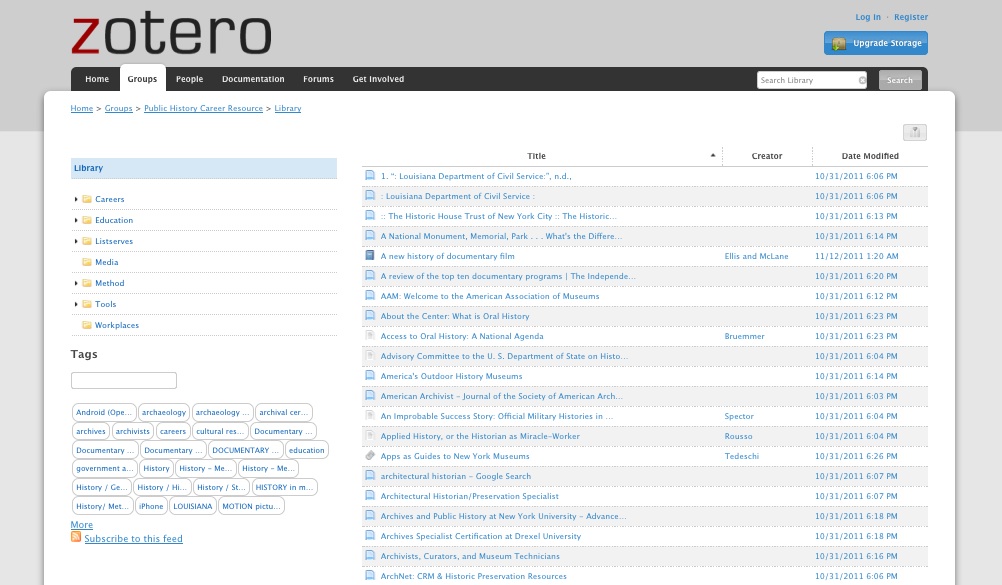
I am always happy to discover how often new media scholarship benefits traditional research as well as public history practice. My recent experience with one particular online project using Zotero demonstrates how new media innovation can invigorate our classroom instruction in unexpected ways. Read More
The Internet gives consultants the opportunity to showcase our expertise for a broad audience while also allowing us to define our niche. We once relied on a web page to represent us online, but people are now turning to social media to find reliable “experts.” Read More
Recently, I attended a local “unconference” designed to bring together preservationists, public historians, community activists and others. During the day, this sentence popped into my head: “People do not forget; they never knew.”
I first came across that pithy explanation of social amnesia in an essay by Barbara J. Read More
Bike culture in Santiago de Chile has boomed in recent years, and today bicycles are veritable mainstays throughout the city. The reasons are many: an uptick in Chileans’ environmental consciousness, skyrocketing public transport prices and the slashing of services, and most importantly, according to the folks at Bicicultura, the cultural dissociation between bicycles and poverty. Read More
You may have noticed a pause in activity here at “Off the Wall” in recent weeks. We haven’t gone out of business–we’ve just been busy as part of the recent effort of getting the National Council on Public History’s new multi-author, multi-section blog, History@Work, ready to launch. Read More
We all have to start somewhere. Public historians arrive in the profession from a variety of different places. We are inspired to work in a field that invokes passion and a lot of heart–but at some point we have all taken our first steps into the profession, either as graduate students or as new professionals who came into our public history work from unexpected directions. Read More
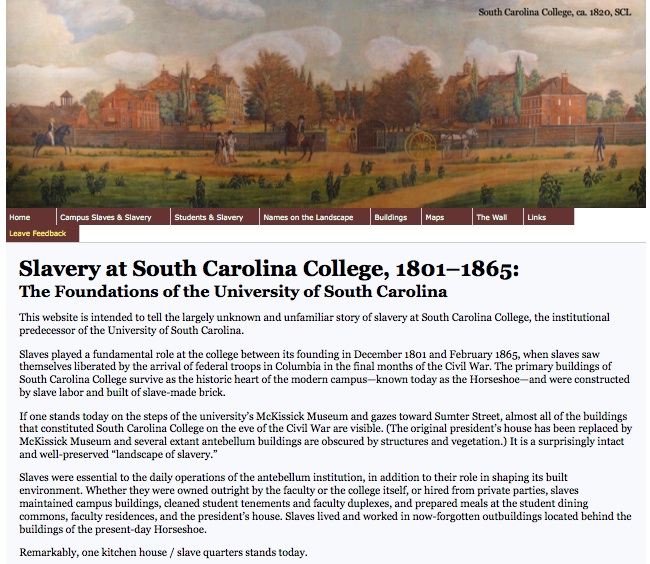
The Public History Program at the University of South Carolina welcomes comments on a new website, “Slavery at South Carolina College, 1801–1865: The Foundations of the University of South Carolina.” While many American colleges and universities in recent years have been researching their historical connections to the institution of racial slavery, this website is the first public acknowledgement of the role of slaves and slavery at the antebellum college that became the University of South Carolina. Read More
Sign Up to Receive News and Announcements Emails from NCPH
You may unsubscribe or change your preferences at anytime by emailing [email protected] Cavanaugh Hall 127, 425 University Blvd., Indianapolis, IN 46202-5140 (317) 274-2716 [email protected]