The value of history–both understanding historical events and the process by which we analyze them–has been demonstrated many times in 2016. The skill at the very core of the research process, critical thinking, cannot be overemphasized in today’s society. Evidenced-based inquiry and discussion is more important than ever. Read More
From around the field this week: A new issue of Public History Review; revival of Public Scholar Program at the US National Endowment for the Humanities; labor history conference in Detroit takes public history as its theme; course on American Architectural History in New Jersey Read More
Several years ago, on a visit to the Levine Museum of the New South in Charlotte, North Carolina, I encountered an exhibit that asked me to participate. No, this was not high tech. No selfies, no QR codes, no downloads, just pencil and paper–yellow sticky notes. Read More
As we mark the end of a tumultuous 2016 and begin what promises to be an eventful new year, History@Work’s editors are reflecting on the posts that prompted the widest readership and dialogue among our community:
Editor’s note: This is the third of a series of blog posts commissioned by The Public Historian on the topic of history and the interpretation of climate change in the national parks, extending the conversation on history in the national parks during this centennial year begun in its November 2016 issue.Read More
From around the field this week: Award for public archives work; symposium on heritage and revolution; collection of writing on history in the Gilmore Girls; online workshops on maker spaces in museums, metals conservation, interpretive planning; dreaming of summer with field courses on heritage management in Cambodia and Islamic Persian architecture in Iran Read More
Editor’s note: This is the second of a series of blog posts commissioned by The Public Historian on the topic of history and the interpretation of climate change in the national parks, extending the conversation on history in the national parks during this centennial year begun in its November 2016 issue.Read More
From around the field this week: Awards for film and other public history projects; conferences memorial art, justice and memory practices, oral history, dark tourism; summer teacher workshops for US educators; reviews of two recent Canadian environmental/public histories. Read More
Public historians are occasionally presented with opportunities to engage in projects relevant not just to our local communities, but of immediate importance to the entire country. Last summer, Donald J. Trump’s nomination as the presidential candidate of the Republican Party, combined with the decision to close Atlantic City’s Trump Taj Mahal in the midst of a labor strike, offered me just such an opportunity. Read More
The National Council on Public History is offering a new way for attendees to get involved in the 2017 NCPH Annual Meeting in Indianapolis, April 19-22, by opening our first-ever Call for Pop-Ups.
We realize this may seem counterintuitive; surely a pop-up is intended to just, well, pop up? Read More
Sign Up to Receive News and Announcements Emails from NCPH
You may unsubscribe or change your preferences at anytime by emailing [email protected] Cavanaugh Hall 127, 425 University Blvd., Indianapolis, IN 46202-5140 (317) 274-2716 [email protected]




 The value of history–both understanding historical events and the process by which we analyze them–has been demonstrated many times in 2016. The skill at the very core of the research process, critical thinking, cannot be overemphasized in today’s society. Evidenced-based inquiry and discussion is more important than ever. Read More
  From around the field this week: A new issue of Public History Review; revival of Public Scholar Program at the US National Endowment for the Humanities; labor history conference in Detroit takes public history as its theme; course on American Architectural History in New Jersey
 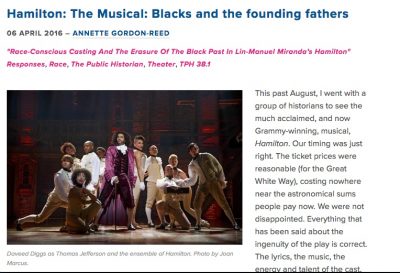 As we mark the end of a tumultuous 2016 and begin what promises to be an eventful new year, History@Work’s editors are reflecting on the posts that prompted the widest readership and dialogue among our community: