We have an ever-growing body of scholarship about how and why historic sites are created, but a panel today focuses on what happens when they close. Chaired by NPS Ranger Chuck Arning of the Blackstone River Valley National Heritage Corridor and featuring panelists Barbara Franco (Gettysburg Seminary Ridge Museum), Bob Beatty (American Association for State & Local History), Sheila Kirshbaum, Tsongas Industry History Center), and Bruce Beesley (Indiana State Museum & Historic Sites), the panel will offer ideas and best practices for making the best out of bad times. Read More
The “unconference” movement is barely a decade old (Tom Scheinfeldt noted in our capstone session that the first one he attended was in Silicon Valley in 2004) but it’s clear that for many people–perhaps particularly for public historians–it offers a welcome alternative to more formal conference formats. Read More
Historians, preservationists, government officials, and elected representatives stand at a frontier of possibility and hope, or anguish and betrayal as the nation enters the sesquicentennial years of the Civil War. This proposed roundtable, in cooperation with audience members, dares to imagine how our Civil War battlefields should be managed for the next 150 years. Read More
We’re trying something new at this year’s NCPH/OAH conference, with due acknowledgement to Apple: a “genius bar” of experienced digital historians who will be available to answer questions on a wide range of topics, problems, and platforms. Our “Digital Drop-In” can be found in Exhibit Hall D Foyer, near the registration area, from 1:30 to 4:30 p.m. Read More
Graduate students and new professionals headed to the NCPH/OAH Conference in Milwaukee–let’s get to know each other! Please join the NCPH New Professionals and Graduate Students Committee for a social outing at Milwaukee Ale House (233 North Water St., downtown Milwaukee, a short walk from the Frontier Airlines Center) on Thursday, April 19th, from 7:30 to 10:30pm. Read More
As with digital history, environmental history and environmental issues are turning up across the 2012 conference program, part of the gradual but (I hope) increasing interest in finding ways to connect our historical work with the concern that many of us feel about climate change and all that relates to it. Read More
Each paragraph below presents a common public history work scenario that differs – a little or a lot – from traditional academy-based work. I am looking for comments, suggestions, alternative ideas, and specific examples of what is described. This was written as a centerpiece for a work session planned for the 2012 annual meeting, but is a topic that deserves widest possible exposure. Read More
A couple or three years ago, I recall hearing someone say in a meeting of the NCPH Digital Media Group that before long, we might find that “digital history” wasn’t really a separate realm anymore, but simply integrated into most aspects of what we do as public historians. Read More
Each paragraph below presents a common public history work scenario that differs – a little or a lot – from traditional academy-based work. I am looking for comments, suggestions, alternative ideas, and specific examples of what is described. This was written as a centerpiece for a work session planned for the 2012 annual meeting, but is a topic that deserves widest possible exposure. Read More
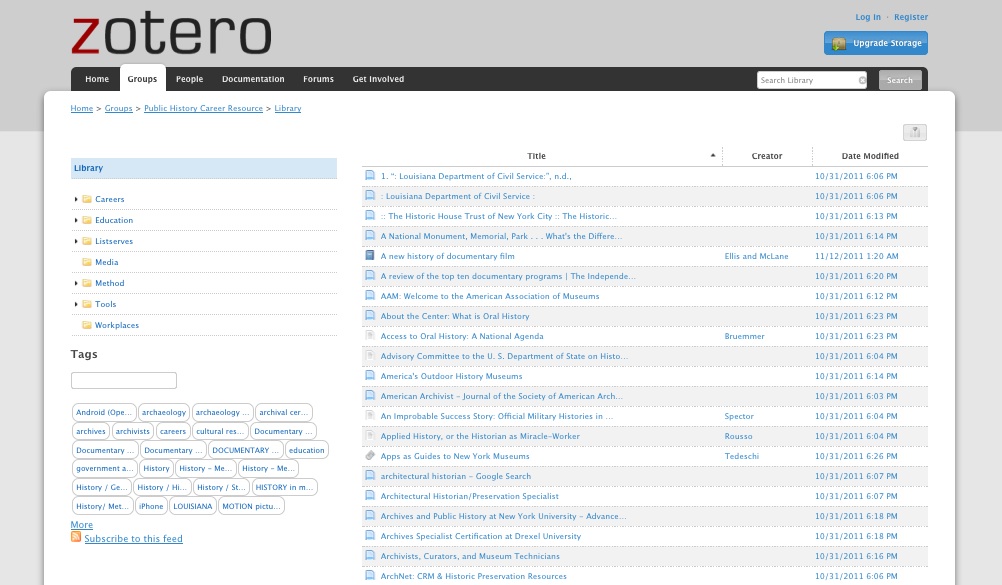
I am always happy to discover how often new media scholarship benefits traditional research as well as public history practice. My recent experience with one particular online project using Zotero demonstrates how new media innovation can invigorate our classroom instruction in unexpected ways. Read More
Sign Up to Receive News and Announcements Emails from NCPH
You may unsubscribe or change your preferences at anytime by emailing [email protected] Cavanaugh Hall 127, 425 University Blvd., Indianapolis, IN 46202-5140 (317) 274-2716 [email protected]