These intriguing images, previewed in last week’s “In Search of a Label” post, depict a public artwork by Sheila Klein called “City Yard,” commissioned as part of the development of the Frontier Airlines Center in Milwaukee in the 1990s. Read More
From our colleagues at the History News Network comes this roundup of the public and digital history components of last week’s conference in Milwaukee. Noting the synergy between the realms of public and digital history, HNN’s David Walsh points out that the center of gravity in the conference blog- and tweet-ospheres was clearly with historians working in those realms, constituting “a monopoly of coverage…so complete it could warrant an anti-trust investigation,” he writes (we think that’s a good thing). Read More
As the dust settles on a wonderful joint conference for NCPH and OAH, the editors of History@Work would like to introduce what we hope will become a semi-regular tradition. We invite you to clear your minds, open your eyes (or, in the future, perhaps your ears as well) and take a stab at responding to our first “In Search of a Label” post, offering your first impressions, free associations and guesses at significance. Read More
NCPH/OAH Annual Conference, Milwaukee, April 20, 2012
Panelists discussed specific ways historians can think about and contribute to solutions about climate change. Chair Phil Scarpino (IUPUI) began by asking, “Why should historians talk about the future? Read More
The program committee for next year’s NCPH conference in Ottawa has issued its call for proposals (below). It’s not too early to start thinking about our 2013 gathering in Ottawa – proposals are due July 15!
“Knowing your Public(s)—The Significance of Audiences in Public History”
2013 Annual Meeting, National Council on Public History
Ottawa, Ontario, Canada, April 17-20, 2013
In 2013 the National Council on Public History will meet at the Delta Ottawa City Centre, in the heart of downtown Ottawa, Canada, with Canada’s Parliament buildings, historic ByWard market, national museums and historic sites, river trails, the UNESCO World Heritage Site of the Rideau Canal, and numerous cafes and restaurants within easy walking distance. Read More
You wouldn’t have known it from the Twitter feed over the past few days, but a steady undercurrent of the conference conversation among public historians in Milwaukee has been the situation with the field’s flagship journal, The Public Historian, and NCPH’s announcement in January that it would be terminating its more than 30-year relationship with the University of California at Santa Barbara, its partner in publishing the journal. Read More
It’s always a pleasure to reconnect with colleagues and friends at a conference, and to have face-to-face conversations that enrich to the increasingly digitized interactions that professional life entails. But the conference experience is also rich with ironies for me, probably because I can’t help thinking about how the kinds of environments in which we hold these gatherings–usually big downtown hotels and convention centers–have been created, how they fit within their social, spatial, and economic contexts, and how we of the mobile knowledge classes fit within them. Read More
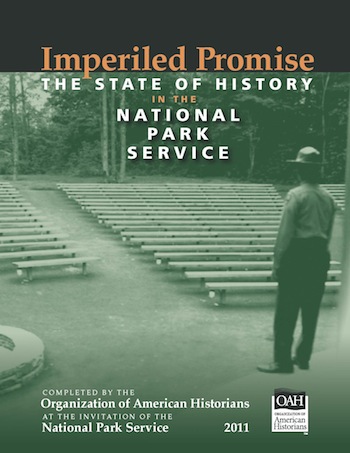
The NCPH/OAH conference brought to light a subject near to my heart this afternoon – history in the NPS. The panel consisted of Marla Miller, Gary Nash, David Thelen and Anne Mitchell Whisnant. On the docket was the discussion of their report on how the NPS stacks up in the history department. Read More
Today’s “Lightning Talk” session was a great one-hour showcase for about a dozen digital projects:
Larry Cebula: Spokane Historical, a web and mobile platform for telling stories of Spokane and Eastern Washington, developed by the Public History program at Eastern Washington University using Curatescape and Omeka
Cathy Stanton: History@Work (hey, that’s us)
Bobby Allen: University of North Carolina/Chapel Hill’s Digital Innovation Lab, an American-Studies-based project that is developing, testing, and documenting best-practice models for faculty and graduate student work in public humanities that integrates community engagement, digital technologies, and interdisciplinary inquiry
Andrew Hurley: the Virtual City Project, which uses three-dimensional imaging technologies to create electronic representations of lost historic landscapes
Trevor Owens: Viewshare, a free web application developed by the Library of Congress for curators and collections managers to create and customize unique, dynamic online views of images from their collections.
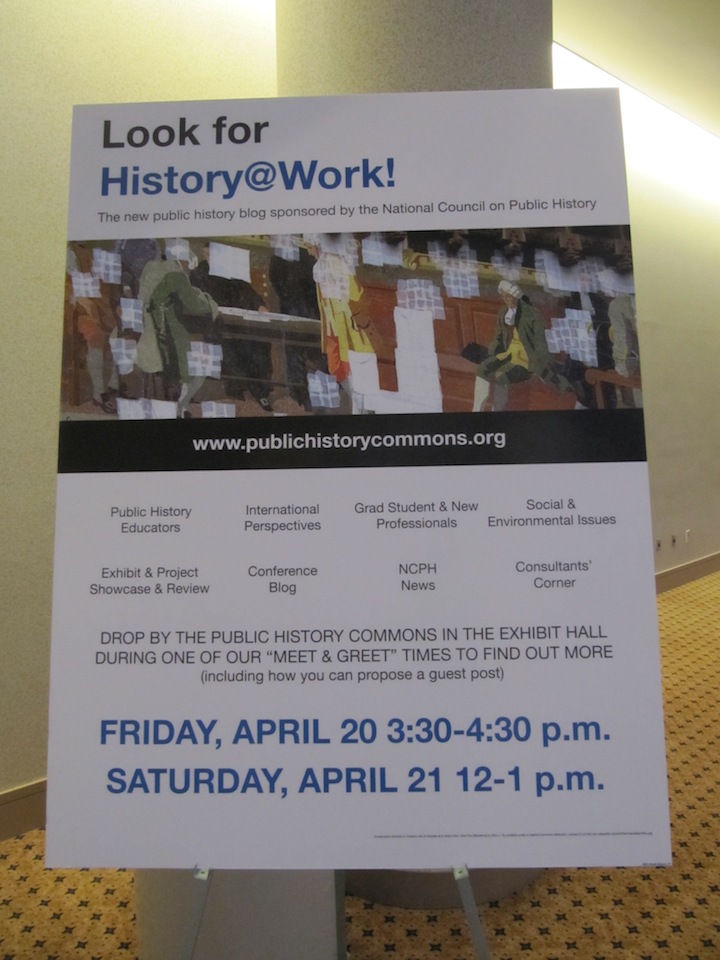
We’re getting ready for our closeup (whoa…maybe not that close!). Join members of the History@Work editorial team for two “meet and greet” gatherings in the Public History Commons area of the Exhibit Hall today from 3:30 to 4:30 or tomorrow from noon to 1 p.m. Read More
Sign Up to Receive News and Announcements Emails from NCPH
You may unsubscribe or change your preferences at anytime by emailing [email protected] Cavanaugh Hall 127, 425 University Blvd., Indianapolis, IN 46202-5140 (317) 274-2716 [email protected]