In my years as a historical consultant, I did several projects for agencies such as the National Park Service and the U.S. Army Corps of Engineers. Much like the church for which I now work, these agencies are interested in their past, but also are sensitive to criticisms that have been levied against them by opposing groups, such as environmental organizations. Read More
Some time ago, I had the opportunity of hearing a presentation by Daniel Walker Howe, a historian who won the 2008 Pulitzer Prize for his book What Hath God Wrought: A History of the United States, 1815-1848. In the course of the seminar, Howe made a plea for academic historians to stop ignoring the general public in their work, declaring that it was time for historians to stop talking only to each other and to engage the larger public. Read More
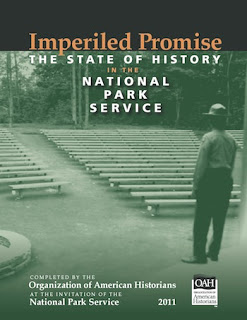
Last Friday, November 2, 2012, National Park Service personnel, public historians, academics, and graduate students from the Northeast met at the Massachusetts State Archives in Boston to discuss the Organization of American Historians’ recent report Imperiled Promise: The State of History in the National Park Service (2011). Read More
What does it mean to be “successful” as an independent consultant? There are, in fact, many ways to succeed in this undertaking. The answer depends on how you define “success.”
The simplest measure of all is survival. Lots of people who try consulting aren’t able to make a go of it in the long run. Read More
In Part I, I talked about balancing your consulting work with your own research work. Setting aside the fact that pursuing your own research in addition to your consulting work may throw the rest of your life out of kilter, you will have to assign a rather high priority to your own research—after your clients’ needs, of course—if you want it to come to fruition in the form of publications. Read More
Public historians who enjoy a regular paycheck find certain aspects of consulting curious–none more so than the issue of money. I expect that this curiosity also extends to the ranks of those who are considering a leap in the consulting direction. Read More
Prompted by Adina Langer, my colleague on the NCPH Consultants Committee and one of the editors of this blog, I am going to relate how I have pursued a research agenda independently of my work for clients. Admittedly, my career as a historical consultant has been somewhat eclectic, but I hope that you may find at least some of what I have to say applicable to your own situation. Read More
What kind of knowledge and skills do you need in order to create a viable historical consulting practice?
Becoming a consultant requires more than simply deciding to work for yourself. It requires the shift to a new mindset, because as an independent consultant you become a creature of the marketplace. Read More
When I started graduate school in the now-distant year of 1979, public history was still in its infancy. Within view of the spot that I habitually occupied in the basement of the university library, two or three loose issues (the entire run to date) of The Public Historian perched precariously on an otherwise empty stack shelf. Read More
Sign Up to Receive News and Announcements Emails from NCPH
You may unsubscribe or change your preferences at anytime by emailing [email protected] Cavanaugh Hall 127, 425 University Blvd., Indianapolis, IN 46202-5140 (317) 274-2716 [email protected]