In my previous post I discussed the value of using social networking platforms for networking. In this post, I will discuss how to use social media for marketing by focusing on building an awareness of your “brand.” Social media provides an opportunity to present yourself and your business to diverse audiences in diverse ways. Read More
From our colleagues at the History News Network comes this roundup of the public and digital history components of last week’s conference in Milwaukee. Noting the synergy between the realms of public and digital history, HNN’s David Walsh points out that the center of gravity in the conference blog- and tweet-ospheres was clearly with historians working in those realms, constituting “a monopoly of coverage…so complete it could warrant an anti-trust investigation,” he writes (we think that’s a good thing). Read More
As the dust settles on a wonderful joint conference for NCPH and OAH, the editors of History@Work would like to introduce what we hope will become a semi-regular tradition. We invite you to clear your minds, open your eyes (or, in the future, perhaps your ears as well) and take a stab at responding to our first “In Search of a Label” post, offering your first impressions, free associations and guesses at significance. Read More
Today’s “Lightning Talk” session was a great one-hour showcase for about a dozen digital projects:
Larry Cebula: Spokane Historical, a web and mobile platform for telling stories of Spokane and Eastern Washington, developed by the Public History program at Eastern Washington University using Curatescape and Omeka
Cathy Stanton: History@Work (hey, that’s us)
Bobby Allen: University of North Carolina/Chapel Hill’s Digital Innovation Lab, an American-Studies-based project that is developing, testing, and documenting best-practice models for faculty and graduate student work in public humanities that integrates community engagement, digital technologies, and interdisciplinary inquiry
Andrew Hurley: the Virtual City Project, which uses three-dimensional imaging technologies to create electronic representations of lost historic landscapes
Trevor Owens: Viewshare, a free web application developed by the Library of Congress for curators and collections managers to create and customize unique, dynamic online views of images from their collections.
The “unconference” movement is barely a decade old (Tom Scheinfeldt noted in our capstone session that the first one he attended was in Silicon Valley in 2004) but it’s clear that for many people–perhaps particularly for public historians–it offers a welcome alternative to more formal conference formats. Read More
We’re trying something new at this year’s NCPH/OAH conference, with due acknowledgement to Apple: a “genius bar” of experienced digital historians who will be available to answer questions on a wide range of topics, problems, and platforms. Our “Digital Drop-In” can be found in Exhibit Hall D Foyer, near the registration area, from 1:30 to 4:30 p.m. Read More
Maybe you, too, have been to professional development workshops during which you discuss the “digital natives” supposedly filling our classrooms. Our students served as the IT departments in their own homes during their childhoods, so we often make the mistake of assuming that any technological task is second nature to them. Read More
A couple or three years ago, I recall hearing someone say in a meeting of the NCPH Digital Media Group that before long, we might find that “digital history” wasn’t really a separate realm anymore, but simply integrated into most aspects of what we do as public historians. Read More
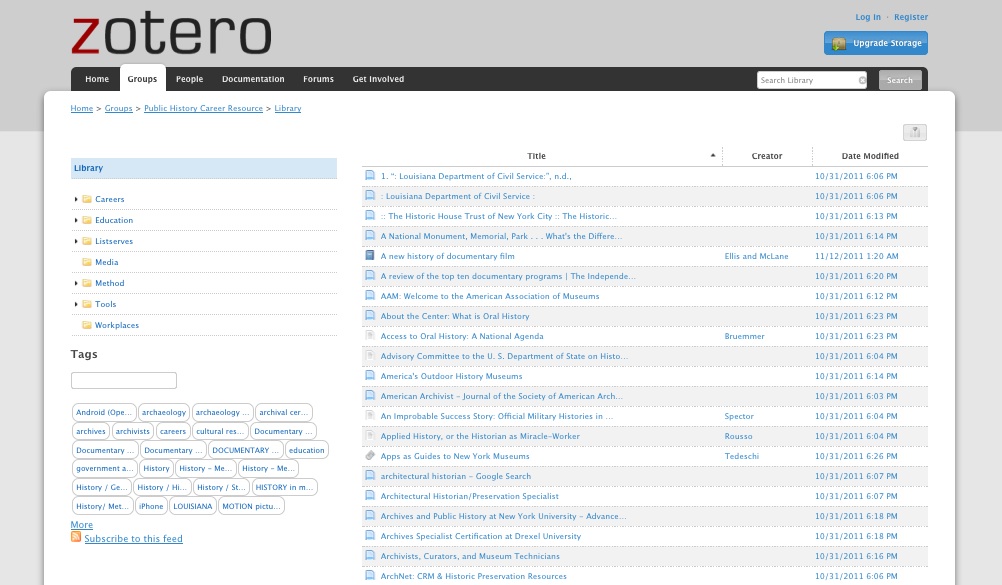
I am always happy to discover how often new media scholarship benefits traditional research as well as public history practice. My recent experience with one particular online project using Zotero demonstrates how new media innovation can invigorate our classroom instruction in unexpected ways. Read More
The Internet gives consultants the opportunity to showcase our expertise for a broad audience while also allowing us to define our niche. We once relied on a web page to represent us online, but people are now turning to social media to find reliable “experts.” Read More
Sign Up to Receive News and Announcements Emails from NCPH
You may unsubscribe or change your preferences at anytime by emailing [email protected] Cavanaugh Hall 127, 425 University Blvd., Indianapolis, IN 46202-5140 (317) 274-2716 [email protected]




 In my previous post I discussed the value of using social networking platforms for networking. In this post, I will discuss how to use social media for marketing by focusing on building an awareness of your “brand.” Social media provides an opportunity to present yourself and your business to diverse audiences in diverse ways. Read More