A little over six years ago, I landed my first museum job. As a newly minted assistant curator, I did what you might imagine curators do. I was responsible for a collection of objects; I conducted research on those artifacts and artworks, I brainstormed new ways of telling their stories, and I developed exhibits. Read More
In addition to the photos that have accompanied Zach McKiernan’s “Letters from Chile” series this spring, there have been many more that we didn’t post with the articles, but which we’re including here in a visual addendum to the series. All are by the author unless otherwise noted. Read More
The National Archives at Kansas City welcomed four local Wikipedians for a Meetup and Scanathon Saturday on June 16, 2012. The meetup theme was “Between the Rivers” and focused on photos and textual holdings related to the Missouri and Mississippi Rivers. Read More
At the outset of this series, I proposed two seemingly simple questions in hopes of unpacking the complexity of sites of memory and how they “engage citizens in human rights issues” vis-à-vis the past. What type of historic work is taking place? Read More
As a professor at a community college, I am typically absorbed in teaching, focused on my classes and students–as many as five classes and upwards of 120-150 students per semester. But recently, I’ve been increasingly engaged in public history by way of developing an associate’s degree program in the field and through involvement in other activities, including the utilization of a restored 1808 manor house on campus, which was the centerpiece of a horse farm when the region had a thriving thoroughbred racing and breeding industry. Read More
This is a personal letter. It is personal because I came to Chile to write and participate in the history of the museum project “National Stadium, National Memory,” whose aim is “the material establishment of national memory in respect… to the Concentration Camp… in 1973.” Read More
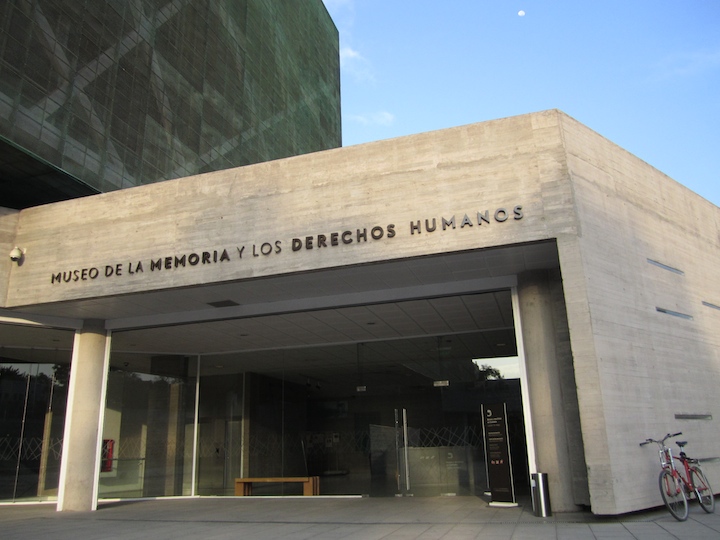
Since my September arrival in Chile, the Museum of Memory and Human Rights has become a common ground for my historical work, with handfuls of visits to its Center of Documentation for conversations and conferences, and the permanent exhibit. Although not a physical or recovered site connected to human rights violations, it sits squarely in the memory landscape of Chile, a barely-born institution that has made waves since its 2010 inauguration under then-President Michele Bachalet. Read More
We have an ever-growing body of scholarship about how and why historic sites are created, but a panel today focuses on what happens when they close. Chaired by NPS Ranger Chuck Arning of the Blackstone River Valley National Heritage Corridor and featuring panelists Barbara Franco (Gettysburg Seminary Ridge Museum), Bob Beatty (American Association for State & Local History), Sheila Kirshbaum, Tsongas Industry History Center), and Bruce Beesley (Indiana State Museum & Historic Sites), the panel will offer ideas and best practices for making the best out of bad times. Read More
In Chile between 1973 and 1990, according to the 2004 National Commission on Political Imprisonment and Torture (The Valech Report), 1,132 sites were utilized as centers of detention, torture, and extermination. They ranged from hospitals and soccer stadiums to police precincts and private houses. Read More
What is the best way of conveying information to an audience? This question is a perennial favorite among academics, who regularly debate the efficacy of lectures as a teaching tool. It’s an increasingly common question in the museum setting too, as more museums embrace participatory projects and initiatives. Read More
Sign Up to Receive News and Announcements Emails from NCPH
You may unsubscribe or change your preferences at anytime by emailing [email protected] Cavanaugh Hall 127, 425 University Blvd., Indianapolis, IN 46202-5140 (317) 274-2716 [email protected]