Editors’ Note:This series showcases the winners of the National Council on Public History’s annual awards for the best new work in the field. Today’s post is by Elizabeth Belanger, author of “Public History and Liberal Learning: Making the Case for the Undergraduate Practicum Experience,” which won the 2013 G.Read More
As senior director of the five public program departments at the Indiana Historical Society I regularly work with interns and faculty, and I regularly employ graduates from history programs. I ask several specific questions when am sifting through applicants:
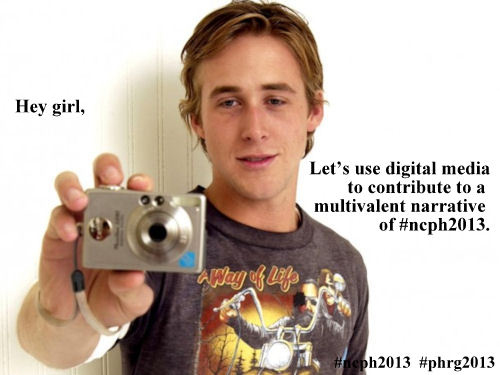
You may have noticed by now that Public History Ryan Gosling has been reappearing in select locations. His handlers, Rachel Boyle and Anne Cullen, will be presenting a paper on last year’s PHRG phenomenon as part of a panel on “Connecting Communities” at the National Council on Public History meeting in Ottawa next month, and we’ve been very happy to have their help for some advance conference promotion. Read More
It is May 1, 1981. A jury of eight internationally renowned architects and sculptors has announced its pick for the design of the Vietnam Veterans Memorial, set to be constructed at the western end of the Constitution Gardens on the National Mall in Washington, D.C.
As a public historian and manager of historical research at Parks Canada for the past 12 years, I have sat on many hiring committees to hire historians, policy analysts, program officers and university students for a range of heritage and history projects based in our national office in Gatineau, Quebec. Read More
In a recent post on History@Work, Zachary McKiernan discussed the utility of an international vision of public history. In many ways, this post encapsulates the rising interest in public history practices outside North America. The recent creation of the International Federation for Public History (IFPH) is a prime example of this. Read More
We are interested in applying a new theoretical approach to public history, and we need your help.
The theory is called “threshold concepts.” Jan Meyer and Ray Land (both education specialists) developed threshold concepts as a way of explaining how students grasp (or don’t grasp) particular disciplines. Read More
This is the third post in a series to discuss the genesis of the idea for the “What Employers Seek in Public History Graduates” session at the 2013 National Council on Public History meeting in Ottawa. Session panelists will continue to share their thoughts on the topic in entries in the coming weeks. Read More
Academic interest in public history is growing, and an increasing number of history departments are looking for a public historian to train students for public history jobs. But what does it mean to start a public history program? Is it as simple as hiring a PhD with a field in public history and telling them to get going? Read More
This is the second post in a series to discuss the genesis of the idea for the “What Employers Seek in Public History Graduates” session at the 2013 National Council on Public History meeting in Ottawa. Session panelists will continue share their thoughts on the topic in entries in the coming weeks. Read More
Sign Up to Receive News and Announcements Emails from NCPH
You may unsubscribe or change your preferences at anytime by emailing [email protected] Cavanaugh Hall 127, 425 University Blvd., Indianapolis, IN 46202-5140 (317) 274-2716 [email protected]