Earlier this summer, as temperatures soared above 100 degrees in El Paso, I was tucked away in a cool room inside the University of Texas El Paso Library’s Special Collection department. I was working with the Casasola Photograph Collection, which holds prints and negatives from the popular Casasola Studio that was located in Downtown El Paso, Texas. Read More
In addition to the photos that have accompanied Zach McKiernan’s “Letters from Chile” series this spring, there have been many more that we didn’t post with the articles, but which we’re including here in a visual addendum to the series. All are by the author unless otherwise noted. Read More
In 2004, I completed my MA graduate program in History with a sure sense of what was going to happen next: teach for a year, and then start a Ph.D. program. By 2007, I wasn’t sure if a Ph.D. was in my future and started exploring other options. Read More
At the outset of this series, I proposed two seemingly simple questions in hopes of unpacking the complexity of sites of memory and how they “engage citizens in human rights issues” vis-à-vis the past. What type of historic work is taking place? Read More
This past Sunday, June 10, the right-wing Corporation 11 de Septiembre held an homage to the dead dictator Augusto Pinochet under the auspices of a documentary screening at the iconic Teatro Caupolican in Santiago Centro. That day it was answered and challenged in sometimes violent ways by diverse sectors of society and weeks before when many of Santiago’s notably non-violent human rights organizations and sites of memory maneuvered to use legal and political recourse to prevent a ceremony that celebrated a leader infamous for overseeing an era of human rights violations. Read More
This is a personal letter. It is personal because I came to Chile to write and participate in the history of the museum project “National Stadium, National Memory,” whose aim is “the material establishment of national memory in respect… to the Concentration Camp… in 1973.” Read More
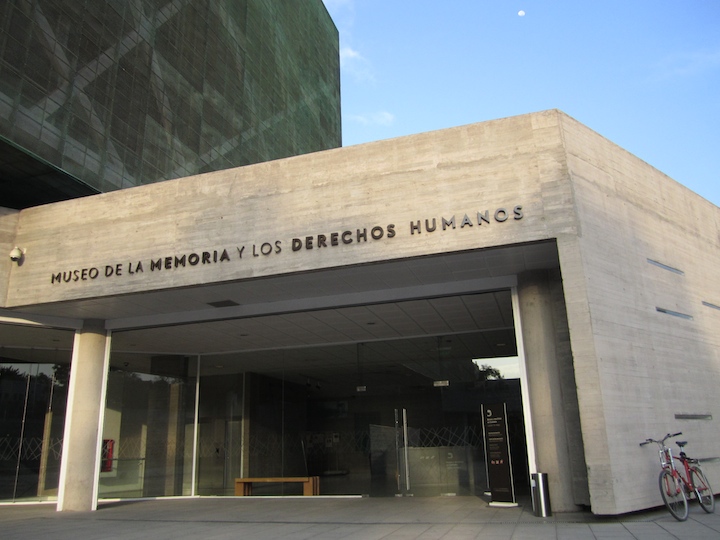
Since my September arrival in Chile, the Museum of Memory and Human Rights has become a common ground for my historical work, with handfuls of visits to its Center of Documentation for conversations and conferences, and the permanent exhibit. Although not a physical or recovered site connected to human rights violations, it sits squarely in the memory landscape of Chile, a barely-born institution that has made waves since its 2010 inauguration under then-President Michele Bachalet. Read More
The Southern landscape and many other parts of the United States remain pockmarked with state historical markers that demand reinterpretation or removal. One state historical marker noting the failure of New Orleans’ 17th Street Canal in the aftermath of Hurricane Katrina demonstrates that Louisiana has landed on the right side of this history. Read More
NCPH/OAH Annual Conference, Milwaukee, April 20, 2012
Panelists discussed specific ways historians can think about and contribute to solutions about climate change. Chair Phil Scarpino (IUPUI) began by asking, “Why should historians talk about the future? Read More
It’s always a pleasure to reconnect with colleagues and friends at a conference, and to have face-to-face conversations that enrich to the increasingly digitized interactions that professional life entails. But the conference experience is also rich with ironies for me, probably because I can’t help thinking about how the kinds of environments in which we hold these gatherings–usually big downtown hotels and convention centers–have been created, how they fit within their social, spatial, and economic contexts, and how we of the mobile knowledge classes fit within them. Read More
Sign Up to Receive News and Announcements Emails from NCPH
You may unsubscribe or change your preferences at anytime by emailing [email protected] Cavanaugh Hall 127, 425 University Blvd., Indianapolis, IN 46202-5140 (317) 274-2716 [email protected]