It’s always a pleasure to reconnect with colleagues and friends at a conference, and to have face-to-face conversations that enrich to the increasingly digitized interactions that professional life entails. But the conference experience is also rich with ironies for me, probably because I can’t help thinking about how the kinds of environments in which we hold these gatherings–usually big downtown hotels and convention centers–have been created, how they fit within their social, spatial, and economic contexts, and how we of the mobile knowledge classes fit within them. Read More
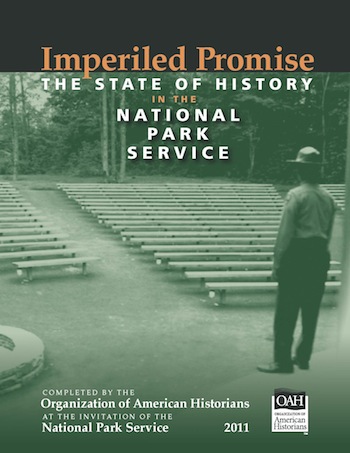
The NCPH/OAH conference brought to light a subject near to my heart this afternoon – history in the NPS. The panel consisted of Marla Miller, Gary Nash, David Thelen and Anne Mitchell Whisnant. On the docket was the discussion of their report on how the NPS stacks up in the history department. Read More
Today’s “Lightning Talk” session was a great one-hour showcase for about a dozen digital projects:
Larry Cebula: Spokane Historical, a web and mobile platform for telling stories of Spokane and Eastern Washington, developed by the Public History program at Eastern Washington University using Curatescape and Omeka
Cathy Stanton: History@Work (hey, that’s us)
Bobby Allen: University of North Carolina/Chapel Hill’s Digital Innovation Lab, an American-Studies-based project that is developing, testing, and documenting best-practice models for faculty and graduate student work in public humanities that integrates community engagement, digital technologies, and interdisciplinary inquiry
Andrew Hurley: the Virtual City Project, which uses three-dimensional imaging technologies to create electronic representations of lost historic landscapes
Trevor Owens: Viewshare, a free web application developed by the Library of Congress for curators and collections managers to create and customize unique, dynamic online views of images from their collections.
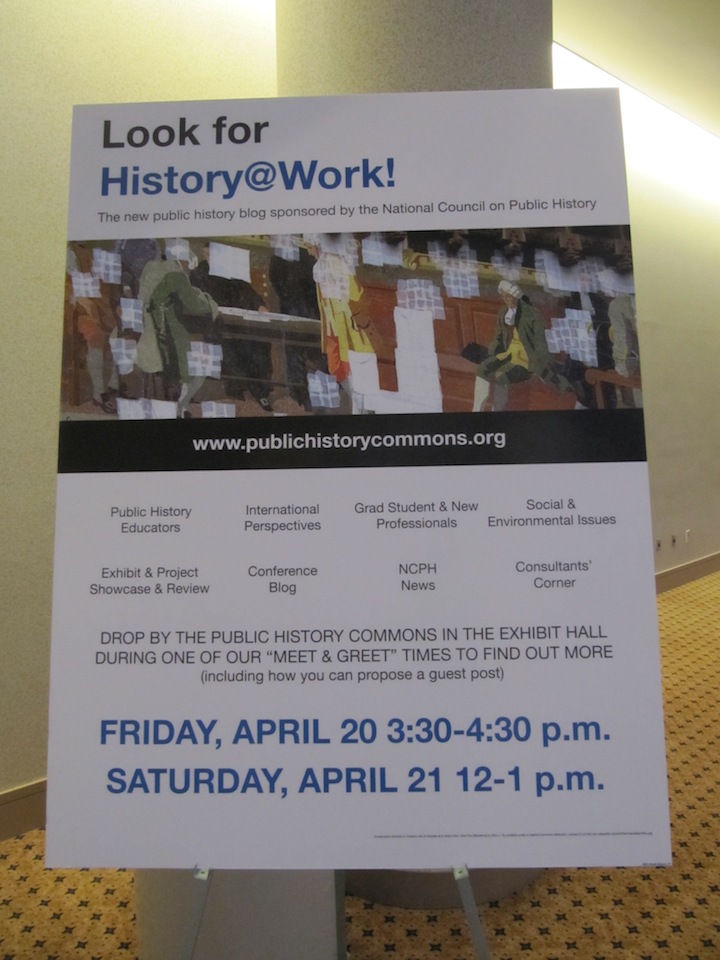
We’re getting ready for our closeup (whoa…maybe not that close!). Join members of the History@Work editorial team for two “meet and greet” gatherings in the Public History Commons area of the Exhibit Hall today from 3:30 to 4:30 or tomorrow from noon to 1 p.m. Read More
We have an ever-growing body of scholarship about how and why historic sites are created, but a panel today focuses on what happens when they close. Chaired by NPS Ranger Chuck Arning of the Blackstone River Valley National Heritage Corridor and featuring panelists Barbara Franco (Gettysburg Seminary Ridge Museum), Bob Beatty (American Association for State & Local History), Sheila Kirshbaum, Tsongas Industry History Center), and Bruce Beesley (Indiana State Museum & Historic Sites), the panel will offer ideas and best practices for making the best out of bad times. Read More
The “unconference” movement is barely a decade old (Tom Scheinfeldt noted in our capstone session that the first one he attended was in Silicon Valley in 2004) but it’s clear that for many people–perhaps particularly for public historians–it offers a welcome alternative to more formal conference formats. Read More
Historians, preservationists, government officials, and elected representatives stand at a frontier of possibility and hope, or anguish and betrayal as the nation enters the sesquicentennial years of the Civil War. This proposed roundtable, in cooperation with audience members, dares to imagine how our Civil War battlefields should be managed for the next 150 years. Read More
We’re trying something new at this year’s NCPH/OAH conference, with due acknowledgement to Apple: a “genius bar” of experienced digital historians who will be available to answer questions on a wide range of topics, problems, and platforms. Our “Digital Drop-In” can be found in Exhibit Hall D Foyer, near the registration area, from 1:30 to 4:30 p.m. Read More
In Chile between 1973 and 1990, according to the 2004 National Commission on Political Imprisonment and Torture (The Valech Report), 1,132 sites were utilized as centers of detention, torture, and extermination. They ranged from hospitals and soccer stadiums to police precincts and private houses. Read More
Graduate students and new professionals headed to the NCPH/OAH Conference in Milwaukee–let’s get to know each other! Please join the NCPH New Professionals and Graduate Students Committee for a social outing at Milwaukee Ale House (233 North Water St., downtown Milwaukee, a short walk from the Frontier Airlines Center) on Thursday, April 19th, from 7:30 to 10:30pm. Read More
Sign Up to Receive News and Announcements Emails from NCPH
You may unsubscribe or change your preferences at anytime by emailing [email protected] Cavanaugh Hall 127, 425 University Blvd., Indianapolis, IN 46202-5140 (317) 274-2716 [email protected]