“The Middle: Where did we come from? Where are we going?”
CALL FOR PAPERS – 2017 Annual Meeting National Council on Public History
Indianapolis, Indiana, April 19-22, 2017 Read More
Jeff Sellers serves as the curator of education at the Tennessee State Museum in Nashville, TN, and has been there since 2005. He is past-president of the Inter-museum Council of Nashville and currently serves on the National Council On Public History New Professional Award Committee. Read More
My thoughts on the Flint water crisis stem from a personal perspective, as well as my academic interests in deindustrialization, African American history, and heritage tourism. When I was two years old, my dad was offered a job as a reference librarian at the University of Michigan-Flint. Read More
Public historians have spent a good deal of time looking at how history is performed in museums and living history sites, in reenactments, and on film and television. Theatre, opera, and musicals have received far less attention, and one reason for this might be that these forms of representation are often thought of as elitist.[1] Read More
From around the field this week: Public history boot camps in Camden, New Jersey; Iraq conference on heritage in conflict zones; oral history research grants; almost-all-expenses-paid opportunity to attend summer Yale Public History Institute Read More
Jennifer Stevens, PhD, is principal, SHRA/Stevens Historical Research Associates. Jennifer attended University of California-Davis for graduate school and now resides in Boise, Idaho, with her husband and two children. She founded SHRA in 2004 and is a graduate affiliate faculty member in the History Department at Boise State University, where she periodically teaches courses in Environmental and Urban History. Read More
Whenever a public historian asks me whether it’s worth the time and effort to run for office in a historical association, or to serve on a committee, I strongly recommend giving it a try. Over the nearly forty years I spent at the Senate Historical Office, I calculate that I spent almost half of that time also serving in one elected office or another in various historical associations and beyond that on any number of standing or ad hoc committees.
I decided to become a professional historian in a campground in Ohio in the summer of 1994. I was spending the day lounging at my campsite, reading About Time: Exploring the Gay Past, by Martin Duberman, when his essay “’Writhing Bedfellows’ in Antebellum South Carolina: Historical Interpretation and the Politics of Evidence” got me so fired up that I decided it was time to go out and do what I could to bring the past to the people. Read More
This year’s conference promises to be one of the best in recent memory. The public history offerings in Baltimore are world class and offer plenty of temptations to draw us away from the conference. Consultants and attendees interested in consulting should find this year’s partnership with the Society for History in the Federal Government a particular draw. Read More
Sign Up to Receive News and Announcements Emails from NCPH
You may unsubscribe or change your preferences at anytime by emailing [email protected] Cavanaugh Hall 127, 425 University Blvd., Indianapolis, IN 46202-5140 (317) 274-2716 [email protected]




 From around the field this week: Public history boot camps in Camden, New Jersey; Iraq conference on heritage in conflict zones; oral history research grants; almost-all-expenses-paid opportunity to attend summer Yale Public History Institute
 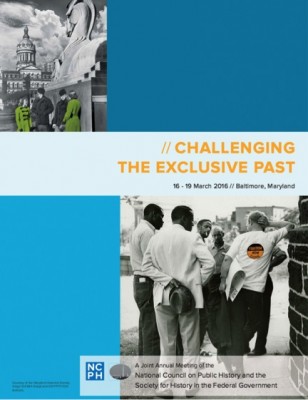 This year’s conference promises to be one of the best in recent memory. The public history offerings in Baltimore are world class and offer plenty of temptations to draw us away from the conference. Consultants and attendees interested in consulting should find this year’s partnership with the Society for History in the Federal Government a particular draw.