In the 1950s, South Carolina embarked on a massive statewide building spree in an effort to provide “separate but equal” schools for its African American and white students. Hundreds of new elementary and high schools in the Modern style sprung up across the state. Read More
Some time ago, I had the opportunity of hearing a presentation by Daniel Walker Howe, a historian who won the 2008 Pulitzer Prize for his book What Hath God Wrought: A History of the United States, 1815-1848. In the course of the seminar, Howe made a plea for academic historians to stop ignoring the general public in their work, declaring that it was time for historians to stop talking only to each other and to engage the larger public. Read More
This is the sixth and final in a series of posts about the findings of our summer 2012 survey on the current state and possible future directions of The Public Historian journal and other NCPH media.
from Anne Mitchell Whisnant, NCPH Journal Task Force:
As a member of the NCPH task force considering the future of The Public Historian, I, like several of my colleagues, have been mining the data from last summer’s survey about the journal. Read More
Was I the only one who noticed this? There was an eerie similarity between Michael Arad’s “Reflecting Absence” memorial in the footprint of the Twin Towers and the virally-circulating AP photo of seawater rushing into the foundations of new skyscrapers at the World Trade Center construction site during Hurricane Sandy’s storm surge last week. Read More
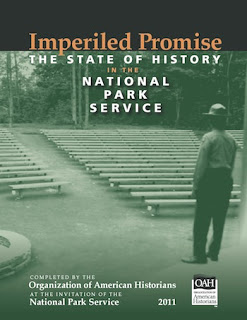
Last Friday, November 2, 2012, National Park Service personnel, public historians, academics, and graduate students from the Northeast met at the Massachusetts State Archives in Boston to discuss the Organization of American Historians’ recent report Imperiled Promise: The State of History in the National Park Service (2011). Read More
This is the fifth in a series of posts about the findings of our summer 2012 survey on the current state and possible future directions of The Public Historian journal and other NCPH media.
—
from Cathy Stanton, NCPH Digital Media Group:
I looked at the question “In what ways would you like to see the possibilities of digital history and digital publishing transform the NCPH journal?” Read More
Public history has been at the forefront of democratizing historical knowledge and utilizing nontraditional modes of inquiry—from oral history to personal archives—since its inception. In that time, it—we—have substantially affected the larger practice of history in the academy.[1] But, to vastly oversimplify, the promises and possibilities of the digital have risen as a challenge to all historians to rethink how we disseminate our work and, at the same time, to spur conversations that question and critique the role of technology in the 21st century. Read More
Next Monday, November 5, at 6:00 p.m. Eastern Standard Time, the NCPH Consultants Committee will debut a new monthly feature for the public history consulting community: a TweetChat. Our preliminary TweetChat will return to a topic that helped launch our presence on HIstory@Work back in the spring.
This is the fourth in a series of posts about the findings of our summer 2012 survey on the current state and possible future directions of The Public Historian journal and other NCPH media.
—
from Linda Shopes, member, NCPH journal advisory group:
As a member of NCPH’s task force considering the future of The Public Historian and its relationship to other NCPH media, I reviewed responses to question #4 of the Council’s recent Public History Readers Survey: What do you think are the weaknesses of The Public Historian? Read More
The History of Medicine in Oregon Project launched a website this month. The project was created by the Oregon Medical Education Foundation in 2001, and joined in succeeding years by Oregon Health & Science University and The Foundation for Medical Excellence, to document and interpret the history of medicine in what is now the state of Oregon and to present that history to the medical community as well as the general public. Read More
Sign Up to Receive News and Announcements Emails from NCPH
You may unsubscribe or change your preferences at anytime by emailing [email protected] Cavanaugh Hall 127, 425 University Blvd., Indianapolis, IN 46202-5140 (317) 274-2716 [email protected]