As a trade union leader and a political activist, I had occasions to attend national and international events. Often, other attendees would bring posters from their respective organizations. I would usually take one of each because I was attracted to either the graphics or the issue or both. Read More
The second part of this art and public history conversation series features artist E.G. Crichton. In addition to being professor in the Art Department at UC Santa Cruz, Crichton is the first artist-in-residence for the GLBT Historical Society in San Francisco. Read More
We public historians are increasing our fluency in languages. We are conversing with colleagues across the globe and across disciplines, we are ever dexterous in our work with new media, and we are constantly strengthening the ways we reach out to audiences, drawing from a language of engagement that has emerged since our field’s early days and that has blossomed in the last ten years. Read More
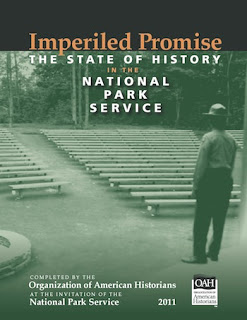
Editors’ Note: This series showcases the winners of the National Council on Public History’s annual awards for the best new work in the field. Today’s post is the second in a two-part series by Marla Miller and Anne Whisnant, two of the four authors of Imperiled Promise: The State of History in the National Park Service, winner of the 2013 NCPH Excellence in Consulting Award in the group category.Read More
Editors’ Note: This series showcases the winners of the National Council on Public History’s annual awards for the best new work in the field. Today’s post is part of a two-part series by Marla Miller and Anne Whisnant, two of the four authors of Imperiled Promise: The State of History in the National Park Service, winner of the 2013 NCPH Excellence in Consulting Award in the group category.Read More
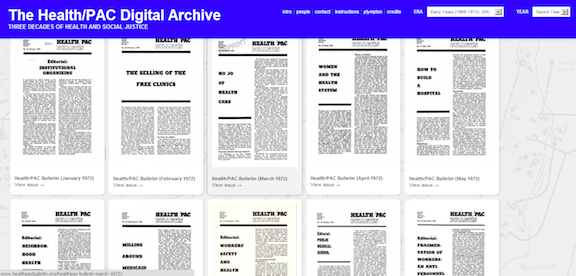
The Health/PAC Digital Archive is a complete collection of the influential Health/PAC Bulletin, which was published for nearly three decades until Health/PAC closed in 1994. Full-text searchable, it amounts to a documentary history of mid- to late-20th Century American health policy and politics. Read More
Pick up a penny. On one side, we observe Lincoln as he was; on the other side, Lincoln as we have chosen to remember him. Public historians face the challenges and rewards of interpreting history for a population obsessed as much with “authenticity” as “legacy.” Read More
Part of what drew me to the University of South Carolina’s Ph.D. program in history in 2010 was the opportunity to engage with controversial topics while pursuing an M.A. in public history along the way. The summer after my first year in the program, I found a part-time job with a private non-profit organization looking for someone to produce a new guidebook for an historic property it managed: a farmhouse located on a former plantation in the hills of one of the Border States. Read More
Quick – name three National Park Service (NPS) units that commemorate, mark or otherwise emphasize the history of industrial work, or the labor movement in the United States.
Okay – Lowell National Historical Park might come to mind. Anywhere else?
On a recent conference call that connected public history practitioners from Bangladesh, Brazil, Italy, Spain, South Africa, and the U.S., one participant remarked on the utility of replicating historic site and museum programs from different geographic locations in others. Another extolled the benefits of sharing ideas, methods, and experiences across the different regions of the world. Read More
Sign Up to Receive News and Announcements Emails from NCPH
You may unsubscribe or change your preferences at anytime by emailing [email protected] Cavanaugh Hall 127, 425 University Blvd., Indianapolis, IN 46202-5140 (317) 274-2716 [email protected]