In the 1950s, South Carolina embarked on a massive statewide building spree in an effort to provide “separate but equal” schools for its African American and white students. Hundreds of new elementary and high schools in the Modern style sprung up across the state. Read More
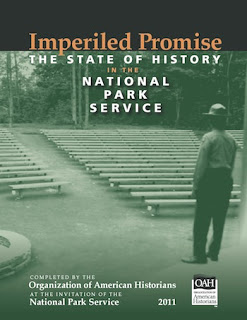
Last Friday, November 2, 2012, National Park Service personnel, public historians, academics, and graduate students from the Northeast met at the Massachusetts State Archives in Boston to discuss the Organization of American Historians’ recent report Imperiled Promise: The State of History in the National Park Service (2011). Read More
Public history has been at the forefront of democratizing historical knowledge and utilizing nontraditional modes of inquiry—from oral history to personal archives—since its inception. In that time, it—we—have substantially affected the larger practice of history in the academy.[1] But, to vastly oversimplify, the promises and possibilities of the digital have risen as a challenge to all historians to rethink how we disseminate our work and, at the same time, to spur conversations that question and critique the role of technology in the 21st century. Read More
In this election cycle, like just about every previous election cycle of recent memory, the role of higher education in improving society has been raised and debated. The past sixty years have seen unprecedented growth in the higher education sector, with a proliferation of for-profit and distance-learning options supplementing established research universities, liberal arts colleges, and community college programs. Read More
I’ve been thinking about failure and public history. Failure—and mistakes more generally—aren’t concepts we like to consider. The word is intertwined with feelings of shame and humiliation, private emotions which are the antithesis of the public nature of public history. Many people’s impulse is to hide failure or “spin” it, the clichéd strategy of “making lemons out of lemonade.” Read More
Around the time that I took on my current position with The Trustees of Reservations, the organization made an internal change: our historic resources department became the cultural landscapes department, our historic resources staff the cultural resources staff. Why was this significant? Read More
NOTE: This post is part of a new and, we hope, semi-regular series in which public history educators share insights and observations about their use of “classic” texts in the public history classroom.
—
Michel Rolph Trouillot, historian, anthropologist, Haitian intellectual and University of Chicago professor, died in July at age 63. Read More
As I approach my second year of doctoral studies in history, I find myself thinking often about dissertation topics. These ruminations may be premature. General exams have not even clouded my horizon yet. Still, I feel a special burden to choose topics wisely because I hope to secure an academic job teaching in a public history program. Read More
Looking from across the pond, the maturity and scale of public history as a discipline and a sector in the US is a striking phenomenon. The narrative is well-established: the crisis in the academic job market; the emergence of new contexts for historical employment, in preservation, education and regeneration; the entrepreneurship of universities in structuring the supply of skilled professionals through new programmes emphasising workplace skills and experience. Read More
Sign Up to Receive News and Announcements Emails from NCPH
You may unsubscribe or change your preferences at anytime by emailing [email protected] Cavanaugh Hall 127, 425 University Blvd., Indianapolis, IN 46202-5140 (317) 274-2716 [email protected]