NOTE: This post is part of a new and, we hope, semi-regular series in which public history educators share insights and observations about their use of “classic” texts in the public history classroom.
—
Michel Rolph Trouillot, historian, anthropologist, Haitian intellectual and University of Chicago professor, died in July at age 63. Read More
Earlier this summer, as temperatures soared above 100 degrees in El Paso, I was tucked away in a cool room inside the University of Texas El Paso Library’s Special Collection department. I was working with the Casasola Photograph Collection, which holds prints and negatives from the popular Casasola Studio that was located in Downtown El Paso, Texas. Read More
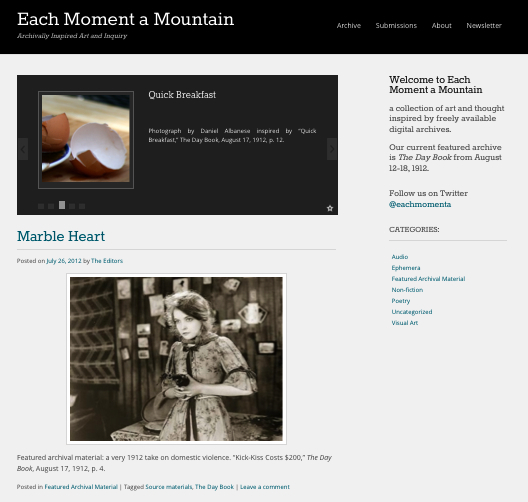
Each Moment a Mountain is a public history and digital humanities project that celebrates art and thought inspired by the wealth of materials housed in freely available digital archives. Showcased are poetry, fiction, non-fiction, art, multimedia, comics, humanities scholarship and other digitally representable creations that engage with text or images from our featured historical archives. Read More
When I started graduate school in the now-distant year of 1979, public history was still in its infancy. Within view of the spot that I habitually occupied in the basement of the university library, two or three loose issues (the entire run to date) of The Public Historian perched precariously on an otherwise empty stack shelf. Read More
As I approach my second year of doctoral studies in history, I find myself thinking often about dissertation topics. These ruminations may be premature. General exams have not even clouded my horizon yet. Still, I feel a special burden to choose topics wisely because I hope to secure an academic job teaching in a public history program. Read More
There are two sides sides to historic preservation. On one side preservationists work to save places, using community character and history to enhance the quality of living through transportation, smart growth, and sustainability. On the other we are seen as obstructionist, the party of “no,” and a limiting factor to the development and modernization of what a community wants to accomplish. Read More
The Olympic opening ceremony last Friday, staged by filmmaker Danny Boyle, left me with a strange feeling of déja vu. All the high-tech elements aside, this show could have been produced in 1912 almost as easily as 2012. Its capsule-history-of-Great-Britain-from-green-and-pleasant-land-through-industrial-power-to-postindustrial-success format essentially followed the pageant form that was popular a hundred years ago. Read More
1997 was the hardest year of my adult life. During that year my marriage of 15 years ended in divorce; during that same year, my employer, a nationally prominent museum of American cultural history, began to transform itself into a children’s museum, and eliminated the position of “senior historian” that I had held for the previous seven years. Read More
The following list was developed from the case statements of the Public History and Sustainability Working Group at the April 2012 NCPH/OAH conference in Milwaukee as well as from the 2010 Working Group that inaugurated this discussion and some other sources. Read More
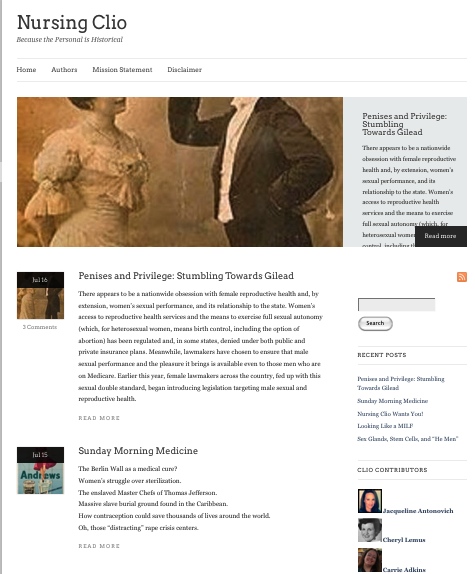
Nursing Clio is a collaborative blog project that ties historical scholarship to present-day political, social, and cultural issues surrounding gender and medicine. Men’s and women’s bodies, their reproductive rights, and their health care are often at the center of political debate and have also become a large part of the social and cultural discussions in popular media. Read More
Sign Up to Receive News and Announcements Emails from NCPH
You may unsubscribe or change your preferences at anytime by emailing [email protected] Cavanaugh Hall 127, 425 University Blvd., Indianapolis, IN 46202-5140 (317) 274-2716 [email protected]